Floating Plant Surface Coverage Calculator
Estimate aquarium floating plant coverage from tank surface area, current cover, target cover, frond or rosette size, weekly growth, thinning, light-block limits, and feeding-ring open water.
📌Floating Plant Presets
📐Tank Surface And Floating Plant Inputs
Use a single rosette for frogbit/lettuce or a small counted frond cluster for tiny floaters.
This cap protects submerged plants and keeps open exchange area above the water.
📊Coverage Snapshot
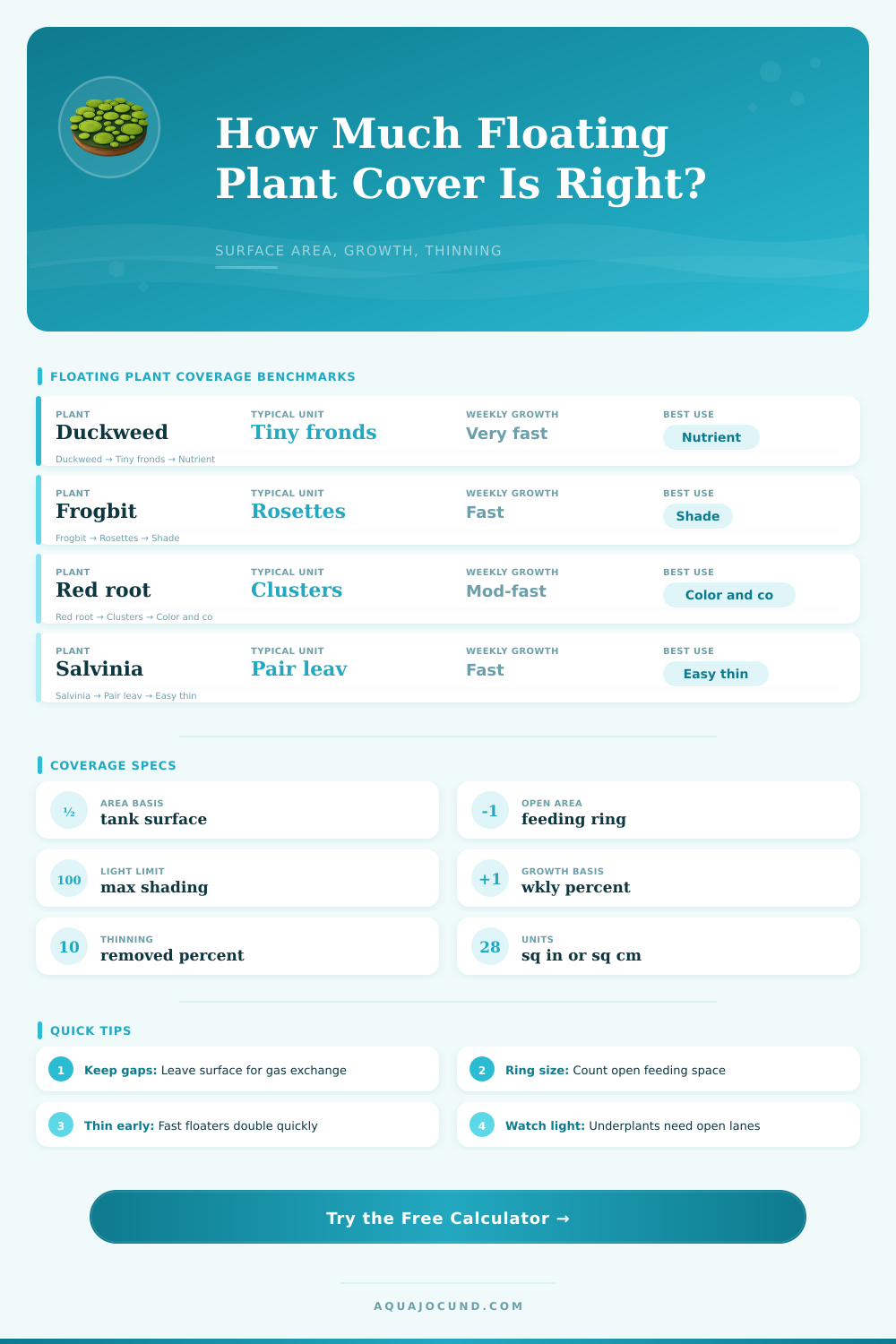
🌱Floating Species Comparison Grid
Duckweed
Tiny fronds, very high nutrient uptake, and the fastest surface takeover.
Plan: frequent nettingAmazon Frogbit
Large rosettes make counts easier and leave natural gaps around roots.
Plan: count rosettesRed Root Floater
Moderate leaf size, colorful tops, and a useful balance between shade and visibility.
Plan: protect light lanesSalvinia
Small paired leaves form rafts that are easy to scoop before they mat tightly.
Plan: thin by area📋Floating Plant Reference Data
| Species | Typical unit area | Weekly growth range | Light-block tendency | Coverage note |
|---|---|---|---|---|
| Common duckweed | 0.02-0.05 sq in / 0.13-0.32 sq cm | 50-100% | High when dense | Use cluster counts, not single fronds |
| Giant duckweed | 0.10-0.25 sq in / 0.65-1.61 sq cm | 35-70% | Medium-high | Larger fronds are easier to skim |
| Amazon frogbit | 1.2-3.5 sq in / 7.7-22.6 sq cm | 20-45% | Medium | Count rosettes plus daughter plants |
| Red root floater | 0.4-1.2 sq in / 2.6-7.7 sq cm | 25-55% | Medium | Color improves with open light |
| Salvinia minima | 0.15-0.45 sq in / 1.0-2.9 sq cm | 35-75% | Medium-high | Often thinned by handful area |
| Dwarf water lettuce | 2.5-8.0 sq in / 16-52 sq cm | 15-35% | High per rosette | Keep crowns away from lids |
| Azolla | 0.05-0.15 sq in / 0.32-0.97 sq cm | 40-80% | High when matting | Best estimated as raft area |
| Riccia mat | 0.5-2.0 sq in / 3.2-12.9 sq cm | 20-45% | Medium | Use tied or corralled patch area |
📏Common Tank Surface Targets
| Tank format | Top dimensions | Surface area | 40% coverage | Open at 40% |
|---|---|---|---|---|
| 5.5 gallon | 16 x 8 in / 41 x 20 cm | 128 sq in / 826 sq cm | 51 sq in / 330 sq cm | 77 sq in / 496 sq cm |
| 10 gallon | 20 x 10 in / 51 x 25 cm | 200 sq in / 1290 sq cm | 80 sq in / 516 sq cm | 120 sq in / 774 sq cm |
| 20 long | 30 x 12 in / 76 x 30 cm | 360 sq in / 2323 sq cm | 144 sq in / 929 sq cm | 216 sq in / 1394 sq cm |
| 29 gallon | 30 x 12 in / 76 x 30 cm | 360 sq in / 2323 sq cm | 144 sq in / 929 sq cm | 216 sq in / 1394 sq cm |
| 40 breeder | 36 x 18 in / 91 x 46 cm | 648 sq in / 4181 sq cm | 259 sq in / 1672 sq cm | 389 sq in / 2510 sq cm |
| 75 gallon | 48 x 18 in / 122 x 46 cm | 864 sq in / 5574 sq cm | 346 sq in / 2230 sq cm | 518 sq in / 3345 sq cm |
| 90P rimless | 90 x 45 cm / 35.4 x 17.7 in | 628 sq in / 4050 sq cm | 251 sq in / 1620 sq cm | 377 sq in / 2430 sq cm |
🔎Coverage Planning Table
| Coverage band | Open water left | Best for | Watch point |
|---|---|---|---|
| 10-25% | 75-90% | New floaters, high-light planted tanks | Nutrient uptake is modest |
| 25-45% | 55-75% | Betta cover, shrimp grazing, mild shade | Keep feeding ring clear |
| 45-65% | 35-55% | Shade control and nutrient export | Submerged plants may stretch |
| 65-80% | 20-35% | Short-term blackout-style shading | Thin often and protect surface movement |
| 80%+ | Under 20% | Temporary plant grow-out only | Gas exchange and light can become limiting |
🔧Feeding Ring And Open Area Examples
| Opening type | Typical size | Open area | Use in calculator |
|---|---|---|---|
| Small round feeding ring | 3 in / 7.6 cm diameter | 7 sq in / 46 sq cm | Small betta or shrimp opening |
| Medium round feeding ring | 5 in / 12.7 cm diameter | 20 sq in / 127 sq cm | Community feeding lane |
| Large round corral | 7 in / 17.8 cm diameter | 38 sq in / 248 sq cm | Floating plant boundary |
| Corner plant-free zone | 6 x 6 in / 15 x 15 cm | 36 sq in / 232 sq cm | Filter return or gas exchange patch |
| Long front viewing lane | 24 x 3 in / 61 x 8 cm | 72 sq in / 465 sq cm | Open lane for light and feeding |
Floating plants multiply. And multiply. They will spread across entire tank top. Until the top of the tank has no empty space left. Then your stem plants underneath stretches towards non-existent light. Floating plants export nutrients. Shy fish hide behind them. From above it appears as if someone fertilized water: It’s a green lawn.
This isn’t horticulture only, it’s also spatial math. How much surface area can you afford to surrender without killing the ecosystem? Hobbyists typicaly rely on guesswork. Add some duckweed or frogbit and see what happens. Spend weekend after weekend removing thick matting that chokes out oxygen flow.
How Much Floating Plant Is Right?
The Math Machine does all of the work for you. It converts fuzzy plans into specific square footages. To start, it asks for surface area of your tank. That tells it how big the canvas is. Next, specify how much you want to cover (your desired percentage). Most hobbyists overestimates this number. Remember, you don’t want everything covered. You just want sufficient shade to reduce algae while preventing plant suffocation below. The tool computes sweet spot based off its light-block limit.
Why does it matter that I got a light limit? Because land plants tolerate shade different than water plants do. Bright conditions is usually required by bottom dwellers. Red root floater, grown at 80% cover, is an effective turn-off-the-lights plant. Note the difference in growth rate and shading intensity among species on reference table. Frogbit forms bigger individual rosette but progresses slowly; duckweed explodes and doubles itself in days if lit properly. Knowing this will help when deciding what to expect from each type and how often to maintain them. Fast growers gets out-of-control quickly and must be thinned regularly to stay stable. Slower ones can be managed with a more relaxed routine.
It factors in growth over time. Based off the percentage it thinks each plant is growing per week, it takes your existing cover and projects into the future. When will it reach its max safe coverage? It forecasts that out and lets you know best time to start thinning. It gives you a maintenance calendar so you can take action early rather than reacting to an overflow situation.
You enter how many areas are being kept open (or reserved for feeding rings) for gaseous exchanges and fish breath. Without these open areas, water quality gets bad fast because of poor oxygen saturation. Practical considerations also include size of the plant units themselves. For example, one rosette of water lettuce will cover much more area than a bunch of azolla. You enter how big (average) your particular plants are in square cm or inches. That accuracy allow you to know down to number of individual fronds/plants to add/remove to reach desired percentage. No guessing at stocking levels. You’re putting a calculated number of biological filtration capacity into proportion to the surface area of your tank.
It is not about having more furnitures. Floating plants can be thought of as a dynamic layer. Floaters aren’t just there; they’re living plant controllers which react directly to light availability and nutrients (in most cases). If they become excessive then it’s typicaly because the water has excess nitrates/phosphate. If they fail to grow then perhaps something limits its development. Floaters can be a potential nuisance. However, following a structure for coverage will keep floaters on your side by maintaining them as a controlled way for improving water quality.
Floating plants are often thinned out, rather than just left alone. By knowing how much space they take up (square footage) and how quickly they expand, you can control the vertical light gradient. Both surface dwellers and those that live in the substrate is safe. It becomes a balanced column with enough space for all layers to grow. Begin with a conservative target of what coverage level you want. Keep necessary open lanes for gas exchange and feeding. Follow the math on when to thin them out, you could of avoided a mess. The outcome is a cleaner tank that’s also healthier. Every inch of surface space are used for something. There’s no suffocating green blanket.