Flatback Pentagon Tank Volume Calculator
Calculate gross and net water volume from back width, side depth, front diagonal panels, height, fill level, and displacement.
🐟Presets
📏Tank Measurements
Calculation Breakdown
⚖Geometry Comparison Grid
📊Formula Reference
| Step | Formula | What it means | Output |
|---|---|---|---|
| Inner dimensions | Subtract glass if outside mode is used | Turns outside measurements into approximate water dimensions | Inside W, D, diagonals, H |
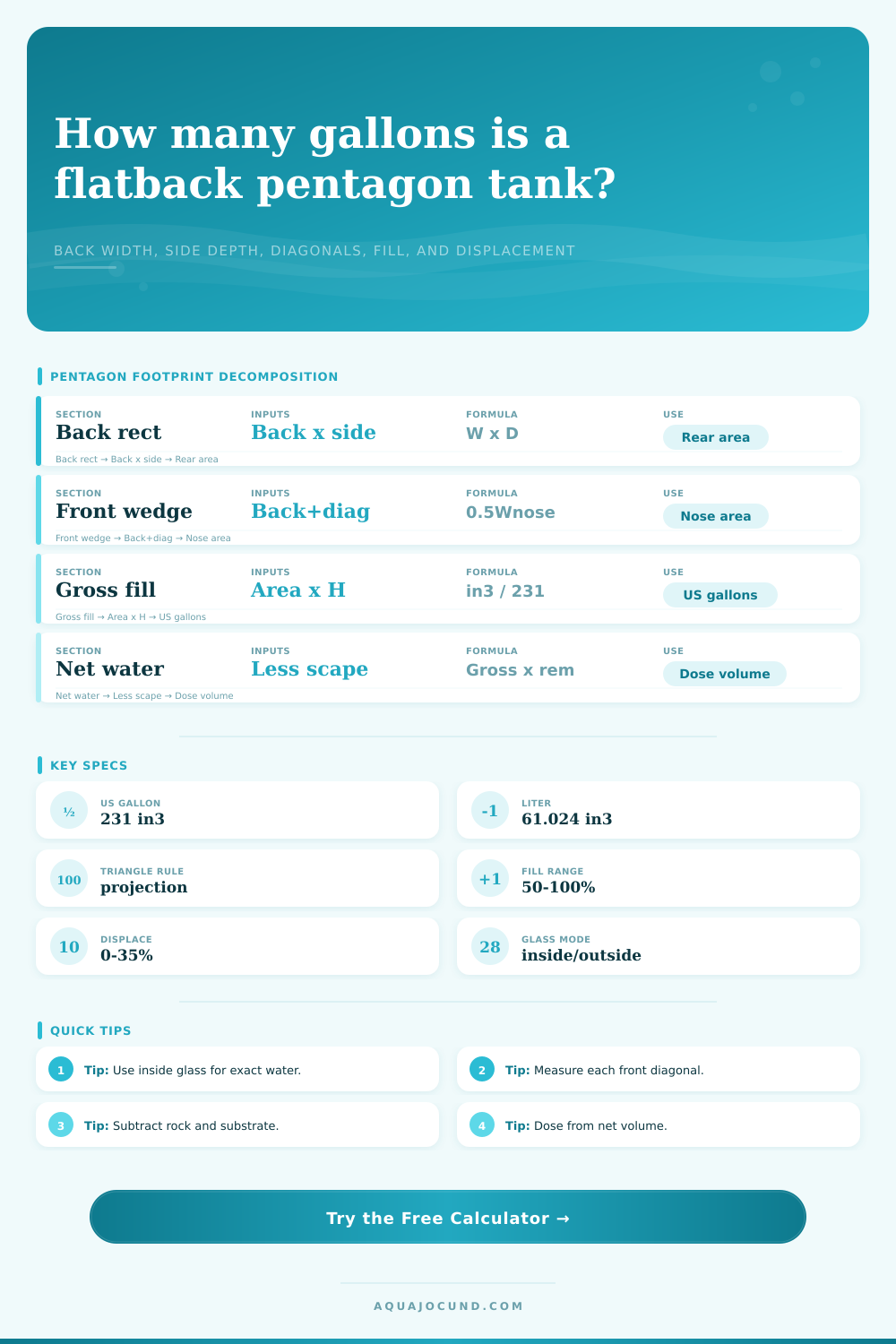
| Nose projection | x = (L2 - R2 + W2) / (2W), n = sqrt(L2 - x2) | Finds the front wedge depth from the two diagonal panels | Front nose depth |
| Floor area | (W x D) + (0.5 x W x n) | Decomposes the pentagon into a rear rectangle and front triangle | Square inches or square cm |
| Net volume | Area x height x fill x (1 - displacement) | Estimates real water after headspace and decor displacement | Gallons and liters |
🧱Displacement Profiles
| Profile | Typical displacement | Common contents | Best calculator use |
|---|---|---|---|
| Open water | 0-3% | Bare bottom, heater, small filter parts | Quarantine or holding volume |
| Light decor | 4-8% | Thin substrate, small wood, light stones | General community tank estimate |
| Planted substrate | 8-12% | Substrate bed, plants, moderate hardscape | Fertilizer and water change planning |
| Heavy planted | 12-18% | Deep substrate, wood, dense stone groups | Conservative net volume estimate |
| Cichlid rockwork | 15-25% | Stacked stone, caves, larger substrate | Medication and mineral dosing volume |
| Reef rock | 12-22% | Porous rock, sand, rear equipment | Salt mix and additive estimates |
📐Common Flatback Pentagon Examples
| Example | Dimensions W x D x diag x H | Approx gross volume | Typical net range |
|---|---|---|---|
| Nano corner | 18 x 9 x 13 x 16 in / 46 x 23 x 33 x 41 cm | 14-16 gal / 53-61 L | 12-15 gal / 45-57 L |
| Small display | 24 x 12 x 17 x 20 in / 61 x 30 x 43 x 51 cm | 29-32 gal / 110-121 L | 25-29 gal / 95-110 L |
| Tall corner | 28 x 14 x 20 x 24 in / 71 x 36 x 51 x 61 cm | 48-52 gal / 182-197 L | 41-48 gal / 155-182 L |
| Large corner | 36 x 18 x 25.5 x 28 in / 91 x 46 x 65 x 71 cm | 90-98 gal / 341-371 L | 76-90 gal / 288-341 L |
🔢Preset Comparison
| Preset | Back width | Side depth | Front panels | Fill / displacement |
|---|---|---|---|---|
| Nano corner | 18 in / 45.7 cm | 9 in / 22.9 cm | 13 in + 13 in | 90% / 4% |
| 25 gal style | 24 in / 61 cm | 12 in / 30.5 cm | 17 in + 17 in | 92% / 8% |
| Planted display | 30 in / 76.2 cm | 15 in / 38.1 cm | 21.5 in + 21.5 in | 88% / 12% |
| Uneven panels | 30 in / 76.2 cm | 14 in / 35.6 cm | 19 in + 23 in | 90% / 9% |
💡Calculation Tips
Why do most hobbyists purchase a corner tank? Because it fits in their room (the one that meets the window). And there’s this mental image of a slick looking centerpiece that take up very little floor space while adding volume.
But what about all that water inside that glass box? The marketing tag typically states twenty five gallons, but in reality it’s more like twenty. And that’s when things start to go wrong: fertilizer mistakes, overdosing on medication.
How to Calculate Your Tank Volume
Enter the flatback pentagon tank volume calculator which bridges that divide between perception and reality by translating your personal dimensions into a real number.
So the first source of confusion lies in the shape itself. What’s called a pentagon tank is basicly a rectangular prism with its two front corners chopped off. In other words, add a triangle to the front of a big rectangle and there you go. The shape itself are a source of confusion.
So what does it do? It divides the floor plan into those two component. The back part is just a plain old rectangle based off your side depth and back width. Next, it measures the length of the diagonal front panels to determine the amount that front “nose” project out. Finally, if you’ve provided measurements for the outside dimension of the glass, it will deduct the thickness of the glass to arrive at the inside water dimensions. That last part is important because three millimeters of glass on every side add up to a significant loss in capacity.
The math then takes the floor area and multiplies it by the height. However, few aquarists fill their tanks all the way up to the brim because it isn’t safe and most don’t want to do so anyway. They’d rather have some space at the top (an inch or two) to avoid water splashing into the skimmer intake, etc. You can adjust for such a restriction using the fill percentage slider. What you end up with before adding any decorations is your gross filled volume.
Sounds great on paper… but it’s not the number from which you should of dose anything. And then there’s displacement. And here’s where everyone goes wrong. You’re not simply holding water in this tank. You’re also holding filtration equipment, driftwood, live rock, sand, gravel, etc. All that solid stuff increase the water level and decreases the amount of actual liquid.
Heavily planted tanks may only have 85% liquid because they lose capacity due to the wood and substrate. Reef tanks that feature large rock structures can lose even more. To handle such situations, the calculator has profiles to let you select an option like heavy planted or cichlid rockwork which will automaticly update the final number. You can also make a judgment call about how much space your hardscape take up and manually input a custom percentage.
Net vs. Gross Volume: Knowing the difference will make all the difference. How do you dose a carbon filter? Do you also dose a water conditioner? The label on the bottle says “For X Gallons.” You pour some into your tank, which holds Y gallons. That’s probably too little. You’re treating for the gross volume of the tank, but not the net volume. Net volume is what’s in the tank to be treated. It’s the actual amount of liquid in the tank after you account for everything else.
Do you have a pentagon tank? Is it a round tank? Maybe it is a rectangle. Figure out what the net volume is, and you’ll always know exactly how much liquid to put in your tank.
The reference tables on this page show the geometry of each profile (how the sides are shaped) and break it down so you can see how that affects the final gallons/liters of water. Asymmetry might make this more confusing (just to note). So if the length of one diagonal (left vs. Right) differ, the wedge at the front will shift. That alters the center of gravity and exactly how much space there is on the floor.
The beauty of it though is that the calculator allows for separate lengths for both sides, so the math remains correct even if you have an imperfectly symmetrical tank. When dealing with something as delicate as a reef system, or some serious aquascaping plan, this precision do matter. It ultimately saves money and protects your livestock. It prevents you from buying too much supply and keeps things steady when something goes out of whack.
But most importantly, it takes away the guessing game of an odd shaped tank. It gives you a starting point that represents what is going on with the water rather than what is going on with the rocks or the glass. After measuring properly, those numbers come back and everything else just starts to fall in line. You start with an odd corner and end up with something that matches your needs and exact size perfecty.