Fish Transport Bag Oxygen Calculator
Estimate oxygen headspace, fish oxygen demand, water volume, safety margin, and the number of bags needed for a transport trip.
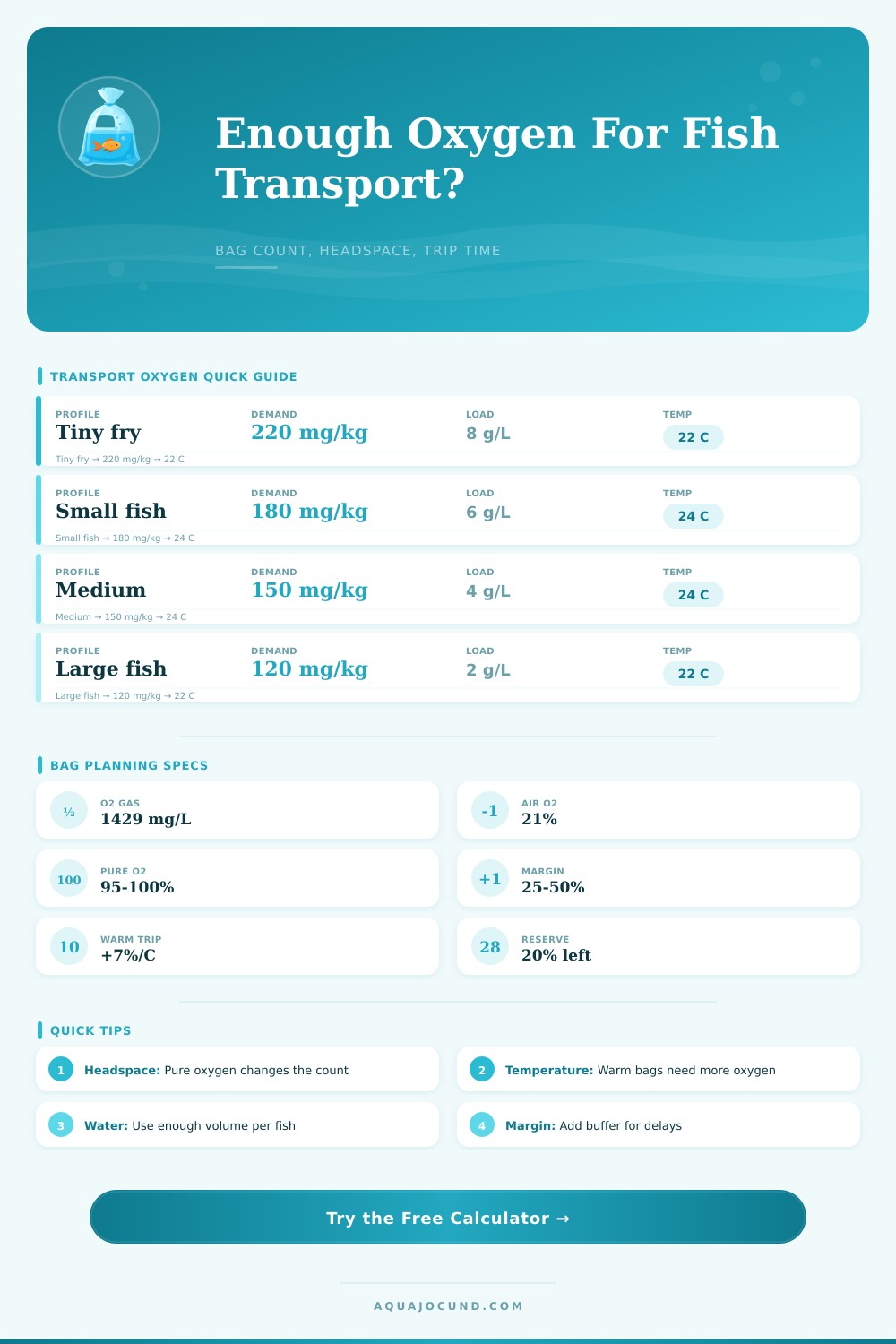
| Fish Profile | Base Demand at 20°C | Length Weight Factor | Water Loading Check |
|---|---|---|---|
| Small slender fish | 180 mg O2/kg/hr | K 0.85 for slim livebearers, danios, rasboras | About 6 g fish per liter for moderate trips |
| Deep-bodied community fish | 170 mg O2/kg/hr | K 1.25 for tetras, barbs, gouramis | About 5 g/L, lower for long or warm moves |
| Goldfish or koi | 140 mg O2/kg/hr | K 1.75 for heavy-bodied carp forms | About 3 g/L because waste load is high |
| Cichlid or perch-like fish | 150 mg O2/kg/hr | K 1.45 for juvenile to adult cichlids | About 4 g/L, split aggressive fish sooner |
| Discus or warmwater cichlid | 160 mg O2/kg/hr | K 1.55 and warm water adjustment | About 3.5 g/L with high oxygen margin |
| Catfish or pleco | 120 mg O2/kg/hr | K 1.30, shape varies widely by species | About 2.5 g/L, bag spines carefully |
| Marine ornamental fish | 170 mg O2/kg/hr | K 1.20 for many reef fish shapes | About 3.5 g/L, keep reserve generous |
| Fry or very small juveniles | 220 mg O2/kg/hr | K 0.70, tiny bodies but high metabolism | About 8 g/L when water quality allows |
| Bag Setup | Water Per Bag | Headspace Per Bag | Typical Use |
|---|---|---|---|
| Small store bag | 0.25 gal / 0.95 L | 0.5 gal / 1.9 L | Small fish, short local trip |
| Standard 1:2 ratio | 0.5 gal / 1.9 L | 1.0 gal / 3.8 L | Common oxygen-filled transport bag |
| Large show bag | 0.8 gal / 3.0 L | 1.6 gal / 6.1 L | Larger fish or longer club events |
| Boxed overnight bag | 0.35 gal / 1.3 L | 1.2 gal / 4.5 L | Light water, high oxygen headspace |
| Breather-style planning | 0.45 gal / 1.7 L | 0.1 gal / 0.4 L | Only when the bag type supports gas exchange |
| Condition | Model Effect | Calculator Input | Planning Note |
|---|---|---|---|
| Cool freshwater move | Lower metabolic rate | 66-70°F / 19-21°C | Still keep a delay margin in the bag count |
| Typical tropical move | Moderate demand | 74-78°F / 23-26°C | Good target for many community fish |
| Warm discus or marine | Higher demand | 80-84°F / 27-29°C | Use more oxygen headspace or more bags |
| Overnight transport | Long exposure time | 18-30 hours | Oxygen may be enough while ammonia or CO2 becomes limiting |
Moving fish from one location to another require that you manage several different variable. It is necessary to understand each of these variable in order to make certain that the fish are safe during they trip. The safety of the fish relies upon three main factor: the amount of oxygen that is available to the fish, the amount of oxygen that the fish will consume, and the amount of water that you will carry in the transport bag.
Each of these variables must be consider in relation to each other. The size and the shape of the fish will determine the amount of oxygen that the fish will consume. For example, a slender danio fish will have a more different oxygen consumption rate than a round bodied goldfish of the same length.
How to Keep Fish Safe During Transport
A factor that the calculator uses to determine the oxygen consumption of the fish is the body shape factor, which allow the calculator to determine the weight of the fish from the length of the fish. The weight of the fish are a factor in calculating the metabolic rate of the fish, which also decreases or increases based on the temperature of the water in which the fish are transported. Thus, trips at 28 degrees Celsius will require more oxygen from the fish than those at 22 degrees Celsius.
The amount of oxygen that is available to the fish is dependent upon the volume of the headspace in which the fish are to be transported, as well as the type of gas that is place into that headspace. Using pure oxygen instead of air will provide more usable oxygen for the fish, but it is important to ensure that the gas is used proper to avoid puncturing the transport bags. The calculator will calculate the amount of oxygen that will move from the headspace into the water, as will the amount of oxygen that will remain in the headspace after accounting for any delay in transportation.
Although the amount of dissolved oxygen that is already within the water is small, the volume of the water is still one of the important variable for transportation; it will determine how much waste build up from the fish, as well as how much oxygen can remain in the water. Many people may want to plan their trips by counting how many fish they have to transport. However, it is important to understand that fish excrete ammonia and carbon dioxide in the water.
Thus, it is important to account for both oxygen levels that can exist in the bags, as well as the loading limit of the water within the bags. The calculator accounts for both of these variable, and recommends the higher of the two variable to ensure that transport bags are not optimized for one factor to the detriment of the other. The length of the trip will impact the amount of oxygen that must be provided to the fish.
Longer trips will require more bag of fish, or more headspace for each bag of fish, or a higher safety margin. It is always important to provide for potential delay in the transport of the fish. For instance, if the transport of the fish is to occur on an overnight shipment, it is important to add some extra capacity for the transport bags to account for instances where the fish might need to stay in the bags long than originally planned.
The activity level of the fish will impact the amount of oxygen that the fish will use during transport. For instance, fish will use more oxygen if they are active, or if someone has just handle and transported them into the transport bags, compared to fish that are resting in the dark within the transport bags. Thus, it is important to account for the activity level of the fish when utilizing the calculator; if the incorrect activity level is chosen, the calculator will output an incorrect reading of the amount of oxygen that the fish will require.
The activity level of the fish is not likely to change for trips that are short term, but it is an important variable for trips that last longer than eight or ten hour. You can use the calculator to enter the variables of the transport bags and trips more than once. For instance, the fish can be entered into the calculator along with the bag count to determine the amount of oxygen margin for that transport trip.
The variables can be adjusted, such as the headspace volume of the transport bags, to determine how that change in volume will affect the amount of oxygen margin for the transport bags. Although the fish transportation bag calculator cannot account for all variables of transport (such as changes in pH, or the temperament of the fish species), the calculator will help to provide an understanding of the transport process. Furthermore, if there are changes in the temperature of the transport bags, or if there are additional fish added to a transport bag, it will take only a few minute to enter those variables into the calculator to determine if any changes in the transport of the fish are needed.
Thus, using the calculator to calculate transport bags will make transport of the bags a manageable task.