
Newbies to the hobby typically purchase a heater and leave it to chance. Problem: Ectotherms (like fish) do not maintain an independent body temperature from their surroundings; instead, they matches the ambient temperature inside them. Even a slight change in temperature causes metabolic stress. This suppresses the immune system and invites disease, but you might not notice anything is wrong until your fish are already visibly sick.
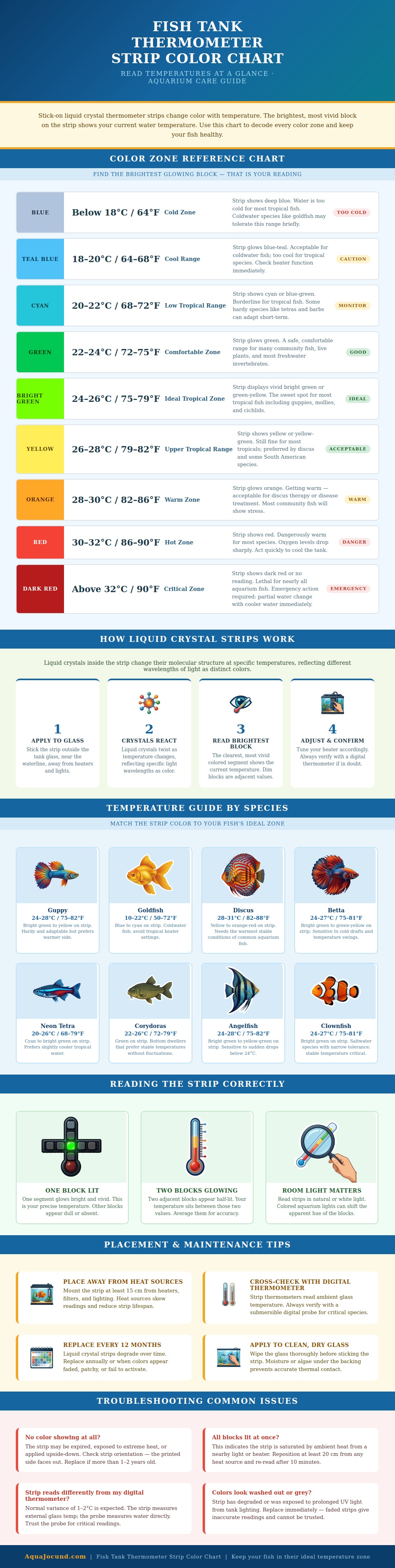
Enter: The reason for those thermometer strips. They translate abstract temperature data into instant visible information that you can read quick without reaching around looking for probes. Here’s how it breaks down in color zones (above). So if you don’t want to have to remember all the numbers, but understand the overall concept, the graph match colors with temperature bands.
How Aquarium Temperature Strips Work
How does it work? Liquid crystals actualy change their structure as they warm and thus will reflect varying shades of light. The bright green square glowing brightly against its darker neighbors is water temp you’re seeing, the “sweet spot” of most community aquariums. It’s stable enough to allow angelfish, tetra, guppies and other species to thrive without has to constantly watch over them.
To understand these, you have to look at them closely because the contrast are the most important part. So just disregard all those faded ones and only look at the one where it’s really poppin’ with vibrant color saturation. Two blocks next to each other is half lit. That means your temperature is somewhere in between. Averaging those readings is probably good enough for day-to-day care; it is not necessarily scientifically accurate, but it is close enough.
Remember, lighting also play a role here in terms of room lighting as certain colors of aquarium lights will skew what the crystal seems to indicate (e.g., a safe looking green may actually be dangerously yellow). So again, make sure to verify in neutral lighting if you’re ever suspicious of a drift. So again, make sure to verify in neutral lighting if you’re ever suspicious of a drift.
Where it’s used: Most folks mess up by placing it too close to their heater, which produces a localized hotspot on the glass surface that doesn’t actualy represent what the water column temp is. Isolating the sensor from outside thermal influences are key to its accuracy, so you want some distance from heating and lighting devices. Oxygen solubility drops sharply as temperatures rise above the ideal range, and a deviation of even two degrees can mean the difference between a healthy discus and a stressed one trying to breathe through thickening water. A healthy fish. Warning badges marks the red zones in the reference guide to signal emergency situations that demand rapid partial water changes.
Finally I should of mention that the strips do have an expiry period; about a year or two as they dry out from the glue and the crystals becomes less sensitive. When this happens you’ll know as they start looking grey instead of vibrant color. That’s your sign it’s time for a new unit, and don’t rely on a faded strip more then you would a cracked gauge. Using both digital and visual tools provides a backup in case of equipment failure or loss of power, which can save lives. The digital probe provide exact numbers where the strip allows immediate trend spotting.
We typically associate cleaning and feeding with the work of maintaining an aquarium. However, stable temperatures is the foundation for both. Even a perfectly filtered tank will cause fish loss if the temperature is not well regulated. Why? Cold water makes it hard for them to get rid of waste, and hot water encourage bacteria to grow. The color chart is a rapid sign that alerts you if something has gone wrong before it becomes a biological emergency. It converts complicated heat language into a readable rainbow, even at a distance.
Your job as an aquarist isn’t to chase perfection hour by hour but rather stability through consistency while avoiding extremes. If that bright green block is burning for weeks at a time then you’ve got your ecosystem balanced. The fish won’t even notice the temperature since it’s never changing enough to matter. That constant light is what tells you your invisible efforts are having an effect and that your aquarium isn’t just surviving, it’s thriving in a world you’ve managed to make comfortabley predictable.
