🐟 Fish Max Size Tank Ratio Calculator
Estimate the largest adult fish length a tank footprint can support using swim length, turning room, activity, group load, and growth reserve.
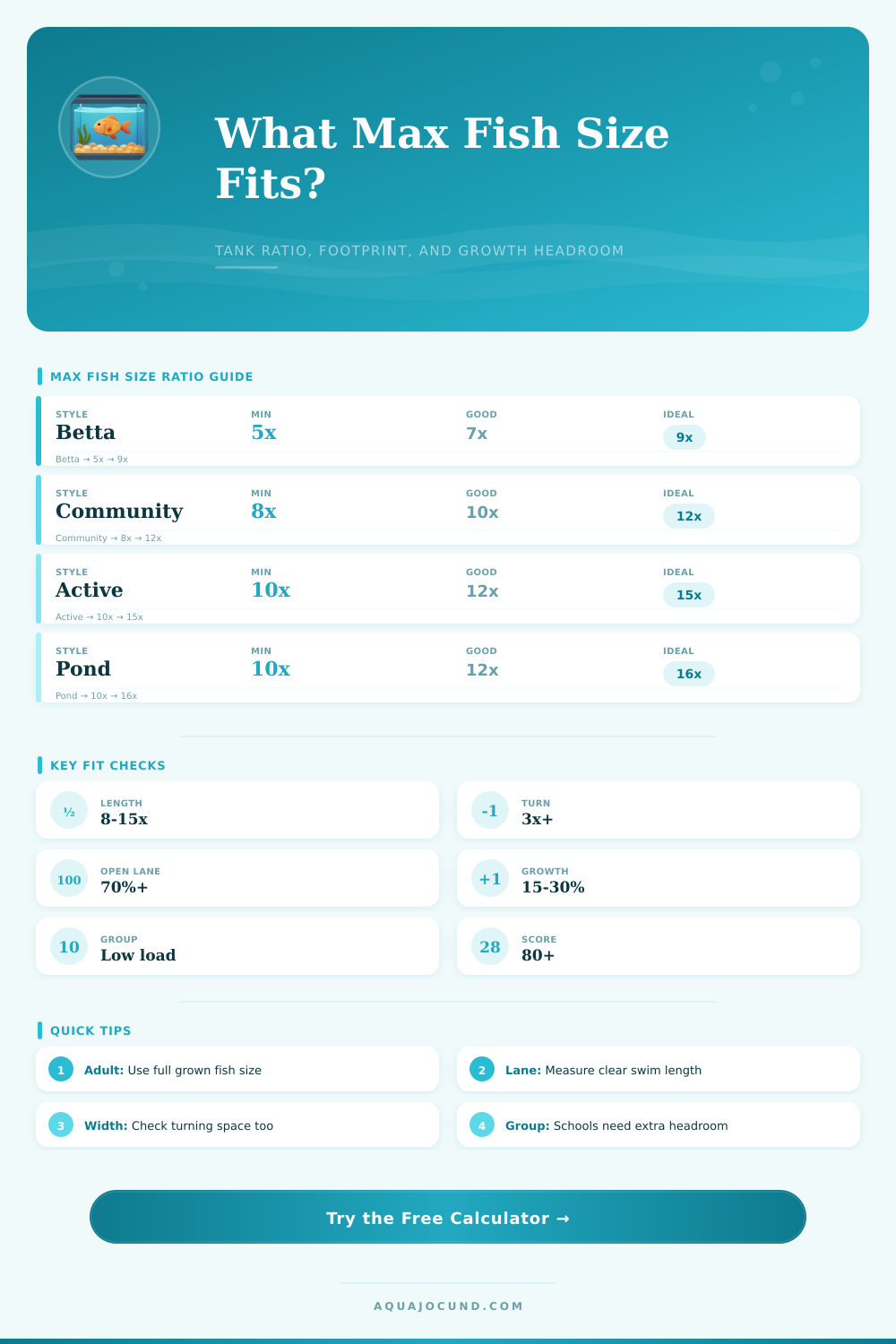
| Activity Profile | Example Fish | Minimum Lane | Comfort Lane | Ideal Lane |
|---|---|---|---|---|
| Sedentary | Perching goby, small ambush fish | 4x adult length | 6x adult length | 8x adult length |
| Calm | Betta, honey gourami | 5x adult length | 7x adult length | 9x adult length |
| Community | Tetra, rasbora, platy | 8x adult length | 10x adult length | 12x adult length |
| Active | Barb, rainbowfish | 10x adult length | 12x adult length | 15x adult length |
| Sprinter | Danio, hillstream style fish | 12x adult length | 14x adult length | 18x adult length |
| Pond cruiser | Goldfish, juvenile koi | 10x adult length | 12x adult length | 16x adult length |
| Body Shape | Turn Width Target | Footprint Need | Best Tank Style |
|---|---|---|---|
| Compact / Flexible | 2.5x adult length | Low | Standard rectangle |
| Torpedo / Streamlined | 3.0x adult length | Medium | Long rectangle |
| Deep Bodied | 3.5x adult length | Medium high | Wide rectangle |
| Long Bodied | 4.0x adult length | High | Long shallow tank |
| Heavy Bodied | 3.5x adult length | High | Wide display or pond |
| Tank | Typical Footprint | Community Max at 10x | Active Max at 12x |
|---|---|---|---|
| 5 gallon | 16 x 8 in / 41 x 20 cm | 1.6 in | 1.3 in |
| 10 gallon | 20 x 10 in / 51 x 25 cm | 2.0 in | 1.7 in |
| 20 long | 30 x 12 in / 76 x 30 cm | 3.0 in | 2.5 in |
| 29 gallon | 30 x 12 in / 76 x 30 cm | 3.0 in | 2.5 in |
| 40 breeder | 36 x 18 in / 91 x 46 cm | 3.6 in | 3.0 in |
| 55 gallon | 48 x 13 in / 122 x 33 cm | 4.8 in | 4.0 in |
| 75 gallon | 48 x 18 in / 122 x 46 cm | 4.8 in | 4.0 in |
| 125 gallon | 72 x 18 in / 183 x 46 cm | 7.2 in | 6.0 in |
| Modifier | Light Impact | Medium Impact | High Impact |
|---|---|---|---|
| Group size | 1-5 fish | 6-12 fish | 13+ fish |
| Decor openness | 90% open | 75% open | 45-60% open |
| Growth headroom | 10% reserve | 20-30% reserve | 45% reserve |
| Flow demand | Calm | Normal | River style |
| Margin setting | 5% reserve | 15-25% reserve | 35% reserve |
- The result is an adult length estimate based on usable footprint, not a promise that every species of that size is suitable.
- If length and turning limits disagree, use the smaller value because width can be the hidden constraint.
- For schooling fish, leave extra lane space so the group can move without constant compression.
- Move tall decor toward rear corners to increase the clear swimming lane percentage.
- Choose longer tanks for active fish and wider tanks for deep bodied or heavy bodied fish.
- Use the juvenile or unknown-size headroom setting when adult size is uncertain.
Everyone says a 20g long is the best tank for tetra keeping. So you purchase one, set up some driftwood, plants and toss in those six neon tetras that look tiny in their plastic bag. Six months later you’re seeing your fish fade, move slower or get stuck behind some decoration. This is not necessarily related to diet or water quality.
It’s typically related to geometry. Specifically, they lacks real space to swim around. Total volume isn’t everything. One thing that’s apparent is volume, this number is printed on products! While gallons are easy to use as a measure of capacity, this measurement doesn’t actualy matter much to the fish. Fish need space around them, room to swim freely.
Why Tank Shape Is More Important Than Size
It might be true that an aquarium holds just as many gallons as another, but what about swimming space? Because the shape of the tank affects available swimming space, you have to know how long your particular tank is and use a calculator. That way you can see how wide your tank should be given your fish (e.g., a betta and a danio will need very different spatial conditions). Doing so shows that even if two or more fish will inhabit a certain-sized tank, their condition must differ (i.e., spatially).
Another key metric is the swim lane. Rainbowfish or barbs, any species that are really active, require an uninterrupted area of water so they can turn and run freely. Putting lots of rock work in the middle of a thirty inch tank will cut down your effective surface area to a twelve-inch obstacle course. The calculator considers decor density and lowers safe fish size to match for planted setups. Although those plants make for a nice looking tank, they also diminish amount of real estate available for swimming. Don’t guess at this stuff; figure out what’s needed based off aesthetics vs space.
Fish move in 3D and turning radius matter just as much as straight line speed. Does it has to turn on a dime? Slender tetra may be able to turn into tighter areas than broad-bodied angelfish, which need more width to pivot. How do you know what type of space your fish requires? Body shape matters. Though they may have vertical height, a long eel will feel cramped in a short wide box. You can use tables to find the right tank for each body type. Keeping footprint of the tank aligned with the fish’s body shape helps long term health and reduces chronic stress.
New owners are frequently surprised by how much more room their “little” juveniles need. If you feed them properly and give them plenty of space, goldfish gets big. The same is true for cichlids. A long tank may seem like plenty of room for your small juvenile fish. However, it’s not enough space for healthy growth. You must plan for the future by allowing at least a 20% buffer. When those small fish reach maturity and double in length, there will be enough space to accommodate them. They’ll remain healthy and have room to move around and breathe comfortabley.
The number is further complicated by schooling behavior which involves many fishes using space at the same time. One fish uses one lane, but a school of fish use several lanes (for example, six tetras). A school does not wait its turn to swim like an individual fish would, it fills the space with itself all at once. That’s more load on the tank than just counting individuals would indicate. Input the number of fish in your groups to understand that behavior and avoid overstocking.
Flow also impacts the way fish feel about their surroundings. In high-flow situations, fish requires more space to rest against the current without fatigue. Stronger filtration creates a river-like effect, so you will want to provide more space for resting spots. If you don’t give them sufficient room, they’ll burn up swimming and won’t live comfortabley. When given adequate space, they can take a break from the current. Choose a tank size that respects their natural movements. This means making their living space one where fish can behave as nature intended instead of stuffing them into boxes.
Geometry matters. The fish do best when you get the geometry right. Fish thrive when their needs are met; this isn’t about how many gallons are on the side of a box, but about the dimensions of the runway to ensure their well-being. For example, I select a twenty gallon long because it’s the right sized runway for their well being, not because 20 is written on the front of the box. You should of picked a bigger one if you wanted more space.