Fish Rack Water Volume Calculator
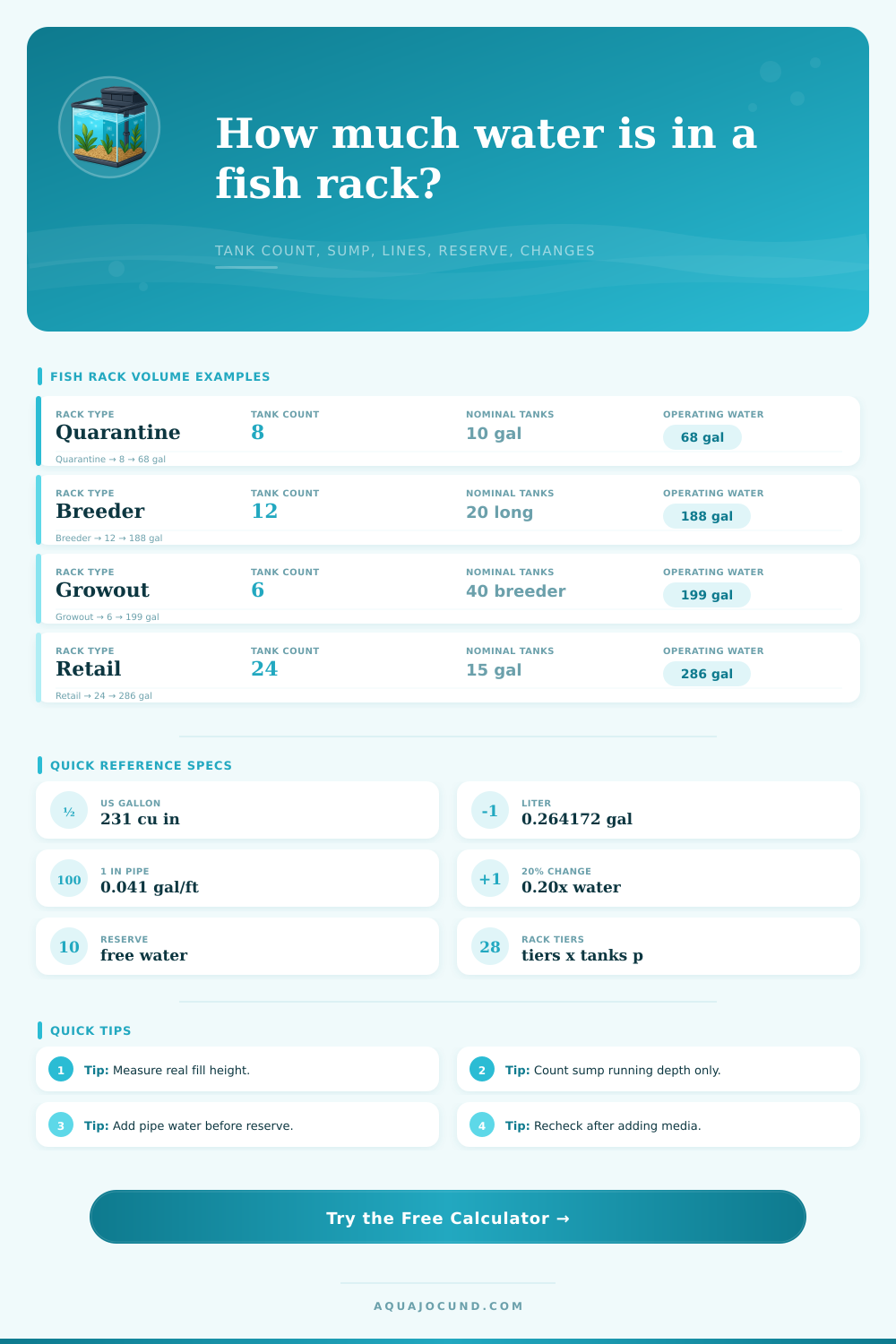
Total rack water from tank counts, fill height, sump, plumbing lines, displacement, reserve, tiers, and water changes.
🐟 Rack presets
⚙ Rack and tank inputs
📊 Rack comparison grid
📘 Reference tables
| Common tank | Dimensions | Nominal size | Typical rack use |
|---|---|---|---|
| 10 gallon | 20 x 10 x 12 in / 51 x 25 x 30 cm | 10 gal / 38 L | Quarantine, fry, small pairs |
| 15 gallon | 24 x 12 x 12 in / 61 x 30 x 30 cm | 15 gal / 57 L | Retail rows, juveniles |
| 20 long | 30 x 12 x 12 in / 76 x 30 x 30 cm | 20 gal / 76 L | Breeders, growouts |
| 29 gallon | 30 x 12 x 18 in / 76 x 30 x 46 cm | 29 gal / 110 L | Broodstock, plant pairs |
| 40 breeder | 36 x 18 x 16 in / 91 x 46 x 41 cm | 40 gal / 151 L | Growouts, cichlids |
| Displacement profile | Typical items | Default deduction | When to increase |
|---|---|---|---|
| Bare bottom holding | Heater guards, small fittings | 1.5% | Large internal filters |
| Sponge filters | Sponges, uplift tubes, valves | 3.5% | Multiple large sponges |
| Planted breeder | Substrate, wood, plant mass | 6.0% | Deep substrate or stones |
| Reef frag rack | Egg crate, plugs, skimmer body | 8.0% | Dense rock or frag trays |
| Cichlid growout | Caves, media, sponge blocks | 5.0% | Rock stacks or ceramic caves |
| Pipe ID | Water per foot | Water per meter | Typical rack line |
|---|---|---|---|
| 0.5 in / 13 mm | 0.010 gal | 0.126 L | Small airlift water manifolds |
| 0.75 in / 19 mm | 0.023 gal | 0.282 L | Compact return branches |
| 1.0 in / 25 mm | 0.041 gal | 0.507 L | Common return and drain lines |
| 1.5 in / 38 mm | 0.092 gal | 1.14 L | Main drain headers |
| 2.0 in / 51 mm | 0.163 gal | 2.03 L | Large central rack headers |
| Water change target | Use case | Calculation | Rack note |
|---|---|---|---|
| 10% | Light stocking | 0.10 x operating water | Often enough for stable holding |
| 20% | General rack | 0.20 x operating water | Common weekly planning value |
| 30% | Heavy feeding | 0.30 x operating water | Useful for growouts |
| 50% | Reset or treatment | 0.50 x operating water | Confirm temperature and chemistry |
💡 Volume tips
When you put a ten gallon tank on a stand, leave two inches of space below the rim, add some gravel, a filter, etc., that’s not ten gallons in there anymore. Most newbies gets caught short by the difference between the nameplate number and real capacity of their tanks. Multiply that by a dozen tanks on a twelve tank breeder rack, or two dozen tanks on a retail display, and you’ve got gallon of confusion (not to mention mis-spending money). A couple gallons here, a couple gallons there. You believe you have two hundred gallons of buffer for your next ammonia spike, but you actualy only have one hundred and fifty. Guess which way that leads?
So the calculator will do all of this for you after you enter your dimensions and profiles. You won’t need to guess displacement coefficients anymorer. And it makes you think about what’s in the glass. Most folks don’t remember that water volume includes more than just the tank. You need to include water volume for your sump, volume of water in your return lines, and reserve capacity for accidental drain downs/evaporation. Without considering the plumbing, you’re designing a system that doesn’t exist. This tool separate free capacity from the operating water which is an important distinction when estimating biological load and pump sizing.
Why You Need to Know Your Real Tank Size
To continue the displacement analogy: Volume is the quiet thief. A bare bottom quarantine tank loses very little space to equipment. But a heavily planted, sponge filtered breeders rack with deep sand substrate and driftwood might see half the usable water in the tank lost to solids. This table on the page shows some defaults for deduction based off set-up. What’s interesting isn’t that it is absolutely correct for your tank. It’s interesting that it shows just how easly your decorations gobble up available volume. That sponge filter, while doing its job and cleaning, also occupies space which would otherwise be used to dilute waste. So if you want a lot more fish, you either need a bigger tank or a cleaner one then the box says.
The second failure is measuring fill height. Intuition leads you to believe that if there’s water close to the top of the tank then it must be full… except it isn’t. The operating level is usually below that. Take away an inch from a dozen tanks and suddenly you have removed far more water than you think. Remember that the calculator wants the real world, or operating level measurement. Why? Because what sits above the water at max capacity doesn’t matter (other than the visual effect). What matters are the surfaces covered and water column living within the biological filters located at the normal water level. That additional inch of open space doesn’t help your fish if they live below the filter intake.
What about reserve capacity? That’s an overlooked but important factor. This isn’t additional water you consume daily. Reserve capacity is the safety net between you and disaster. If you drain out a little more than intended during a cleaning mishap or lose power which shuts down your pump, reserve capacity keeps you from siphoning. Having a reserve of 15. 20% allows for breathing room when things don’t work right. Otherwise, even a small hiccup will cause your water level to drop into pumps or expose filter media. This could of lead to potential damage and stress.
The calculator refers to this as free capacity because not all the water in your tank is working all the time. These figures, of course, translate into water changes. If you know your actual working volume, you also know precisely how many gallons of new water are required for any size water change (20%; 30%). This precision saves you money in the long term because you don’t guess at what size your tanks really are and thereby undershoot or overshoot your dosing of salts and conditioners. In other words, you begin treating your rack as a designed system rather than a black box.
At its core, though, creating a fish rack is about mastering things that change. One of the simplest and perhaps most fundamental variables are volume. When you know how much water you have, you know your stocking limits, your dosing schedule, and that you can trust your water tests. Your tanks become more than just survivable; they become places where fish not only live but thrive. And it’s all because you get the numbers right. The math is easy. What sets an expert apart from a hobbyist is not so much whether they use it as a tool but whether they’ve made a habit out of measuring what really matters. Begin with the volume and everything will fall into place.