Fish Food Cost Per Month Calculator
Estimate monthly fish food cost from fish biomass, feeding percent, food type, container size, container price, waste, growth, and feeding schedule.
🐟Stock and feeding rate
This adds a guidance line in the breakdown; the feeding percent remains editable.
Use the combined estimated live weight of all fish being fed.
Use positive values for juveniles or conditioning, negative values for planned light days.
🍲Food package and waste
Optional. Leave at zero when comparing only food cost.
Cost Breakdown
📊Food type quick specs
📋Food type cost comparison data
| Food type | Dry matter factor | Typical feed rate | Waste tendency | Best calculator use |
|---|---|---|---|---|
| Dry flake | 0.90 | 1.0% to 2.0% | Medium | Small community fish that feed at the surface |
| Micro pellet | 0.92 | 1.2% to 2.2% | Low | Tetras, rasboras, bettas, small cichlids |
| Sinking pellet | 0.91 | 1.0% to 2.0% | Low to medium | Bottom feeders, cichlids, larger omnivores |
| Algae wafer | 0.90 | 0.8% to 1.8% | Medium | Grazers, plecos, loaches, shrimp community feeding |
| Frozen food | 0.20 | 2.0% to 6.0% | Medium to high | Reef fish, discus, finicky feeders, conditioning |
| Prepared gel food | 0.35 | 2.0% to 5.0% | Medium | Goldfish, grazers, mixed vegetable and protein diets |
| Freeze dried food | 0.94 | 0.8% to 1.8% | Medium | Treat feeding and protein rotation |
| Fry powder | 0.93 | 5.0% to 12.0% | High | Fry tanks where many small feedings are used |
🔍Species and feeding comparison grid
| Stocking group | Typical biomass | Daily rate | Common food style | Monthly note |
|---|---|---|---|---|
| Single betta | 5 to 10 g | 1.0% to 2.0% | Micro pellet or small floating food | Package usually lasts many months |
| Nano tetras or rasboras | 15 to 40 g | 1.5% to 2.5% | Flake or micro pellet | Waste factor matters more than package size |
| Community livebearers | 40 to 100 g | 1.5% to 3.0% | Flake, pellet, occasional frozen | Growth adjustment helps with juveniles |
| Goldfish | 100 to 500 g | 1.5% to 3.0% | Gel, sinking pellet, vegetables | High biomass drives monthly use |
| African cichlids | 150 to 600 g | 1.2% to 2.2% | Pellet or herbivore pellet | Dense food and low waste reduce cost |
| Discus | 250 to 900 g | 2.0% to 4.0% | Frozen, gel, pellet mix | Multiple feedings raise monthly use |
| Reef community fish | 80 to 350 g | 2.0% to 5.0% | Frozen and pellet blend | Use frozen dry matter factor for fair comparison |
| Predator fish | 500 to 3000 g | 0.5% to 1.5% | Large pellet or prepared frozen | Lower percent but large biomass |
📏Common stocking presets reference
| Preset | Biomass | Food type | Feed rate | Package assumption |
|---|---|---|---|---|
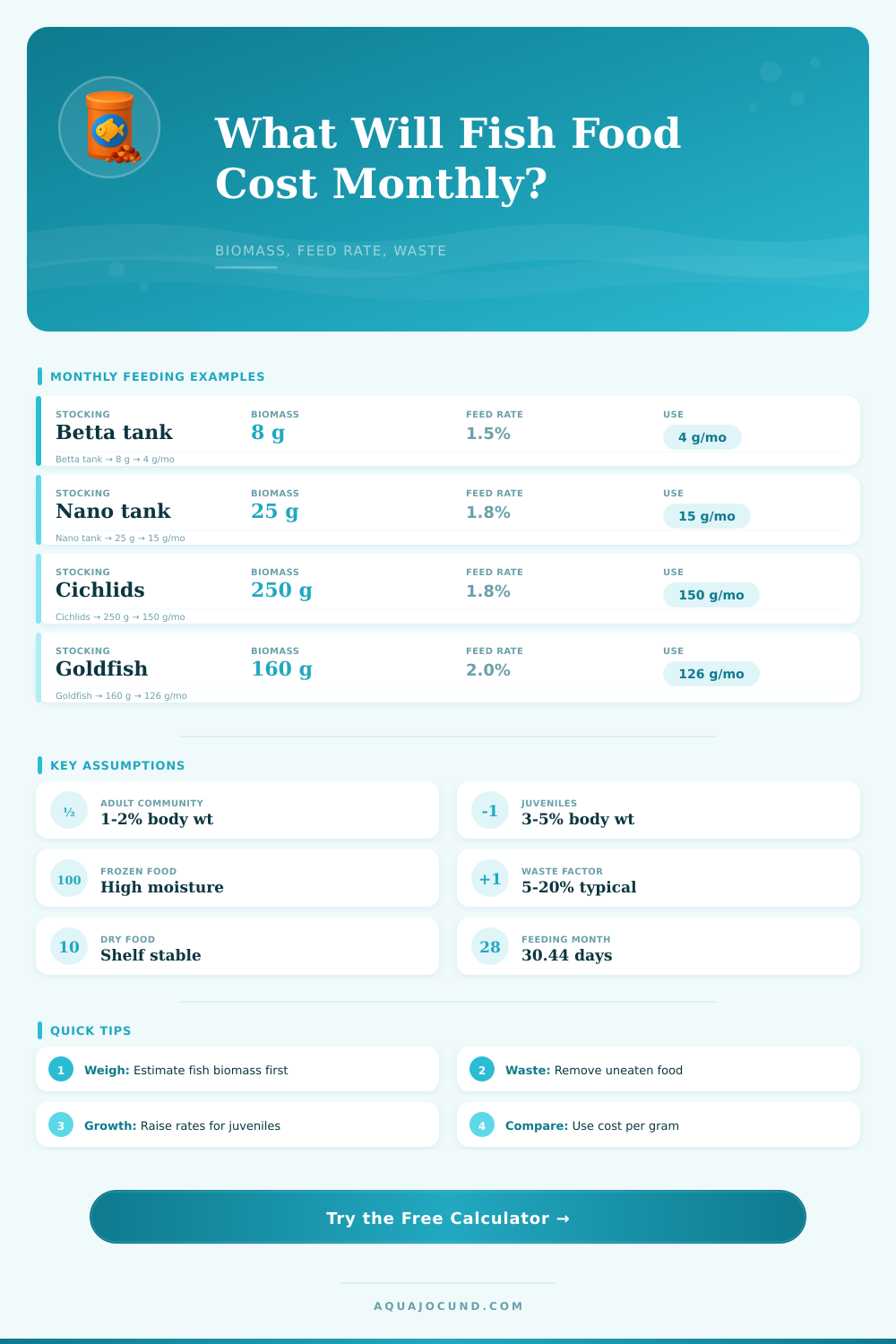
| Betta desk | 8 g / 0.28 oz | Micro pellet | 1.5% | 20 g container |
| Nano community | 25 g / 0.88 oz | Flake | 1.8% | 30 g container |
| Planted school | 75 g / 2.65 oz | Micro pellet | 1.7% | 60 g container |
| Goldfish pair | 160 g / 5.64 oz | Gel food | 2.0% | 340 g prepared batch |
| Cichlid group | 250 g / 8.82 oz | Sinking pellet | 1.8% | 250 g container |
| Discus tank | 420 g / 14.82 oz | Frozen food | 3.0% | 450 g pack |
| Reef community | 180 g / 6.35 oz | Frozen food | 3.5% | 100 g pack |
| Fry growout | 35 g / 1.23 oz | Fry powder | 8.0% | 50 g container |
💸Cost math reference
| Step | Formula | Example | Why it matters |
|---|---|---|---|
| Dry-equivalent target | Biomass x feed % | 100 g x 2% = 2 g/day | Starts from body weight, not tank gallons |
| Package-weight food | Dry target / dry matter factor | 2 g / 0.90 = 2.22 g/day | Frozen and gel foods contain more water |
| Adjusted daily food | Food x waste x growth | 2.22 g x 1.10 = 2.44 g/day | Captures uneaten food and planned growth feeding |
| Monthly use | Adjusted daily food x feeding days | 2.44 g x 30 = 73.2 g | Separates fasting days from daily ration size |
| Monthly cost | Monthly use / container grams x price | 73.2 / 100 x price | Converts grams used into package fraction |
💡Fish food budgeting tips
We all guess what a bag of flake will cost us, so we purchase one that seems reasonable (e.g., “I think a 2-month supply should be about $20”). Fish don’t eat food at an even pace year-round. That means most hobbyist is off base in their estimates. The amount of food you spend isn’t based off container size or tank size; it’s based on biomass.
You can calculate your real feeding expense, or actual nutrient delivery, for each month. To do this, use the food type, feed ration %, package info, waste factors, and biomass. This completely alters your perspective on budgeting when looking at containers and feeding.
How to Calculate Fish Food Costs
To begin, enter your total live weight of fish. Because metabolism is driven by mass, a thinly stocked 75g will typically uses less food then a well populated 20g grow out. Before tinkering with percentages, get an approximate idea of how much your fish weigh together. Enter that value into the calculator and let it do the rest.
By default, adult community fish eats between one and two percent of their bodyweight per day. Those juveniles need much more as they’re busily creating tissue instead of simply maintaining it. If you’re feeding fry or conditioning breeders, you can account for this phase of life on the calculator too. This is very important.
A second layer of complexity comes from food type. A hundred grams of pellets isn’t equal to a hundred grams of frozen cubes; the latter has large water weight as a frozen or gel food. To adjust for this difference and allow fair cost comparisons, the calculator use different dry matter factors. While frozen items tend to have higher moisture content (plus potentially better palatability), they’re lower in dry matter compared to pellets or flakes. Knowing this avoids the common error of pricing by gram regardless of product format, a small technical point with a huge impact on budget accuracy.
Another cost driver that many people overlook is waste. Depending on your setup, this can vary drasticly. Whether it’s uneaten food sinking to the bottom of your tank or getting stuck in filtration media, it essentially vanishes into thin air and out of your pocketbook, never to be seen by your livestock again. To show this loss in reality, we provide an overfeed/waste factor input. Spillage occurs in most tanks, particularly those housing aggressive feeders such as schooling species. Bumping this number up provides a more truthful estimate of how much money you’ll spend each month. Doing so will also show why maintaining strict feeding schedules and keeping things clean are financially beneficial.
After plugging in the numbers, it spits back out your estimated monthly cost and how many days a single container will actualy last. It also displays your estimated cost per month along with how long it should of likely last before emptying or going bad. That way you can buy ahead and not run out in the middle of the month. Or at least you will know if something is going to go bad. And the reference table on the page spells all of this out nicely, depending on which common scenario applies to your fish stocking.
Same concepts apply whether you have one lonely betta or several voracious cichlids. Volume is driven by biomass while price is dictated by efficiency. Over time, this data tracks trends that are masked by individual purchases. Perhaps you realize your costs increase in the winter because waste volume is high while metabolism is lower (slower processing). Maybe you discover that moving from flakes to pellets decreased your overall consumption even though a pellet package was more expensive up-front. This information helps you make better long-term choices regarding your tank management and what they needs to eat. Feeding becomes not only a chore but also a managed part of your hobby budget.
At the end of the day, understanding the price of feeding your fish healthily enables you to spend money with peace of mind on something else. Not being surprised by regular food costs means you’ll be able to spend more on nicer decorations or a better filter. Estimation helps eliminate the concern of under- or over-ordering premium goods without reaping matching rewards. The hobby becomes grounded in practicality while still being fun and experimental.
So weigh your stock first and estimate your reasonable waste factor. Then let the calculator crunch the numbers for you in terms of monthly amounts and conversions. You’re going for predictable care that’s sustainable, but won’t break the bank. Regular feeding is good for the fish, and it is also good for your wallet. A few seconds more per month can go a long way to achieving that balance.