
It’s a hydraulic engineering system: streamlined to move swiftly. Inside its body are special component working together to overcome water resistance. Looking at them make you see the animal differently. Suddenly, instead of being something passive, it is an active machine.
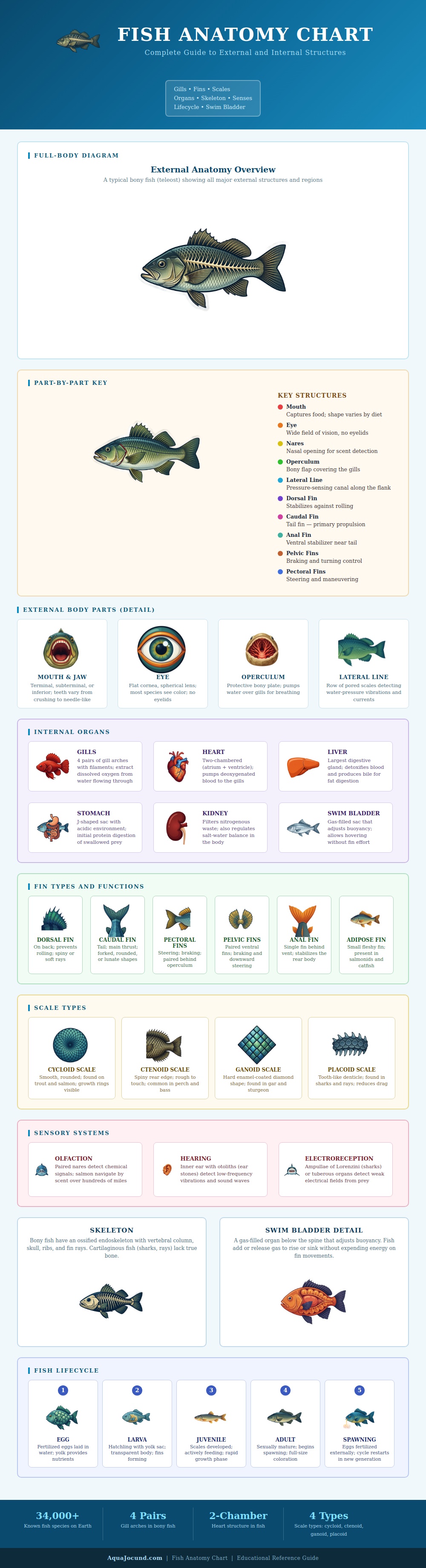
Many believe that the tail is doing everything. It’s not that simple. The chart above shows this more clearly than any textbook: the tail produces thrust, while the other fins (pectoral, anal, and dorsal) keeps the fish from rolling over on its side. The anal and dorsal fins are like a keel on a sail boat. Without them, the animal would turn into a useless corkscrew from the forward momentum. Pectoral fins is used as both brakes and steering wheels. A set of paired fin can quickly stop a speeding fish or turn it on a dime.
How Fish Swim and Survive
But speed isn’t everything. Control in three dimensions are needed too. And it is not just armor. Shark skins (placoids) feel sandpapery; their microscopic ridges break up the water flow, reducing drag. Ctenoid scales (tiny hooks) adds texture; cycloid scales (smooth) facilitate easy gliding. Together, these help keep the shark moving endlessly, swimming is its life, without getting tired like bony fish do. Outside is protected from environmental physical forces.
Most folks never pay attention to this lateral line until you see it labeled. Underneath the skin, running down each side, is the lateral line, which is a series of small pores running down the flank. The lateral line acts as an organ that senses vibration and change in water pressure. A fish can feel something approaching without necessarily seeing it. Think about how you feel when somebody walks into a room but you don’t turn around… that’s what I’m talking about. Fish is aware of such things with the lateral line. That’s why schooling fish acts like one unit. When one fish feels pressure shift from his neighbor, he reacts to match it and so does every other fish in school.
The same rules of efficient design apply internally. For instance, they has a two chambered heart. It pumps blood through the gills, which take on oxygen from the water before sending it throughout the rest of the body. In addition, the fish do not re-oxygenate the blood via a return to the heart as we do in mammals. After leaving the gills, the blood pressure decrease and is not good for sustained efforts. It is fast and simple different than built for endurance.
The addition of the swim bladder further adds a wrinkle. Fish can manipulates their gas content to float at whatever depth they desire without expending energy to swim around. Energy savings here are immense. Without the bladder, the fish would of have to swim all the time just to keep itself submerged. A tired fish cannot do this for very long. With the bladder, it can just hang in place with little effort.
The senses are also very specific. Because the water prevents the eyes from getting dry or dirty they do not need eyelids. But they do depend greatly on olfaction. The nostrils is designed specifically for smell. In fact, salmon can return home to the stream where they was born from several hundred miles away using only their sense of smell. Sharks also has a set of electroreceptors that are sensitive to the small electrical field created when muscle tissue contracts in another animal. All these senses combine to paint a picture of the aquatic environment. It compensates for poor vision, which happens often in murky water.
These adaptations are both resilient and fragile; this is what the life cycle illustrates. From egg through larval stages, the young fish must rely based off their yolk sacs for nutrition before moving to self-feeding status. Fin development, scale formation and other changes occurs during the shift into the juvenile stage. As adults, fish has learned the physics of their world. They understand how to use all of their organs, senses and fins in order to survive.
The next time you see a fish swim across your screen, notice its delicate fin movements and how its scales shine as it glides effortless through the water. It’s not just movement, but a complex livig machine running like a well-oiled engine. It is something so easily overlooked, yet it is what makes it possible for life to flourish in the deeps. Its anatomy knows how to push forward while the water pushes back.
