Filter Turnover Per Hour Calculator
Estimate real aquarium turnover from rated pump flow, head height, plumbing restriction, media load, clogging, tank volume, and target range.
| Filter Type | Typical Real Flow | Main Loss Source | Best Turnover Use |
|---|---|---|---|
| Hang-on-back filter | 70-90% of label | Cartridge and intake sponge | Nano to medium community tanks |
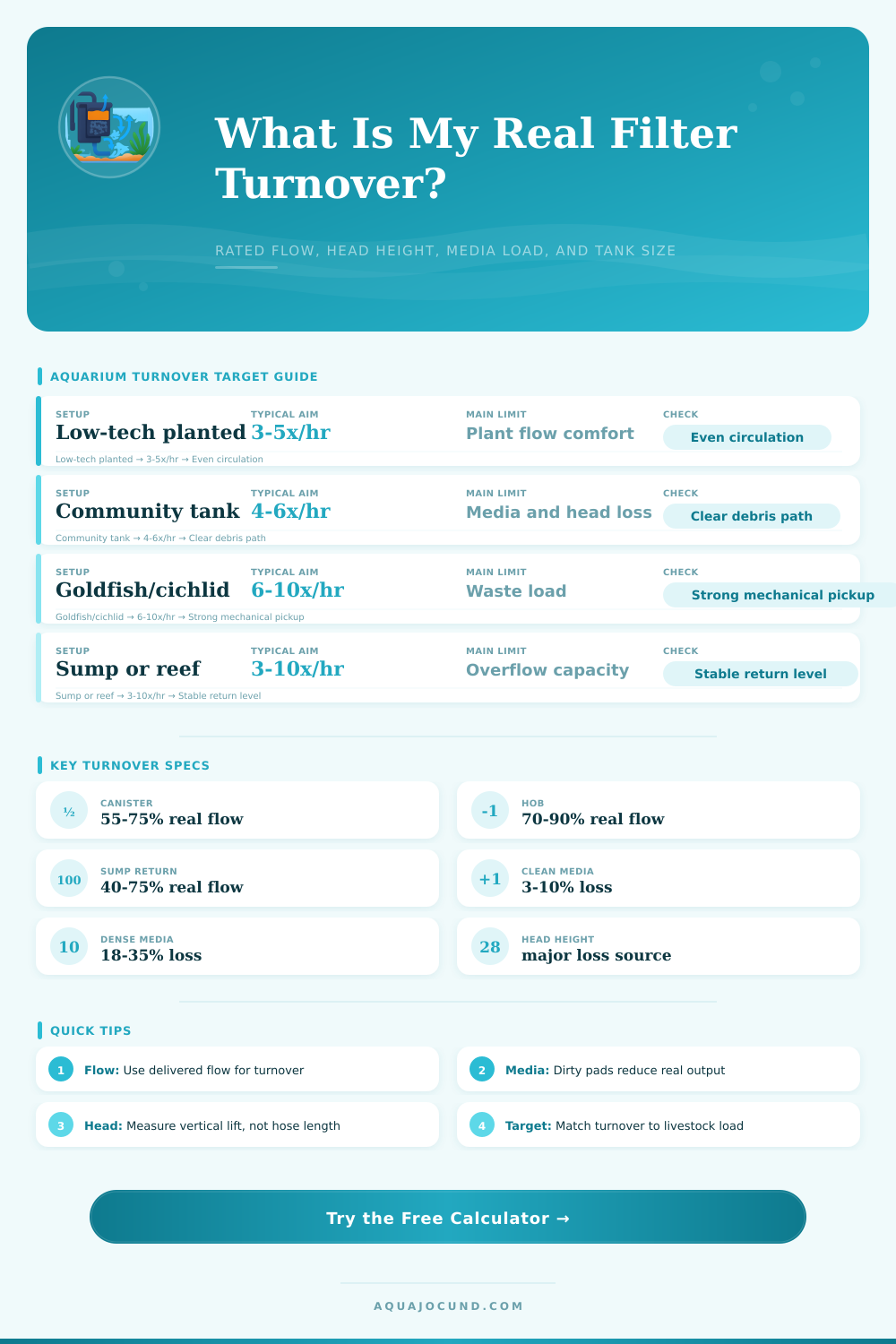
| Canister filter | 55-75% of label | Head lift, hose, dense baskets | Medium and large display tanks |
| Internal power filter | 75-92% of label | Foam block and debris loading | Small tanks or added circulation |
| Air sponge filter | 35-70% of nominal water lift | Air rate and sponge pores | Fry, shrimp, quarantine, gentle tanks |
| Sump return pump | 40-75% of label | Vertical lift and fittings | Overflow systems and reef returns |
| Matten foam filter | 45-80% of drive pump | Foam face velocity | Low maintenance biological filtration |
| Tank Goal | Turnover Range | Flow Character | Calculator Target |
|---|---|---|---|
| Low-tech planted or shrimp | 3-5x per hour | Gentle but complete circulation | 4x midpoint with reserve |
| Community aquarium | 4-6x per hour | Balanced filtration and debris pickup | 5x midpoint with reserve |
| High-tech planted tank | 6-10x per hour | Broad circulation without blasting plants | 8x midpoint with reserve |
| Goldfish or messy feeders | 6-10x per hour | Strong mechanical removal | 8x midpoint with reserve |
| Cichlid or high-waste tank | 7-12x per hour | Strong pickup and gas exchange support | 9.5x midpoint with reserve |
| Reef or sump return | 3-10x per hour | Matched to overflow and display flow plan | 6x midpoint with reserve |
| Water polishing | 8-12x per hour | Temporary fine filtration pass | 10x midpoint with reserve |
| Tank | Common Dimensions | Volume | 4-8x Delivered Flow |
|---|---|---|---|
| 10 gallon | 20 x 10 x 12 in / 51 x 25 x 30 cm | 10 gal / 38 L | 40-80 GPH / 151-303 LPH |
| 20 long | 30 x 12 x 12 in / 76 x 30 x 30 cm | 20 gal / 76 L | 80-160 GPH / 303-606 LPH |
| 29 gallon | 30 x 12 x 18 in / 76 x 30 x 46 cm | 29 gal / 110 L | 116-232 GPH / 439-878 LPH |
| 40 breeder | 36 x 18 x 16 in / 91 x 46 x 41 cm | 40 gal / 151 L | 160-320 GPH / 606-1211 LPH |
| 55 gallon | 48 x 13 x 21 in / 122 x 33 x 53 cm | 55 gal / 208 L | 220-440 GPH / 833-1666 LPH |
| 75 gallon | 48 x 18 x 21 in / 122 x 46 x 53 cm | 75 gal / 284 L | 300-600 GPH / 1136-2271 LPH |
| 125 gallon | 72 x 18 x 21 in / 183 x 46 x 53 cm | 125 gal / 473 L | 500-1000 GPH / 1893-3785 LPH |
| Loss Source | Light Impact | Moderate Impact | High Impact |
|---|---|---|---|
| Vertical head height | 0-1 ft / 0-0.3 m | 2-4 ft / 0.6-1.2 m | 5+ ft / 1.5+ m |
| Hose or pipe run | Under 3 ft / 0.9 m | 4-8 ft / 1.2-2.4 m | 10+ ft / 3+ m |
| Fittings and valves | 0-2 fittings | 3-6 fittings | 7+ fittings or tight elbows |
| Media restriction | Coarse foam, open rings | Mixed baskets or pads | Fine floss, packed resin, clogged pads |
| Maintenance condition | Clean prefilter | Seasoned biofilm | Dirty intake or clogged polishing layer |
Aquarium filter often do not provide the amount of water movement that is stated in the box for the particular brand of filter. The number listed in the box is the box rating for the filter. The actual movement of the water from the filter is often lower than the box rating for the filter.
The reason that the actual water movement is lower is due to the requirement of the pump to lift the water to a certain height, and the restriction of the water movement that the hoses and filter media create. The one measurement that is often most important of the actual movement of the water from the filter is the turnover of the water per hour. The turnover per hour indicates the number of times that the entire tank of water pass through the filter per hour, and is the most important measurement for maintaining the aquarium.
Find the Real Water Flow and Turnover of Your Aquarium Filter
The calculator will perform the mathematical calculations for you. All you need to enter is information about the dimensions of the tank, the type of pump that you will utilize, the head height that the filter creates, the length of hose that will be utilized, the number of filter fittings that will be utilized, the density of the filter media, and the maintenance condition of the aquarium filter. The calculator will compare the flow rate of the filter that these variable indicate to the turnover rate that the fish require.
The importance of this comparison is that the rating of the filter from the manufacturer may state that it will move 200 gallon of water per hour. Due to the various factors described in the article, the actual amount of movement of the water may be less than 200 gallon of water per hour. This comparison allows you to see the difference between the two numbers without having to calculate the percentage of the difference yourself.
One of the factors that reduces the movement of the water that is created by the filter is the vertical head height that is created by the filter. The vertical head height is the distance that the pump lifts the water. Each foot of vertical head height will reduce the amount of water movement by the filter.
The addition of elbows or valves to the filter further create the loss of movement. The length of the hose that is used to place the filter into the aquarium may also contribute to the reduction of the movement of the water; however, the length of the hose is less important than the vertical head height create by the filter, unless the length of the hose is very long (six or eight feet, for instance). In these case, the friction within the long length of hose will reduce the amount of water movement.
Another factor that reduces the movement of the water is the restriction of movement by the filter media. For instance, a fine polishing pad or a packed resin basket will reduce the movement of the water by fifteen or twenty percent, even if the prefilter is very clean. The calculator is able to separate these factors, and show which one is contributing to the reduction of the movement of the water from the filter.
The target turnover rate of the water in the aquarium will differ depending on the type of aquarium that is to be maintained. For example, a low-tech planted tank that contains few fish will have a turnover rate that is significantly less then a goldfish tank or a tank that contains types of fish that tend to create mess in the tank. Additionally, the turnover rate will be different for a reef system.
The different type of aquariums have different turnover rate requirement, which are represented in the calculator. The maintenance of the aquarium filter can have a significant effect upon the movement of the water. For example, a well-maintained filter will move the water that is required to maintain the aquarium.
However, an neglected filter may not be able to provide the necessary movement of the water. For instance, an neglected prefilter or a layer of floss that is often found within the filter may become clogged with the detritus of the tank. This will reduce the movement of the water through the filter.
The maintenance condition of the filter is one of the factor that is represented in the calculator. Finally, the actual movement of the water within the display tank may not be the same as the movement of the water that is created by the filter. For instance, the filter may create a high rate of movement of water through the tank, but it may not be able to move the water into each area of the aquarium.
The creation of dead spots within the aquarium is common, even if the movement of the water from the filter is correct. The movement of the water within the aquarium is created by the filter, the addition of water element, and the placement of the filter’s intake and return filters. The calculator does not calculate any of these factor, however, so it is possible that a powerhead may have to be added to the aquarium to increase the movement of the water within the display tank.
The process in utilizing the calculator is to use the calculator to determine the actual movement of the water that will be created by the aquarium filter. This movement can be compared to the turnover rate that the fish in the aquarium require. Any difference between these two number indicates a problem with the aquarium filter.
For instance, if the calculated actual movement of the water from the filter is lower than the turnover that the livestock of the aquarium require, then the problem may be with the head height that the filter creates, the media that the filter uses, or the fact that the pump that you utilized was purchased according to the specifications of the pump as stated in the box of the pump. In each of these case, adjustments can be made to the aquarium filter to increase the movement of the water, and the movement can be re-calculated with the adjusted filter. The goal is to ensure that there is enough movement of clean water to balance the waste that is created by the tank’s fish.
While a high movement rate of water is desirable, it isnt the goal of the aquarium to have the most highest possible movement of water from the filter.