🧪 Filter Media Volume Calculator
Size aquarium filter chamber volume, usable media fill, biological capacity, flow contact, and tray headroom.
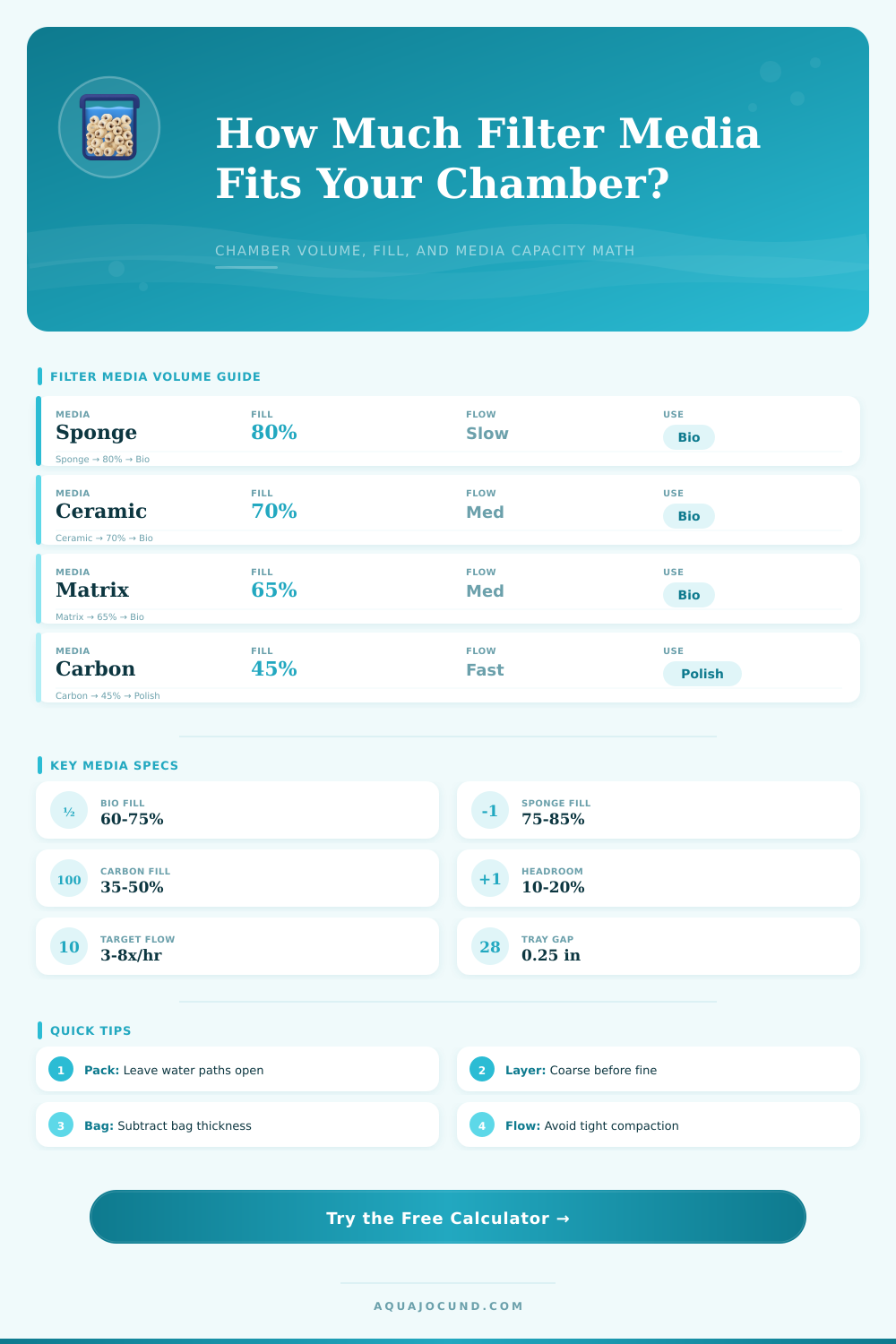
| Media Type | Bulk Density | Practical Fill | Open-Flow Notes |
|---|---|---|---|
| Coarse sponge block | 0.08 kg/L / 0.67 lb/gal | 75-85% | Leave compression light so pores do not collapse. |
| Fine polishing foam | 0.10 kg/L / 0.83 lb/gal | 60-75% | Best after coarse media; clogs faster at high flow. |
| Ceramic rings | 0.36 kg/L / 3.0 lb/gal | 60-75% | Needs water movement around ring voids. |
| Sintered glass media | 0.42 kg/L / 3.5 lb/gal | 55-70% | High surface media, avoid crushing or dust packing. |
| Porous lava rock | 0.55 kg/L / 4.6 lb/gal | 55-70% | Irregular pieces need more headroom and rinsing. |
| Plastic bio balls | 0.12 kg/L / 1.0 lb/gal | 75-90% | Excellent void space in wet/dry trays. |
| Activated carbon bag | 0.50 kg/L / 4.2 lb/gal | 35-50% | Thin layers improve contact and replacement access. |
| Zeolite granules | 0.78 kg/L / 6.5 lb/gal | 35-55% | Dense chemical media; use only when appropriate. |
| Tank | Dimensions | Bio Media Volume | Typical Flow |
|---|---|---|---|
| 5 gal | 16 x 8 x 10 in / 41 x 20 x 25 cm | 0.15-0.35 L | 25-50 gph / 95-190 L/h |
| 10 gal | 20 x 10 x 12 in / 51 x 25 x 30 cm | 0.30-0.70 L | 50-100 gph / 190-380 L/h |
| 20 long | 30 x 12 x 12 in / 76 x 30 x 30 cm | 0.60-1.40 L | 100-200 gph / 380-760 L/h |
| 29 gal | 30 x 12 x 18 in / 76 x 30 x 46 cm | 0.90-2.00 L | 145-290 gph / 550-1100 L/h |
| 40 breeder | 36 x 18 x 16 in / 91 x 46 x 41 cm | 1.20-2.80 L | 200-400 gph / 760-1515 L/h |
| 55 gal | 48 x 13 x 21 in / 122 x 33 x 53 cm | 1.70-3.80 L | 275-550 gph / 1040-2080 L/h |
| 75 gal | 48 x 18 x 21 in / 122 x 46 x 53 cm | 2.30-5.20 L | 375-750 gph / 1420-2840 L/h |
| 125 gal | 72 x 18 x 21 in / 183 x 46 x 53 cm | 3.80-8.50 L | 625-1250 gph / 2365-4730 L/h |
| Fill Pattern | Best Use | Safe Fill Range | Warning Sign |
|---|---|---|---|
| Coarse to fine foam stack | Mechanical prefilter | 65-85% | Water bypasses around foam edges. |
| Loose ceramic basket | Biological media | 60-75% | Tray rattles or forms dry pockets. |
| Bagged chemical pouch | Carbon, resin, zeolite | 35-55% | Bag balloons or blocks spillway. |
| Wet/dry drip tray | Air-exposed bio media | 70-90% | Trickle plate floods instead of drips. |
| Upflow reactor tube | Fluid or contact media | 30-60% | Media grinds or escapes screens. |
| Formula | Imperial | Metric | Use In Calculator |
|---|---|---|---|
| Rectangular chamber | L x W x H / 61.024 | L x W x H / 1000 | Gross chamber liters before fill adjustments. |
| Net chamber height | Height - gap - divider | Height - gap - divider | Subtracts water headroom and bag thickness. |
| Usable media volume | Gross x fill x baskets | Gross x fill x baskets | Primary result in liters and gallons. |
| Dry weight estimate | Liters x kg/L x 2.2046 | Liters x kg/L | Approximate dry media mass. |
| Turnover | Flow gph / tank gal | Flow L/h / tank L | Flow contact card and status note. |
Aquariums requires a specific amount of filter media to maintain the stability of the water in an aquarium. The amount of filter media that you use will determine whether the water in the aquarium remain clear or becomes unbalanced. If you use too little filter media, the waste that the fish create will accumulate in the water too quick for the filter to remove that waste from the tank.
Too much filter media, however, will allow the water to find alternative routes around the filter media, allowing some of the filter’s chambers to not perform there filtering function of the water. The calculator that is provided on this page will allow you to calculate the amount of filter media that your filter chamber should hold. This calculator takes into account an area at the top of the filter media chamber, the thickness of the dividers within the filter, and the different types of filter media packing style that can be used.
How Much Filter Media to Use in Your Aquarium
These factors are taken into consideration because filter media baskets does not typically fill the entire filter media chamber from edge to edge. Each type of filter media has a slightly different calculation associated with it due to the different ways in which each type of media interact with the water within the aquarium. The flow rate at which the water move within the filter media chamber and the turnover of the water within the aquarium are two factors that this calculator considers.
If the water moves through the filter at too high of a rate, the water will not have time to exchange gases between the water and the environment, it will not drop the amount of debris within the water, and the water will not allow for the water to interact with the filter media. Too slow a rate of water movement through the filter media will create “dead” zones within the filter in which the debris will settle due to the slow movement of the water within the filter. This calculator compares the flow rate to the size of the aquarium, calculating a turnover rate of the aquarium’s water so that the user can understand whether their current pump and filter is working together in an effective manner.
Many aquariums are not constructed in the shape of perfect rectangle. The presets within this filter media calculator are established for common aquarium sizes and filter media style, so they can be utilized as a means of accounting for the non rectangular shapes of many aquariums and their filter chambers. It is not recommended that you attempt to maximize the percentage of the filter media that is filled into the filter chamber.
Using too much filter media within the chamber can lead to the drop in the flow rate of the water through the filter. Additionally, the chamber may create channels through which the water will move while ignoring the filter media. Use the packing style option of the calculator to model the effect that different types of bags or baskets will have upon the appearance of the chamber itself.
Using this option will allow you to ensure that the calculations of the amount of filter media to be used are performed in a way that reflect the performance of that filter media when its actualy running within the aquarium. This media calculator calculates the dry weight of the filter media. The dry weight of the media may be of use to you if you are purchasing the media in bulk.
For instance, sintered glass filter media will have a different dry weight than plastic bio balls of the same volume. The dry weight of the media may be important in situations in which you must lift the tray that contain the filter media, or if the stand upon which the filter media is placed has weight limit. This filter media calculator also produces a relative score of the biological capacity of the filter media.
The calculator establishes the biological capacity score based off the purpose of the filter media and the characteristic of the surfaces of the filter media. This score isnt an absolute score, but it can be used to compare different types of filter media to one another. The ideal amount of filter media to be placed within a filter media chamber is not necessarily the maximum amount of that media that can be placed into the chamber.
The ideal amount of filter media is the amount that will allow the water within the aquarium to move evenly through the chamber, that will leave room for any future adjustments to the filter, and that will accommodate the maintenance requirement of the aquarium itself. This calculator is designed to assist in finding this ideal amount of filter media for your aquarium. You should of used this to check your setup.