🐟 Filter Media Volume to Tank Ratio Calculator
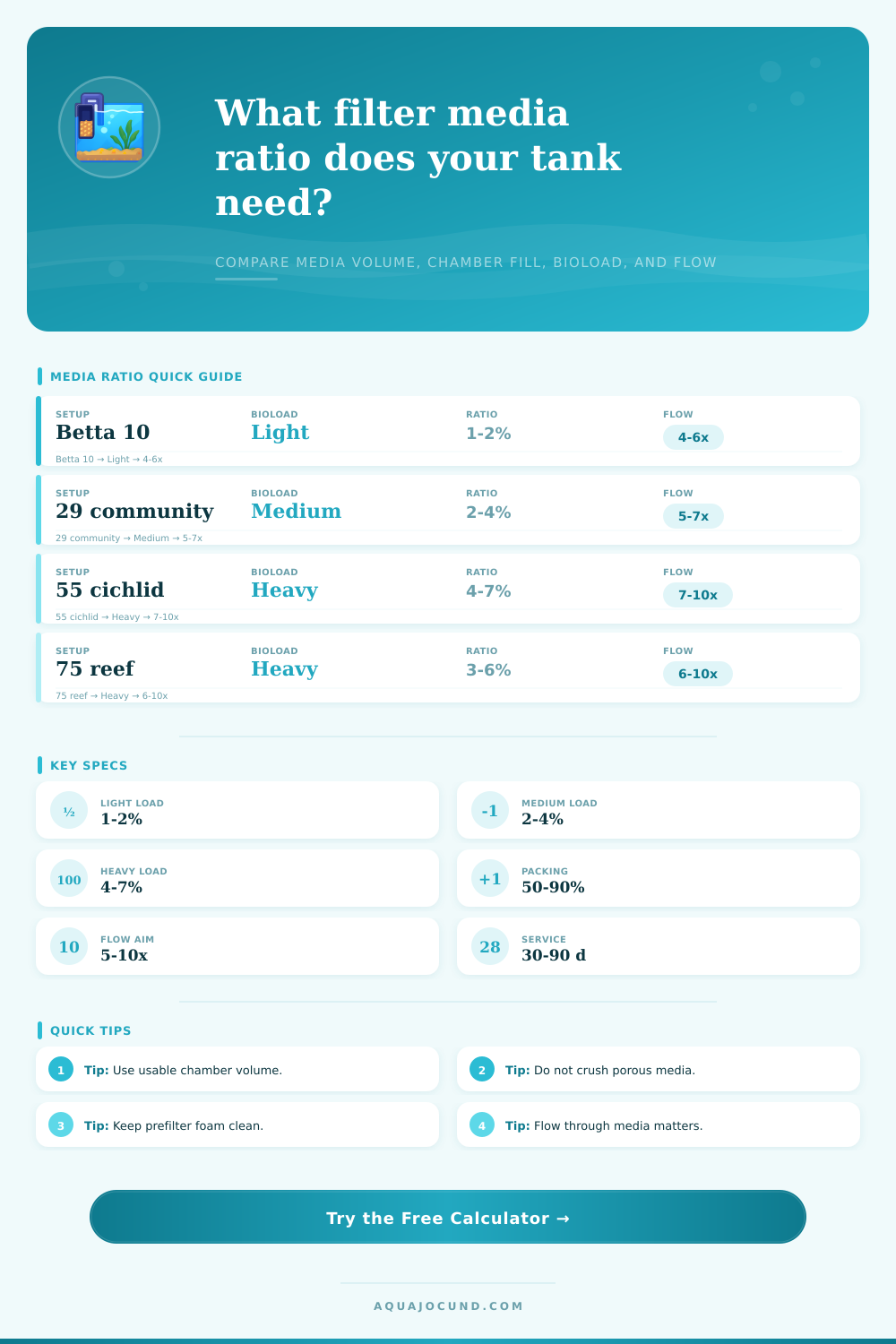
Estimate aquarium filter media ratio from tank volume, usable chamber size, media type, packing density, bioload, flow turnover, replacement interval, and target ratio.
| Media type | Rated area | Useful packing | Practical note |
|---|---|---|---|
| Ceramic rings | 300 m²/L typical | 65-85% | Good all-round choice when water is pushed evenly through baskets. |
| Sintered glass | 700 m²/L typical | 55-80% | High surface area, but needs prefiltration to avoid blocked pores. |
| Pumice / matrix | 500 m²/L typical | 60-85% | Irregular pieces leave useful channels and tolerate moderate debris. |
| Plastic bio balls | 160 m²/m³ typical | 80-95% | Best in wet/dry or trickle areas; lower submerged area per liter. |
| K1 moving bed | 800 m²/m³ typical | 40-60% | Needs aeration and free movement; do not pack as static media. |
| Coarse sponge | 350 m²/m³ typical | 70-95% | Combines mechanical and biological filtration when rinsed gently. |
| Lava rock rubble | 250 m²/L typical | 55-80% | Variable pore structure; rinse dust and avoid compaction. |
| Ceramic block pieces | 900 m²/L typical | 45-70% | Strong surface density, but water must contact the exposed faces. |
| Tank size | Dimensions | Tank volume | 2% media target | 4% media target |
|---|---|---|---|---|
| 10 gallon | 20 x 10 x 12 in / 51 x 25 x 30 cm | 10 gal / 38 L | 0.20 gal / 0.76 L | 0.40 gal / 1.5 L |
| 20 long | 30 x 12 x 12 in / 76 x 30 x 30 cm | 20 gal / 76 L | 0.40 gal / 1.5 L | 0.80 gal / 3.0 L |
| 29 gallon | 30 x 12 x 18 in / 76 x 30 x 46 cm | 29 gal / 110 L | 0.58 gal / 2.2 L | 1.16 gal / 4.4 L |
| 40 breeder | 36 x 18 x 16 in / 91 x 46 x 41 cm | 40 gal / 151 L | 0.80 gal / 3.0 L | 1.60 gal / 6.1 L |
| 55 gallon | 48 x 13 x 21 in / 122 x 33 x 53 cm | 55 gal / 208 L | 1.10 gal / 4.2 L | 2.20 gal / 8.3 L |
| 75 gallon | 48 x 18 x 21 in / 122 x 46 x 53 cm | 75 gal / 284 L | 1.50 gal / 5.7 L | 3.00 gal / 11.4 L |
| 125 gallon | 72 x 18 x 21 in / 183 x 46 x 53 cm | 125 gal / 473 L | 2.50 gal / 9.5 L | 5.00 gal / 18.9 L |
| Turnover through media | Typical result | Contact pattern | When to adjust |
|---|---|---|---|
| 2-4x tank volume per hour | Gentle | Long contact, low polishing | Small fish, shrimp, or low-current tanks. |
| 4-7x tank volume per hour | Balanced | Good oxygen and contact | Community freshwater and many mixed systems. |
| 7-10x tank volume per hour | Strong | High oxygen, shorter dwell | Messier stock or heavy feeding with enough chamber area. |
| 10x+ tank volume per hour | Fast | May bypass compact media | Use larger baskets, diffusers, or parallel chambers. |
| Interval | Media approach | Ratio buffer | Calculation note |
|---|---|---|---|
| 7-21 days | Frequent rinse | Small buffer | Use actual usable volume; avoid replacing all media at once. |
| 30-60 days | Normal service | Moderate buffer | Most calculators should include 10-20% clogging allowance. |
| 60-120 days | Slow service | Larger buffer | Extra media volume helps offset flow loss and pore fouling. |
| 120+ days | Long interval | High buffer | Use strong prefiltration and confirm water still crosses the media bed. |
When it comes to aquarium filters, most people think that bigger is better, if they throw extra filter media into their filters, their water will be clearer, right? Well, not necessarily…biology doesn’t always work like mathematics. While it might seem like a larger sponge would automaticly handle more water, in terms of clean water vs dirty water, it’s often determined by the amount of biological surface area available per unit volume of water.
In other words, there’s often a fine line between crystal-clear water and murky chaos, and it’s all about finding the right balance between resistance (how well water flows through your media) and capacity (the amount of biological surface area available). That’s where this calculator comes in handy. It allows you to compare size of your filter to the size of your tank so you can figure out how to best use usable volume within your media chambers.
How to Choose the Right Filter Size
Your filter boxes is sized by their total volume, not the amount of space they have left for biological growth; something most newbies forget. That’s why tool wants to know about your chamber volume (i.e., what’s left once you subtract mechanical prefilter foam, inlet pipes, baffles, etc.). All that matters is how much can be used well for filtering. If your basket is big, but water just shoots through a small channel without getting soaked in the media, then it doesn’t help. Therefore, we apply an efficiency factor to deal with bypass problems or uneven packing. It shows you reality of your own setup.
The other thing that makes a big difference are packing density. Most folks do this wrong because they think that jamming the basket as full as possible gives them most surface area. The opposite is true. Overpacked baskets provides a pathway of least resistance for water flow, not more contact time. Even porous media (sintered glass, ceramic rings) need some air space; otherwise, there’s no way for the water to get into the pores. Loose media should be between 65-85% full in order for water to go through the pores and bring the nutrients in the water to the home(s) of the bacteria. Pack your media down too far and the water never contact the needed surface area. This causes the bacteria to starve, leading to long-term instability. That small detail can mean a lot.
Finally, one variable that tends to get overlooked until it becomes problematic: flow rate. High turnover rates look good on paper but may in fact impede biological filtration. When water passes through your media too fast, it doesn’t have enough time to break down ammonia into nitrite, and subsequently nitrite into nitrate. To ensure a balanced turnover rate, five to seven times an hour (for most community tanks), the calculator compares your flow against your tank size. This will maintain high oxygen levels while avoiding too much loss of contact time. However, if you run faster than ten times an hour, you typically need to divide your media between several chambers so it doesn’t bypass. Just because something moves quickly doesn’t mean it’s efficient…if the chemical reactions can’t keep pace with water movement.
The ratios is very different when considering bioload; A planted tank with shrimp will generate significantly less waste compared to a single goldfish or a pair of cichlids. You can account for this by choosing your bioload class and adjusting accordingly (i.e., heavier feeders require greater volumes of media to handle their output). Depending off how frequently you feed your livestock, you may have to double your target ratio from two percent to something like five or even six percent to keep up. This isn’t based on your tank’s physical size; it’s based on the amount of stress your fish/other organism place on its life support system.
The design also takes into account frequency of maintenance, i.e., running a filter for 90 days before giving it a good cleaning necessitates increased capacity as the filter gradually gets more clogged with debris. Over time, pores will fill up and flow rate slows down, so adding some additional volume to the media gives you a buffer where you can continue operating normally between services. The buffer saves you time and helps prevent rapid increases in ammonia if maintenance is missed.
Ultimately, filters create space for the unseen workers who keep your water safe. The calculator takes the guessing out of how much space you need. Tuning the flow correctly along with proper placement of the media can remove the need for a huge filter; you only require sufficient volume to accomplish the task at hand, based on the needs of your tank. Good planning makes for clean water, measure to match, fill carefully and let the bugs do their thing. You should of used this sooner.