📅 Filter Media Rotation Schedule Calculator
Plan filter media rinse, replacement, overlap, and biological preservation dates from media type, tank load, flow, and service history.
Filter media rotation result
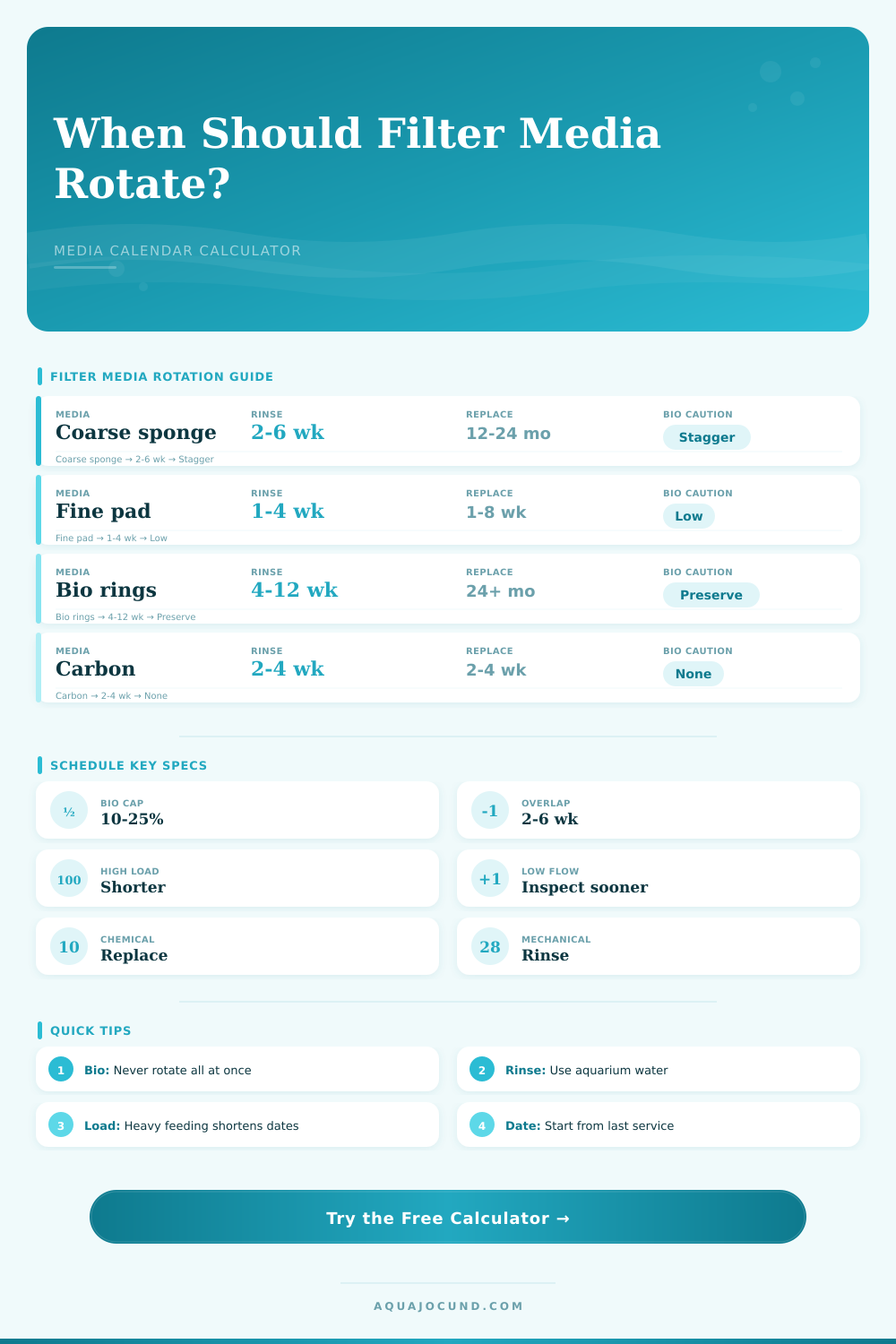
| Media type | Primary role | Base rinse/check | Base replacement | Rotation rule |
|---|---|---|---|---|
| Coarse sponge block | Mechanical plus biological | 30 days | 540 days | Rinse in removed tank water; replace in sections |
| Fine polishing pad | Mechanical polishing | 14 days | 28 days | Rinse or replace when flow drops |
| Filter floss layer | Fine mechanical capture | 7 days | 14 days | Replace frequently; keep biological media untouched |
| Ceramic bio rings | Biological surface area | 60 days | 900 days | Swish lightly; replace 10-20% only when needed |
| Sintered glass bio media | High-surface biological media | 75 days | 1080 days | Preserve mature media and overlap new media |
| Moving bed bio media | Self-cleaning biological media | 90 days | 1440 days | Check movement and debris; avoid bulk replacement |
| Activated carbon pouch | Chemical adsorption | 14 days | 28 days | Replace on schedule or when adsorption demand rises |
| Phosphate-removal resin | Chemical adsorption | 14 days | 21 days | Use measured phosphate trend to shorten or lengthen |
| Peat or botanical fiber | Chemical tint and mild ion exchange | 21 days | 42 days | Rotate by target water effect, not by brand label |
| Tank example | Volume | Typical load | Mechanical interval | Bio media approach |
|---|---|---|---|---|
| Nano shrimp tank | 10 gal / 38 L | Light | 3-6 weeks | Swish sponge gently; avoid replacement |
| Community aquarium | 40 gal / 151 L | Moderate | 2-4 weeks | Replace one section after overlap |
| Planted canister tank | 55 gal / 208 L | Moderate | 3-5 weeks | Keep bio baskets staggered by month |
| Goldfish aquarium | 75 gal / 284 L | Heavy | 1-3 weeks | Protect mature sponge and ceramic media |
| Small pond filter | 300 gal / 1136 L | Seasonal heavy debris | 1-2 weeks | Clean mats in sections, not all chambers |
| Input factor | Calculator effect | Interval impact | Calendar use |
|---|---|---|---|
| Heavy stocking | Multiplies load by 1.25-1.55 | Rinse and chemical dates move earlier | Watch for flow drop and trapped waste |
| Heavy feeding or debris | Multiplies load by 1.20-1.45 | Mechanical media shortens fastest | Use the earlier inspect date |
| Low turnover | Below 4× per hour adds 25% | Earlier inspection and rinse | Do not wait for complete clogging |
| Multiple filters | Reduces rotation pressure slightly | Allows safer staggered work | Service only one filter at a time |
| Chemical exhaustion signal | Adjusts replacement interval directly | Measured rise shortens dates | Replace chemical media rather than rinsing it |
Don’t wash your filter like it’s a dishwasher. That removes good bacteria which will lead to crashes in water chemistry.
If you have a rotation schedule, then it’s a safety net for your livestock. You can’t afford to lose the livig system that makes the water safe.
Why You Should Not Wash All Filter Media at Once
That’s the crux: biological stability vs. This refers to mechanical cleanliness. Mechanical media remove physical detritus. Pads get full, they inhibit flow. They must be attended to frequent.
Media host colonies of nitrifying bacteria. They don’t like attention. You can’t attend to two thing on the same schedule.
For a given tank load, the calculator does the arithmetic for different media types. It separates pad rinse dates from absorbent replacement dates, that maintains an intact biological colony.
How about timing? Maybe your old sponge will do with a delicate swish around in tank water once or twice per month. The ceramic rings in that same canister might last up to two years. Change everything at cleanup time and you restart the biological clock. That’s bad news for the fish and tiring for you.
Using this tool create a staggered calendar that show the difference between sponge and ceramic. Rinse the sponge next week but leave the bio media alone. Swap out some activated carbon two months later (and don’t touch the bio media). Keep the microorganisms alive and water clear.
The tipping point for this balance will depend based off the load of the tank. A planted/low bioload/shrimp tank doesn’t put out much in terms of waste. Filter media might not need changing for months at a time. A heavily loaded goldfish tank, on the other hand, will create lots of organics every day. This mean mechanical media gets clogged quicker and there’s more biological load to service as well.
So the heavy load scenario would of shorten the interval different than the calculator. It tells you that your particular environment is harder on it then an average example. The margin for error is lower so you have to check earlier.
Chemical media also makes things more complex because they operate on a countdown timer. These media such as phosphate resins and activated carbon has only so much capacity for binding molecules. When they’re full, they’re done. They won’t look dirty but will be useless. Carbon isn’t something you can rinse and make useful again. It needs to go.
This is where knowing when to replace it comes into play. This is where knowing when to rinse becomes important. If you don’t know the difference, you waste money and has poor water quality. Think about rinsing a spent bag of carbon while your toxin levels build in your tank.
The trick realy is consistency. Whether you do it on exactly the same days as the calculator says doesn’t really matter. Just make sure you develop a habit.
Remember that the calculator’s output is a baseline under average conditions. You might be overfeeding. Maybe you’re running a light touch, your tank might require more or less frequent maintenance. Use this as your guide but don’t treat it like a law.
Look at the clarity. Feel the flow rate. Smell your media. Is the sponge holding onto foul-smelling sludge? Rinse it sooner. Rinse it sooner. Biological media looks pristine? Leave it be for longer.
Ultimately, you want to maintain your filter and keep it working without disturbing the unseen labor of the filter. Maintaining an aquarium isn’t simply a matter of what’s visible to the eye; it also requires maintaining health that you cannot see.
Your filter is a life support system, not a cleaning device. Protecting your filter by planning for its various types of media lifespan does two things. First, it prevents a sudden crash in your water parameters. Second, it eliminates any worry over having done too much (or too little) during your maintenance cycle. It allow you to be on-plan and keep the bacteria happy.
This quiet reliability is what turns a hobbyist setup into a thriving, long-term ecosystem.