Fertilizer PPM Calculator Planted Tank
Convert a planted aquarium fertilizer dose into ppm per dose, weekly added ppm, post-water-change reset level, and dose needed to reach a target nutrient level.
🌿Fertilizer PPM Presets
📐Tank Volume, Compound, and Dose
Fertilizer PPM Result
⚖Macro and Micro PPM Comparison
🧪Fertilizer Compound Reference
| Compound | Useful fractions | Typical use | Calculator note |
|---|---|---|---|
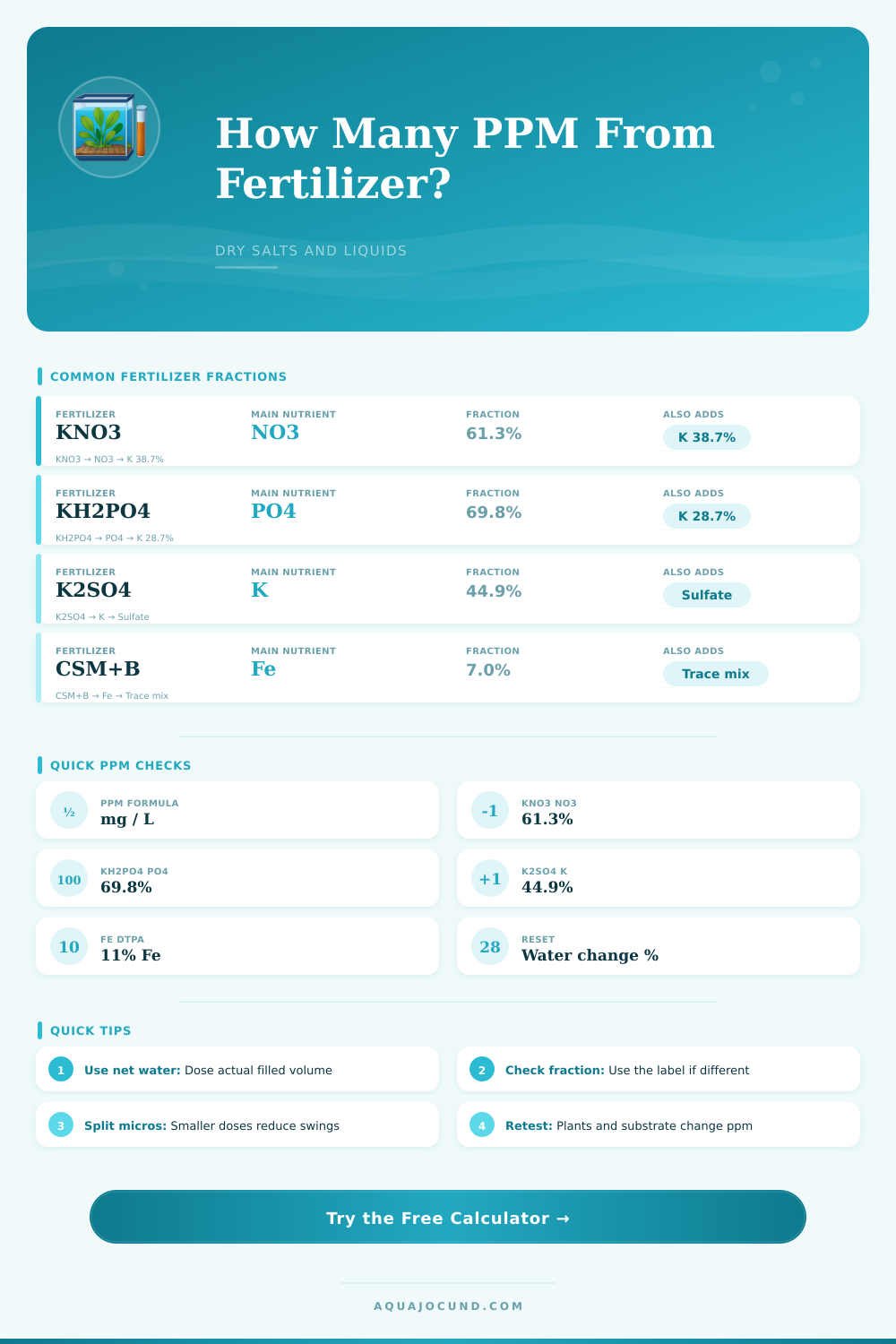
| KNO3 potassium nitrate | NO3 61.3%, K 38.7% | Nitrate plus potassium | Select NO3 or K depending on the ppm being checked |
| KH2PO4 mono potassium phosphate | PO4 69.8%, K 28.7% | Phosphate plus potassium | Good for checking small PO4 doses |
| K2SO4 potassium sulfate | K 44.9% | Potassium without nitrate | Useful when NO3 is already high |
| MgSO4.7H2O magnesium sulfate | Mg 9.9% | Magnesium adjustment | Use Mg as the selected nutrient |
| Calcium nitrate tetrahydrate | NO3 52.5%, Ca 17.0% | Nitrate with calcium | Can be checked as NO3 or Ca |
| CSM+B trace mix | Fe about 7.0% | General trace dosing | Use label data for exact batches |
| Fe DTPA | Fe 11.0% | Iron dosing | Common chelated iron entry |
| Fe gluconate | Fe 12.5% | Iron dosing | Often used for frequent small doses |
📊Target Range Planning Table
| Dosing style | NO3 weekly | PO4 weekly | Micro or Fe approach |
|---|---|---|---|
| Very lean shrimp tank | 1-5 ppm | 0.1-0.5 ppm | Trace at low label strength |
| Low tech planted | 5-10 ppm | 0.3-1 ppm | Small weekly or split micro dose |
| EI lite | 10-20 ppm | 1-2 ppm | Micros 2-3 times weekly |
| High light with CO2 | 15-30 ppm | 1.5-3 ppm | Frequent macro and micro rotation |
| Fish-heavy planted | 0-10 ppm added | 0.2-1.5 ppm | More K and traces, less NO3 |
📏Common Tank Dose Examples
| Tank size | Dimensions | Net volume | 1 g KNO3 adds about |
|---|---|---|---|
| 10 gallon | 20 x 10 x 12 in / 51 x 25 x 30 cm | 38 L | 16.2 ppm NO3 |
| 20 long | 30 x 12 x 12 in / 76 x 30 x 30 cm | 76 L | 8.1 ppm NO3 |
| 29 gallon | 30 x 12 x 18 in / 76 x 30 x 46 cm | 110 L | 5.6 ppm NO3 |
| 40 breeder | 36 x 18 x 16 in / 91 x 46 x 41 cm | 151 L | 4.1 ppm NO3 |
| 75 gallon | 48 x 18 x 21 in / 122 x 46 x 53 cm | 284 L | 2.2 ppm NO3 |
| 125 gallon | 72 x 18 x 21 in / 183 x 46 x 53 cm | 473 L | 1.3 ppm NO3 |
🔢Formula and Conversion Checks
| Item | Formula | Use it for | Common mistake |
|---|---|---|---|
| Dry nutrient mg | grams x 1000 x fraction | Dry salts and powders | Using compound grams as nutrient grams |
| Liquid nutrient mg | mL x mg per mL | Stock or commercial liquids | Entering bottle mL instead of dose mL |
| PPM | nutrient mg / tank liters | All selected nutrients | Using display volume instead of filled volume |
| Water change reset | old ppm x remaining water + source ppm x new water | Weekly accumulation | Assuming every water change resets to zero |
| Target dose | ppm gap x liters / fraction | Finding a needed correction | Ignoring purity or label strength |
Perhaps your goal was to imagine thick growth and colorful displays, only to realize there’s a bit more than meets the eye (and math) to that. Maybe you invest in fancy-fancy bottles of fertilizer. But without knowing how those molecules behave in your water, you’re shooting blind.
The calculator do the math for you. It will spare you the mistake of confusing something’s weight with how much of it is available as a nutrient. It is a subtle difference but one that is critical to both your wallet and health of your plants.
Why Use a Dosing Calculator
The problem with this (and really why all dosing programs are designed) is that there’s a big gap between how much salt you measured out and how much nutrients is absorbed by your plants. When you put a gram of potassium nitrate into your tank, you aren’t actualy adding a full gram of nitrate. There’s also potassium and oxygen riding along for the ride inside that molecule. Those things takes up space but don’t add any weight to nitrogen part of the molecule. So if you’re measuring out your powders based off their overall weight, you’ll end up overdosing.
The tool does this fractional conversion for you. It knows standard ratios of chemicals so you don’t have to remember the molecular weights. And it makes sure when you tell it you want five parts per million of something, it delivers five parts per million of it. It will not be five parts per million of whatever else is in salt you measure.
Another common mistake is tank volume. Manufacturers advertise nominal sizes, but the label on your tank typically won’t reflect its actual water volume. Once you factor in rocks, driftwood, substrate, and area where tubing and filters exist, your actual water capacity will be much less then what the stated size suggests. Dosing for a 30g tank when you really have 25g full of water means every nutrient spike you make will be twenty percent higher than expected.
To close this gap between market size and real-world size, you can enter exact dimensions (or just your own custom net volume). You can switch between rectangular, cylinder, and even bowed front shapes depending on how many tank you have. This helps you get as close as possible to knowing the true amount of water displaced. This helps avoid shock dosing that leads to algae outbreaks and plant melt.
Water changes complicate matters because they reset your baseline every single week. On Tuesday, you could of added enough nutrients to get to twenty parts per million. Yet when you do a fifty percent water change on Saturday, half of all those accumulated nutrients dissapears instantly. The start level in the results section indicate exactly where you start every new cycle of the week. That’s important, very important, for understanding what concentration levels you’re trying to achieve (i.e., your “steady-state” concentration).
If you have some nitrates or phosphates in your source water already, the calculator takes that into account as well. Your doses don’t fight against what’s already there; they complement it. It turns a messy routine from one week to the next into a predictable rhythm of chemicals.
Some nutrients (e.g., macro nutrients such as nitrate and potassium) is consumed faster and need a bigger volume. Others (such as micronutrients and iron) is present only in tiny amounts, so they must be given in exact doses. Too much iron will discolor your water. This is not desirable and may also encourage undesired bacteria. Not enough will just stall the formation of new leaves.
Depending on how heavily dosed your tanks are (i.e., a high intensity planted tank with lots of CO2 vs. A lean shrimp tank), the preset values in the tool assist you in selecting a sensible starting point. Then you can tweak those settings according to purity of the products that you use and dose frequencies.
So what’s the result? There’s no magic number. There’s no need to hit dead-on precision each and every day. Instead, there’s a safe range of dosing that promotes plant growth while minimizing pest issues. A slow adjustment is good; a rapid change in nutrition is stressful. Use moderate amounts, stabilize them, and let the plants adjust over time.
This is how you transition from reactive “why isn’t my tank doing this or that?” troubleshooting to proactive “I can make my tank do this or that!” tank management. Rather than wondering why your stem plants aren’t growing or why your moss has gone black, you know exactly the link between the white stuff on your scale and livig things inside your tank. Math is easy. You have more time to sit back and admire the show instead of fretting over the behind-the-scenes chemistry that makes the show go on.