🌱 Fertilizer Dose Per Water Change Calculator
Estimate planted aquarium fertilizer needed after a water change from remaining nutrients, tap or RO nutrients, target ppm, product strength, dry salts, and split-dose safety limits.
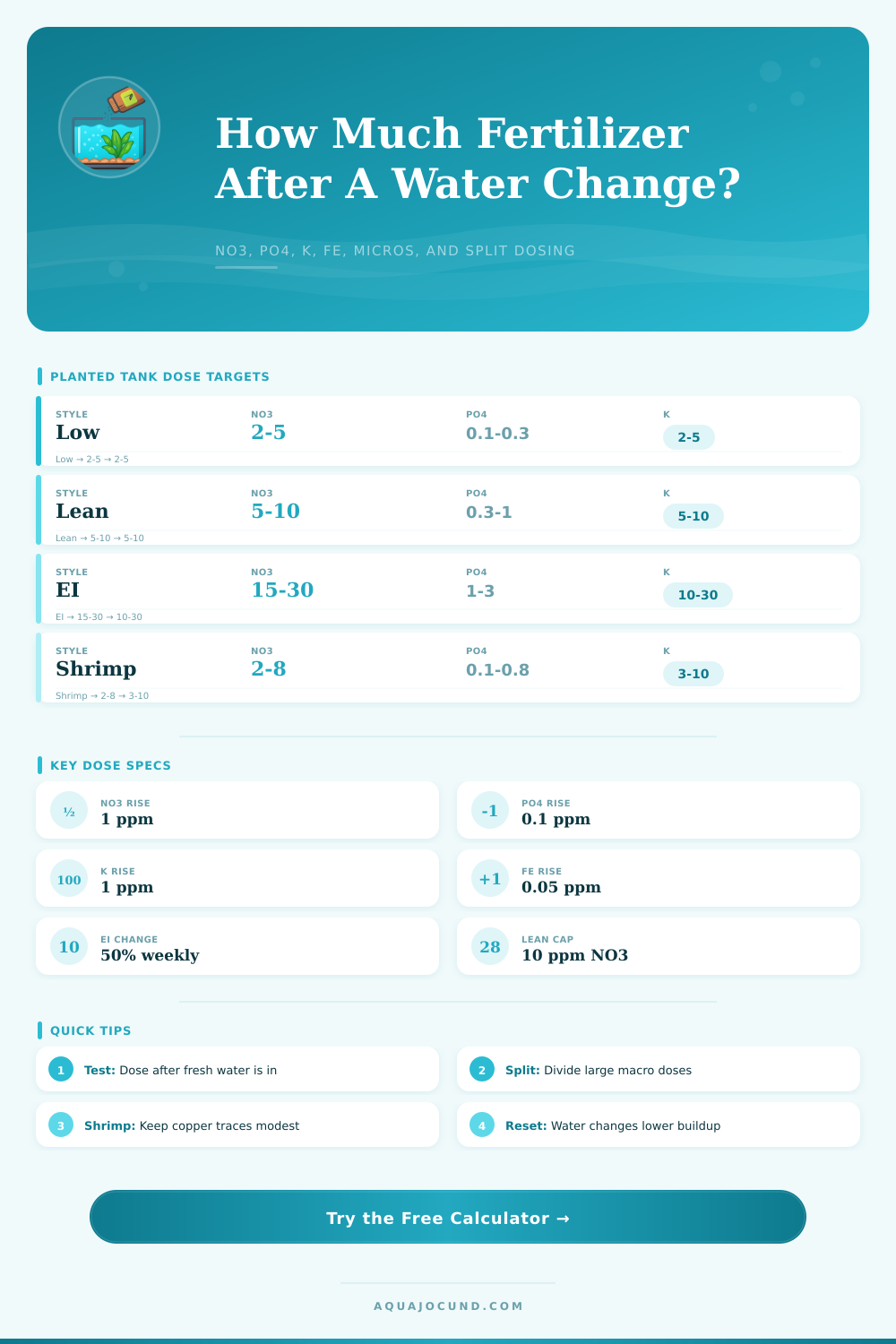
| Strategy | Water Change Reset | Post-Change Target | Best Fit |
|---|---|---|---|
| Low-tech | 20% to 35% weekly | NO3 2 to 5 ppm, PO4 0.1 to 0.3 ppm, K 2 to 5 ppm | Slow tanks, no CO2, modest light, fish-fed systems |
| Lean | 30% to 50% weekly | NO3 5 to 10 ppm, PO4 0.3 to 1 ppm, K 5 to 10 ppm | Controlled growth, aquascapes, shrimp-friendly trimming pace |
| EI | 50% weekly reset | NO3 15 to 30 ppm, PO4 1 to 3 ppm, K 10 to 30 ppm | High light, CO2 injection, heavy stems, rapid recovery |
| Aquasoil | 40% to 70% early | Lower nitrate at first, watch ammonia and phosphate release | New active soil layouts with roots feeding from substrate |
| Profile | 1 ml per 10 gal Adds | Trace Notes | Calculator Use |
|---|---|---|---|
| Complete lean liquid | NO3 0.7, PO4 0.07, K 0.45, Fe 0.004 ppm | Light micros for repeated weekly use | Good first estimate when the bottle is not aggressive |
| Complete EI liquid | NO3 1.5, PO4 0.15, K 1.0, Fe 0.006 ppm | Macro-heavy, usually paired with 50% changes | Use for larger post-change reset doses |
| Macro stock solution | NO3 2.0, PO4 0.20, K 1.3, Fe 0 ppm | No traces included | Pair with a separate micro or iron dose |
| Shrimp-safe complete | NO3 0.35, PO4 0.04, K 0.35, Fe 0.002 ppm | Lower trace intensity | Useful when sensitive invertebrates set the ceiling |
| Dry salts | Calculated from target ppm and tank liters | CSM+B estimate for trace iron | Best when macros need independent correction |
| Before Change | Source Water | Water Changed | Remaining After Change |
|---|---|---|---|
| 20 ppm NO3 | 0 ppm NO3 | 50% | 10 ppm before dosing |
| 20 ppm NO3 | 5 ppm NO3 | 50% | 12.5 ppm before dosing |
| 2 ppm PO4 | 0.2 ppm PO4 | 40% | 1.28 ppm before dosing |
| 0.10 ppm Fe | 0 ppm Fe | 60% | 0.04 ppm before dosing |
| Tank Type | Nutrient Caution | Trace Caution | Water Change Dosing Note |
|---|---|---|---|
| Caridina shrimp planted | Keep nitrate modest and stable | Avoid large copper-containing trace jumps | Use lean targets and small split doses after changes |
| Community fish planted | Moderate nitrate is usually tolerated | Standard complete fertilizers often fit | Credit source-water nitrate before adding more |
| CO2 stem tank | Deficiency shows quickly under strong light | Iron and micros may be dosed on alternate days | Reset macros at water change, then maintain daily |
| New aquasoil layout | Soil may release nitrogen and phosphate | Roots may reduce water-column demand early | Start below normal targets and retest frequently |
Most planted aquarium keepers know this: You see your plants struggling, you grab a syringe and hope for the best. At this point, you stop being a chemist and begins to guess. There’s no need for that. Knowing what’s in your tank after the drain cycle completes will make all the differance between stable growth and an outbreak of algae.
Plants does not care about your schedule. Concentration matters to plants. Replacing half the volume of water leaves behind approximately half amount of nitrate and phosphate compared to the original concentration. Depending on your source water, new tap water can introduces additional factors (i.e., unexpected minerals, residual chlorine). The calculator above do the math after you enter your source water readings and tank volume. It saves you from having to memorize displacement corrections and dilution factor.
How to Feed Your Aquarium Plants Correctly
There are two inputs that matter more than all others: your actual water volume minus the substrate and rock. Unless you’re using a twenty-nine gallon display with no gravel, a twenty nine gallon tank doesn’t hold twenty nine gallons of water. Depending on how deep you bury that gravel, it can be off by as much as ten to fifteen percent each time you make a dose. People ignore this until their nitrates run high or low consistantly. That’s why the calculator asks what percent of your total tank volume is actualy filled with water. It needs to know exactly how many milliliters of liquid touch your leaves and roots.
You must also know what’s coming into the tank from your source water. Reverse osmosis? It contributes nothing. City water? Maybe two parts per million of nitrate. That base affect the target quite a bit. Starting with five parts per million instead of zero means you’ll only need to add fifteen for a goal of twenty parts per million. The calculator gives you credit for that preexisting buffer and won’t let you blindly follow a bottle label and overdose yourself.
But even then, most of your targets are set by dosing style. Moderate, steady levels will support slow growing plants, keep your shrimps safe, and work well with lean (low tech) tanks. Steady, modest doses works for high light and extra CO2 styles where rapid stem growth is supported. There’s also a ceiling to each approach, a point beyond which plants cannot consume before algae gets its chance. Don’t just aim for high numbers because they seem productive; instead, look at the row in the reference table that matches your carbon dioxide and lighting levels. High nitrates in a low-light tank cost money and feed nuisance algae.
The other handy tip, don’t be afraid to split doses if necessary. Large macro doses can overwhelms your plants and cause fast changes that allow bacteria to grow as the plants reacts. Regular small doses keep things steady, and this tool has a way to limit max dose per day (so it can recommend what split makes sense). This will help with micros and iron in particular, which break down rapidly in light, like iron which oxidizes. Often a big dose of iron go bad before plants even have time to absorb any. Splitting up adds an effective way to ensure it’s always available but not so concentrated as to risk toxicity from fast changes.
For example, while dry salt mixtures are accurate and easy to scale, they require an accurate scale for measuring. While liquid mixtures are handy, they can be all over the map different than one brand to another. And following broad suggestions blindly without knowing exactly how much of whatever you’re using leaves you with blind spots. If your bottles has precise labels indicating how many ppm per milliliter, then you can plug those numbers directly into the custom fields as well. That way, you bridge the gap between the world of science and the world of commercial mixtures, and combine them to make a calculated adjustment based off not only on the contents of your tank, but also the actual stuff in the bottle rather than just an approximate estimate.
Water changes maintain water quality and act as resets. They remove buildup of organic matter, add back used trace elements, and provide a fresh start for upcoming week’s growth. Treating water changes as an opportunity to rebalance your nutrient ratios will avoid long term imbalance. For example, potassium may deplete more quickly than nitrate in high bioload tanks, while phosphate might hang around when plants is nitrogen deficient. Monitor these individually instead of presuming a constant ratio to avoid stunting growth or getting brown tips on leaves.
It doesn’t have to be perfect, but it should be consistent. Routine spikes are far worse for plants than a steady dose. After all, once you’ve established your tank’s baseline (including what your source water adds) and your dose amount, it simply becomes routine. There is no more guesswork, only control.
Algae is hungry. The water is clear. Plants is growing.