Fenbendazole Aquarium Dosing Calculator
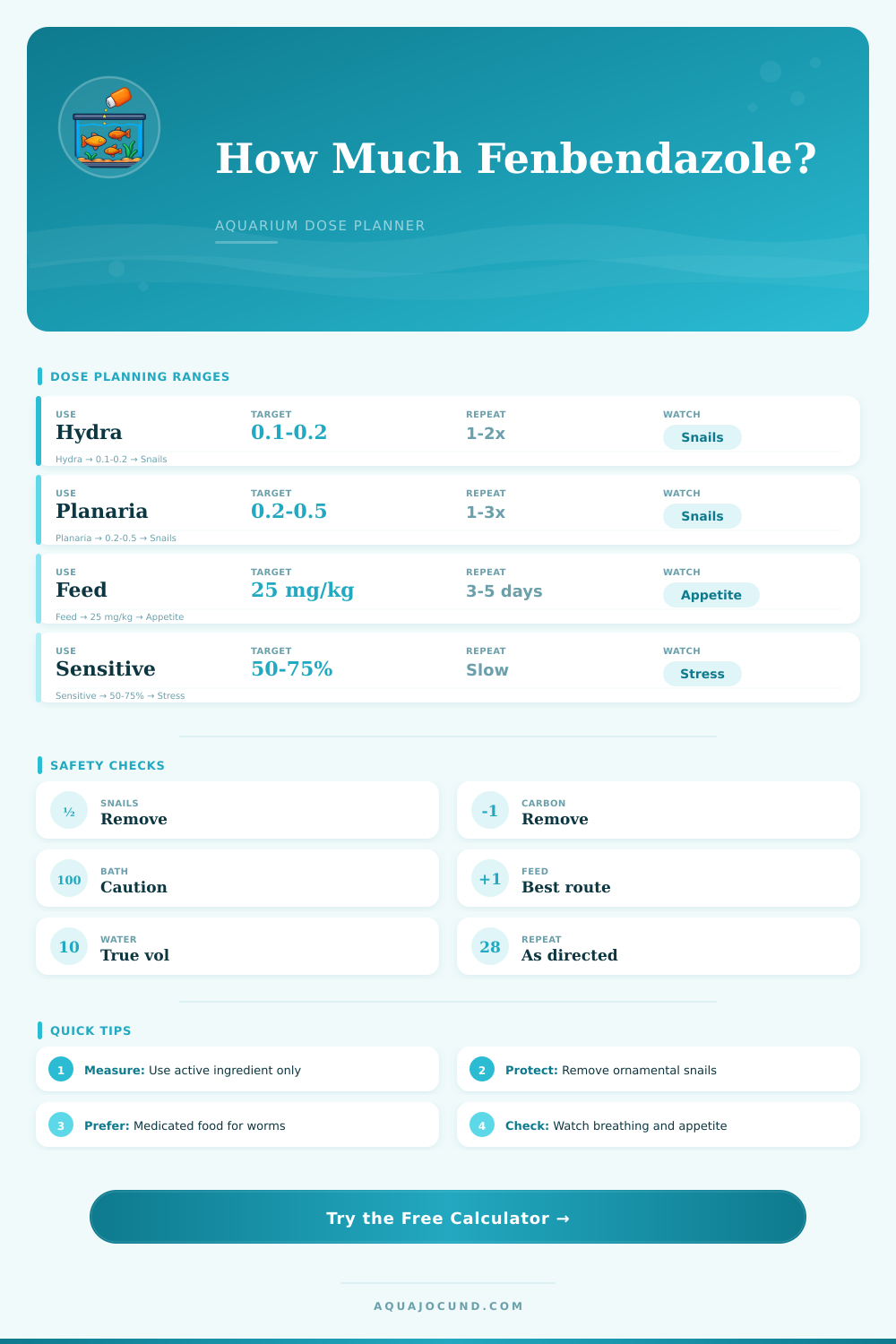
Estimate active fenbendazole, product amount, medicated feed concentration, and redose math from true tank volume or fish biomass.
| Target or route | Calculator field | Best fit | Main caution |
|---|---|---|---|
| 0.1 mg/L bath | Low water-column target | Hydra arithmetic in planted or shrimp tanks. | Ornamental snails may be injured or killed. |
| 0.2-0.5 mg/L bath | Moderate water-column target | Planaria math when the user has a known target. | Bath exposure is not risk-free for fish. |
| 0.59 mg/L example | 0.1 g of 22.2% per 10 gal | Common hobby packet-strength conversion. | It is product math, not a universal prescription. |
| 25 mg/kg feed | Feed dose target | Internal worm feed planning by biomass. | Fish must eat the full medicated ration. |
| Reduced start | 50-75% safety margin | Scaleless fish, fry, weak fish, or unknown tolerance. | Under-dosing may fail while full dosing may stress fish. |
| Product type | Active strength | Measure unit | Conversion used |
|---|---|---|---|
| 22.2% granules | 222 mg/g active | Grams of product | Active mg divided by 222. |
| Pure powder | 1000 mg/g active | Grams of product | Active mg divided by 1000. |
| 10% liquid | 100 mg/mL active | Milliliters of liquid | Active mg divided by 100. |
| 5% liquid | 50 mg/mL active | Milliliters of liquid | Active mg divided by 50. |
| Custom product | User-entered | g or mL selected | Active mg divided by custom strength. |
| Tank | Typical dimensions | Usable water estimate | 0.2 mg/L active example |
|---|---|---|---|
| 5 gal | 16 x 8 x 10 in | 4.0-4.6 gal after decor | 3.0-3.5 mg active. |
| 10 gal | 20 x 10 x 12 in | 8.0-9.2 gal after decor | 6.1-7.0 mg active. |
| 20 long | 30 x 12 x 12 in | 16-18 gal after decor | 12-14 mg active. |
| 40 breeder | 36 x 18 x 16 in | 32-36 gal after decor | 24-27 mg active. |
| 75 gal | 48 x 18 x 21 in | 60-68 gal after decor | 45-51 mg active. |
| Biomass | 25 mg/kg daily active | 2% feed ration | Active per gram feed |
|---|---|---|---|
| 50 g fish | 1.25 mg/day | 1.0 g food/day | 1.25 mg/g feed. |
| 100 g fish | 2.5 mg/day | 2.0 g food/day | 1.25 mg/g feed. |
| 250 g fish | 6.25 mg/day | 5.0 g food/day | 1.25 mg/g feed. |
| 500 g fish | 12.5 mg/day | 10 g food/day | 1.25 mg/g feed. |
| 1000 g fish | 25 mg/day | 20 g food/day | 1.25 mg/g feed. |
Fenbendazole is a medication that is use by many aquarist in the water treatment of flatworms and internal parasite. In order to use fenbendazole, the aquarist must calculate the dose of fenbendazole that will be necessary to treat the affected aquarium inhabitant. The dose calculations depends upon various variable.
Some of the variables that will influence the amount of fenbendazole that is necessary include the volume of the aquarium, the concentration of fenbendazole that the user utilizes, and the weight of fish in the aquarium. Before beginning the fenbendazole treatment, the aquarist must decide whether the aquarist will add the fenbendazole to the aquarium water (also referred to as a bath treatment), or if the aquarist will add the fenbendazole to the food that is provide to the fish (also referred to as a medicated food treatment). The fenbendazole will spread throughout the aquarium water, and is useful in treating parasite that live upon the surfaces of the aquarium.
How to Calculate Fenbendazole Dose for Your Aquarium
By contrast, adding fenbendazole to the food will deliver the fenbendazole directly to the fish, and is useful in treating internal parasites that live within the fish. A dosing calculator can make it easy to compare the two treatments to determine which is the best treatment option for the given aquarium. One of the calculations that must be made prior to adding fenbendazole to the aquarium is the volume of the aquarium.
The volume of the aquarium can be difficult to calculate due to the amount of substrate, rocks, and other aquarium equipment that can displace some of the water in the aquarium. A dosing calculator can account for the water displacement by the aquarium’s inhabitants and equipment. By entering the expected percentage of the aquarium that will be filled with water, and by entering the estimated amount of water that the aquarium’s inhabitants and equipment will displace, the calculator will automatically calculate the amount of liter or gallons of water that will be found in the aquarium.
An incorrect amount of water will lead to either under-dosing or over-dosing of the fenbendazole to the fish. Additionally, the dosing calculator also accounts for the sensitivity of the fish to fenbendazole. While some fish species are more sensitive to fenbendazole than others, some tanks may contain other species that are sensitive to fenbendazole, such as snail or fry fish.
A dosing calculator will account for the sensitivity of the fish by allowing the aquarist to enter the number of gram of fenbendazole that should be provided to the less-sensitive fish species, and automatically calculating the amount of fenbendazole that should be provided to the more-sensitive species. In addition to the volume of the aquarium, the fenbendazole dosage also depends upon the strength of the fenbendazole that is to be utilized. Different fenbendazole products has different concentrations of fenbendazole.
For instance, fenbendazole granule may contain 22% fenbendazole, but fenbendazole powder may contain a higher percentage of fenbendazole. The dosing calculator stores such percentages. It is also necessary to enter whether the fenbendazole is to be measured in gram or in milliliters.
The total weight of a fenbendazole package is not the same as the weight of the active fenbendazole. If the aquarist is to add fenbendazole to the food that is provided to the fish, a different calculation must be used to determine the amount of fenbendazole that should be added to the food. The amount of fenbendazole will be measured in relation to the weight of the fish.
The amount of grams of fenbendazole will be calculated per kilogram of fish in the aquarium. The amount of fenbendazole that can be calculated by entering the total estimated biomass of the fish in the aquarium, and the percentage of the food that is fed to the fish each day. The calculator will calculate the amount of fenbendazole that must be added to the food, based off the amount of food that the fish will consume each day.
In addition to calculating the amount of fenbendazole that will be needed to be added to the aquarium water each day, a dosing calculator can also calculate how much fenbendazole will be needed for the fish to be treated over the entire treatment period. For instance, if the aquarist is to add fenbendazole to the water of the aquarium, water change may be required over time to treat the fish for the parasites. Each water change will lower the amount of fenbendazole that is in the aquarium.
The dosing calculator will calculate the amount of fenbendazole that will be needed for the fish to be treated over time, even with water changes. By contrast, if the aquarist is to add fenbendazole to the food provided to the fish each day, the amount of fenbendazole that is in the aquarium will remain the same, and the calculator will calculate the total amount of fenbendazole that will be needed to treat the fish over time. While the dosing calculator includes variables regarding the volume of the aquarium, the sensitivity of the fish, the concentration of fenbandazole in the product to be utilized, the amount of fenbendazole that must be added to the food to provide the fenbendazole to the fish, and the amount of fenbendazole that will be needed for the fish over time, the dosing calculator cannot account for every variable in the aquarium that may impact the response of the fish to fenbendazole.
Variables including the temperature in the aquarium, the metabolism of the fish, and the presence of live plants in the aquarium may impact the response of the fish to fenbendazole. Therefore, the dosing calculator will provide a starting point for adding fenbendazole to the aquarium, but fenbendazole treatments should be observed to ensure the health of the fish. For instance, the breathing rate of the fish should be observed.
Additionally, the appetite of the fish should be observed. If either the breathing rate or the appetite of the fish change as a result of the fenbendazole treatments, the fenbendazole treatments should be stopped. Thus, while the dosing calculator will help to ensure that fenbendazole is added to the aquarium in an appropriate amount, the fenbendazole treatments also require observation to ensure the health and well-being of the fish in the aquarium.