💨 Evaporative Fan Temperature Drop Calculator
Estimate aquarium fan cooling from tank surface area, airflow, room humidity, target drop, evaporation volume, BTU removal, and refill planning.
✅ Evaporative Cooling Results
| Fan Exposure | Useful Airflow | Evaporation Response | Best Calculation Use | Watch Point |
|---|---|---|---|---|
| Clip-on surface fan | Small directed stream | Fast over a local patch | Nano and small display tanks | Uneven surface coverage |
| Open rim fan across tank | Broad sweep over water | Balanced cooling and refill | Most open-top aquariums | Room humidity buildup |
| Canopy exhaust fan | Pulls humid air out | Moderate if intake is open | Canopies and partial lids | Blocked makeup air |
| Sump or refugium fan | Hidden cooling zone | Steady when sump is open | Reef systems and stands | Stand humidity and salt creep |
| Wide crossflow | Even sheet of moving air | High area efficiency | Rimless and shallow tanks | Higher refill demand |
| Wet-dry or splash airflow | Air plus wetted media | Very strong evaporation | Filter chambers and weirs | Rapid top-off drawdown |
| Tank | Dimensions | Surface Area | Typical Fan Airflow | Daily Evaporation Range |
|---|---|---|---|---|
| 5 gal nano | 16 x 8 x 10 in / 41 x 20 x 25 cm | 0.9 ft² / 0.08 m² | 10 to 25 CFM | 0.03 to 0.15 gal |
| 10 gal rectangle | 20 x 10 x 12 in / 51 x 25 x 30 cm | 1.4 ft² / 0.13 m² | 15 to 35 CFM | 0.07 to 0.25 gal |
| 20 long | 30 x 12 x 12 in / 76 x 30 x 30 cm | 2.5 ft² / 0.23 m² | 25 to 55 CFM | 0.15 to 0.50 gal |
| 40 breeder | 36 x 18 x 16 in / 91 x 46 x 41 cm | 4.5 ft² / 0.42 m² | 35 to 80 CFM | 0.25 to 0.90 gal |
| 75 gal display | 48 x 18 x 21 in / 122 x 46 x 53 cm | 6.0 ft² / 0.56 m² | 50 to 110 CFM | 0.40 to 1.40 gal |
| 125 gal display | 72 x 18 x 21 in / 183 x 46 x 53 cm | 9.0 ft² / 0.84 m² | 80 to 160 CFM | 0.70 to 2.30 gal |
| Room RH | Fan Cooling Potential | Target Drop Check | Evaporation Signal | Calculation Note |
|---|---|---|---|---|
| 30% to 40% | High | 3 to 6°F often possible | Refill rises quickly | Wet-bulb gap is large |
| 40% to 55% | Moderate to high | 2 to 5°F is realistic | Daily top-off likely | Common indoor range |
| 55% to 70% | Moderate | 1 to 3°F is safer | Less water loss | Humidity limits cooling |
| 70% to 85% | Low | Small drop only | Slow evaporation | Vent room air first |
| Above 85% | Very low | Target may not happen | Surface stays damp | Wet-bulb limit is tight |
Summer brings warm water and low oxygen levels. When the water warms, fish seems less active. Solutions include using a chiller (electricity guzzler) or clipping a fan to the rim of your tank (evaporative cooling).
Evaporative cooling depends on evaporating water, which will cool the water. Why does this work? Because water evaporating from the surface absorbs heat from the water column. Because it’s quieter and much cheaper than a chiller.
How Evaporative Cooling Works for Fish Tanks
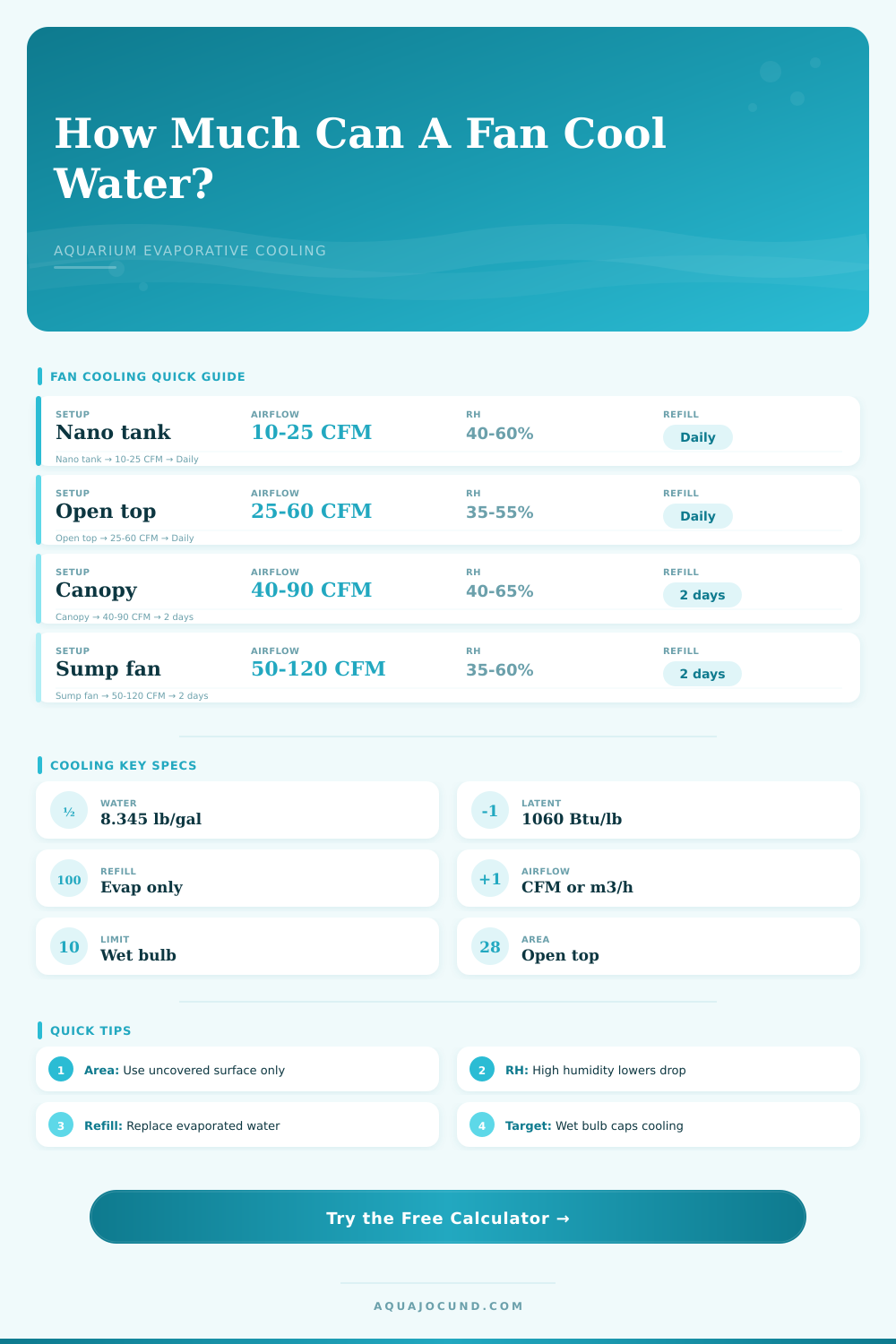
What’s the catch? It only works if you know why it works. The biggest thing to remember is to know what you’re measuring. Everyone assumes that the fan pushes cool air INTO the tank. Wrong! What the fan do is sweep moist air off the surface and replace it with drier room air. As water evaporates off the surface, it takes energy. In fact, it takes 1060 BTUs for each pound of water to evaporate. Where does that come from? It comes from the water column. The fish are okay, they just get cooler water.
Once you enter the open surface area of your tank, the calculator do all the math for you (above). All you have to do is provide it with actual amount of airflow hitting that water. No more guesswork when trying to account for hidden losses and coefficients. With this information you should of be able to trust the output…but then you have to look at your room.
Evaporative cooling isn’t effective in humid environments. In fact, there’s nowhere for the water to go if the air is already saturated with moisture. The phase change ceases. That’s why the tool requires your rooms relative humidity. Anywhere north of seventy percent will pose a challenge for you. To get any sort of real temperature drop, you’ll need to ventilate the room itself. Sure, you could blow some air across your tank all day long. But if the air coming off the surface is as wet as the air going into it…you won’t notice much difference in temp. It’s a thermodynamic limit.
Don’t forget: Volume isn’t everything. Surface area matter as well. Sure, a 50g tank is going to hold a lot of water. But the shape matters too. Most of its surface area is underwater. It shows almost no surface area to the air. That 50g breeder tank sitting next to it? Same amount of water but it sits flat on your table. That big ol’ piece of glass is exposed to the air. That’s where the fan can work best. The calculator takes this into account.
It doesn’t evaporate under there, the evaporation occurs at the surface. Not down below in the depths. I could have a thousand gallon tank with a lid on it. In that situation, a fan won’t help me one bit. The water must be exposed. You may have to prop open the canopy or install an exhaust fan pulling humid air out. Either way, the air flow needs to pass over the water. It shouldn’t spin around in a circle inside a closed box.
The expense is here, planning refills. For every degree you cool, you lose water. How much? The calculator give an estimate. This keeps your low-water sensor from waking you up at three in the morning. To make up for the evaporation, you must top off using fresh water. That’s especially important if you’re running a saltwater system. Water evaporates, leaving salt in the tank. Allow your tank to go down too far and you’ll need to correct the salinity (and that stresses your livestock). The tool sizes your top-off reservoir. It also assists you with planning when to refill it. It’s not just about cooling but about logistics.
Are you willing to give away water to keep yourself comfortabley? But there’s a limit to that method. The water cannot be cooled any lower than the ambient wet-bulb temperature in the room. It’s a physical constant. So if you live in a hot humid room, using a fan won’t help much. At best it’ll reduce the temp two or three degrees. Sometimes that’s all that’s required to maintain safety. It isn’t going to transform a tropical tank into a coldwater tank. Don’t hold out for miracles. Hold out for consistent heat reduction provided you have airflow.
Also remember that the air needs to be dry to keep you safe. Evaporative cooling uses simple physics, so you don’t have to use fancy equipment. You only need water, air flow, and a way to regulate humidity. The math comes from the calculator. What about everything else? That’s simply making sure there’s airflow and wetting the tank. How you achieve that won’t matter to your fish. All they’ll know is the water isn’t boiling, which they’ll thank you for.