💧 Evaporation Rate By Surface Area Calculator
Estimate aquarium water loss from exposed surface area, temperature, humidity, air movement, lid coverage, sump area, and skipped top-off concentration.
| Water profile | Typical salinity | Typical TDS | Concentration concern |
|---|---|---|---|
| Soft freshwater planted | 0.1 to 0.3 ppt | 80 to 250 ppm | Mineral swing matters for sensitive shrimp and plants |
| Hardwater livebearer | 0.3 to 0.8 ppt | 250 to 600 ppm | Hardness rises if top-off is delayed |
| African cichlid mineralized | 0.6 to 1.2 ppt | 500 to 900 ppm | Watch steady mineral creep between water changes |
| Blackwater low TDS | 0.0 to 0.1 ppt | 20 to 120 ppm | Small water loss can be noticeable in very soft systems |
| Low brackish | 3 to 8 ppt | 5,000 to 12,000 ppm | Top-off errors shift salinity quickly |
| High brackish | 10 to 20 ppt | 15,000 to 28,000 ppm | Daily freshwater top-off is often needed |
| Reef aquarium | 34 to 36 ppt | 35,000 ppm | A 2 to 3% concentration rise is worth correcting |
| Marine fish only | 31 to 35 ppt | 32,000 ppm | Salinity rises because salt does not evaporate |
| Condition | Factor range | Typical setup | Calculator effect |
|---|---|---|---|
| Still air plus calm surface | 0.64 to 0.85x | Covered planted tanks | Lower surface exchange |
| Normal room plus return ripple | 1.00 to 1.12x | Most community aquariums | Baseline estimate |
| Open top with draft | 1.15 to 1.29x | Rimless display near airflow | Moderate increase |
| Cooling fan and ripple | 1.45 to 1.62x | Summer fan cooling | High daily top-off demand |
| Reef waves and overflow | 1.35 to 2.09x | Open reef with sump | High gas exchange and evaporation |
| Dry room correction | 1.08 to 1.18x | Winter heat or dehumidifier | Boosts vapor pressure deficit impact |
| Tank size | Display surface | Nominal volume | Typical weekly evaporation |
|---|---|---|---|
| 10 gallon | 20 x 10 in / 1.39 ft² | 10 gal / 38 L | 0.2 to 0.6 gal with lid, normal room |
| 20 long | 30 x 12 in / 2.50 ft² | 20 gal / 76 L | 0.6 to 1.3 gal open top |
| 29 gallon | 30 x 12 in / 2.50 ft² | 29 gal / 110 L | 0.7 to 1.5 gal with warmer water |
| 40 breeder | 36 x 18 in / 4.50 ft² | 40 gal / 151 L | 1.1 to 2.4 gal rimless |
| 55 gallon | 48 x 13 in / 4.33 ft² | 55 gal / 208 L | 0.8 to 2.0 gal depending on canopy |
| 75 gallon | 48 x 18 in / 6.00 ft² | 75 gal / 284 L | 1.7 to 4.5 gal with sump and fans |
| 125 gallon | 72 x 18 in / 9.00 ft² | 125 gal / 473 L | 2.5 to 6.5 gal open display |
| Water and room condition | Vapor pressure deficit | Evaporation tendency | Planning note |
|---|---|---|---|
| 76°F water, 72°F room, 70% RH | About 0.9 kPa | Low | Humid rooms slow evaporation |
| 78°F water, 72°F room, 50% RH | About 1.8 kPa | Moderate | Good baseline for many homes |
| 80°F water, 70°F room, 35% RH | About 2.6 kPa | High | Dry winter air increases top-off |
| 82°F reef, 76°F room, 45% RH | About 2.2 kPa | High | Warm reefs with sumps lose more |
| Fan-cooled surface | Same VPD, higher exchange | Very high | Fan speed changes daily water loss |
Aquariums loses water rapidly. People notice there is less water in their tanks. On Saturday they might top off a tank. By Tuesday it’s down again. Why? It is not due to leaks, but because water molecules escapes into the atmosphere. What causes this? Airflow, humidity, temperature, and surface area do. Unless you understand these variables, most folks are just guessing at how much water to replace. Evaporation leads to over-salting and damaged sensitive equipment. Knowing what to expect prevent both.
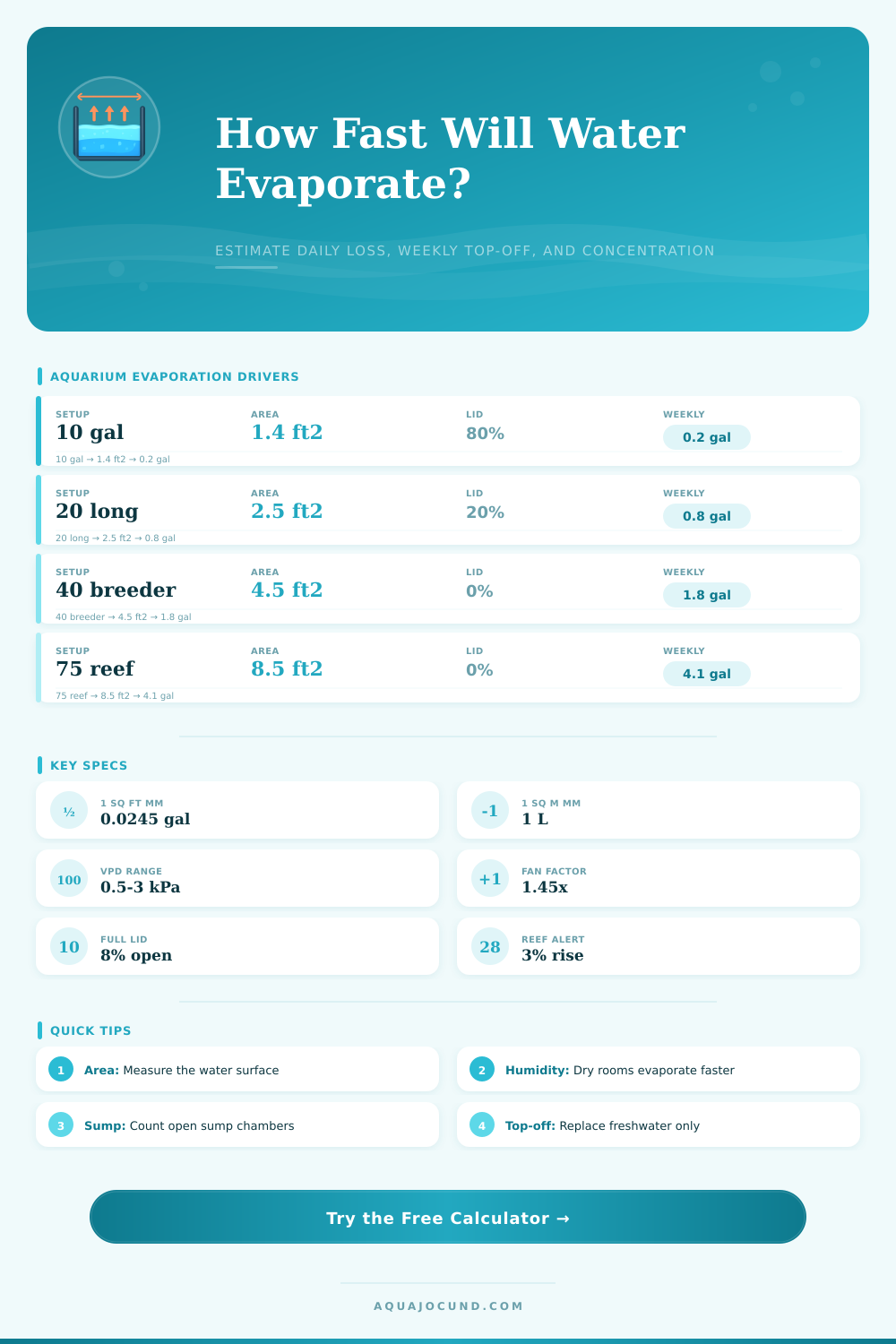
Surface area is most important. It is about how much water covers the surface. It is not about how deep the water is. For instance a 40g wide tank loses more water per day different than a 30g cube that’s as high as that same 40. Use a calculator and plug in your size, and let it do the math for you. No need to guess coefficient. It even factors in lids.
Why Aquariums Lose Water
Even if your tank has a lid it doesn’t really seal the tank because there is filter intakes and other things like feeding slots. Mesh lids block out debris but don’t stop vapor pressure. Evaporation increase with air flow, A still air layer retards evaporation. Drafts/fans remove this layer continuously. Reef tanks equipped with wavemakers requires regular (daily) top-offs during the summer months. Agitation speeds up gas exchange, which is good, but it also speeds up the rate of evaporation, which is bad. The faster your gas exchange, the more rapid water will evaporate. Using a cooling fan to reduce tank temps? Expect evaporation to skyrocket accordingly. That’s the price of thermal management.
Water evaporation is where chemical stability gets dicey. As water goes up into the atmosphere as pure water vapor, dissolved ions (minerals & salts) is left behind. Because there’s no change in mass, but volume decreases, concentration increase. That’ll raise the hardness a little in your freshwater tank, something that shouldn’t of hurt shrimp temporarily. In your saltwater tank, a couple percent increase in salinity will stress corals. It’ll also affect how fish balance their fluid. The tool gives an estimate for top-off concentration after you skip a few days. While three days might not harm anything in spring, it could spell trouble if it’s winter and the air humidity are low.
Most people forget about the sump and how complex it make things. If you have an open sump, it can expose almost as much surface area to the air as the main tank. In that case, water will be leaving from both sources at the same time. You think there’s a leak in the main tank but it’s actualy water leaving through the sump. When calculating your top-off system, make sure you account for the entire area of the sump, including the part below the water line.
Accurate measurement of variables require work but it’s worth the effort. Mark the glass with a ruler and note how much it drops over forty-eight hours. Record parameters and put them into the model. Does the math match the estimate? If you calculate a weekly loss of a single gallon yet find two gallons missing, inspect airflow paths and humidity settings. Dry rooms with active dehumidifiers will pull water from any open surface aggressively. They won’t prevent evaporation; that’s impossible in an open system. Rather than stopping it, you’re managing the results of that loss. Steady, stable water and consistent chemistry foster thriving aquatic life. Knowing what causes daily losses begin a process of planning rather than guesswork.