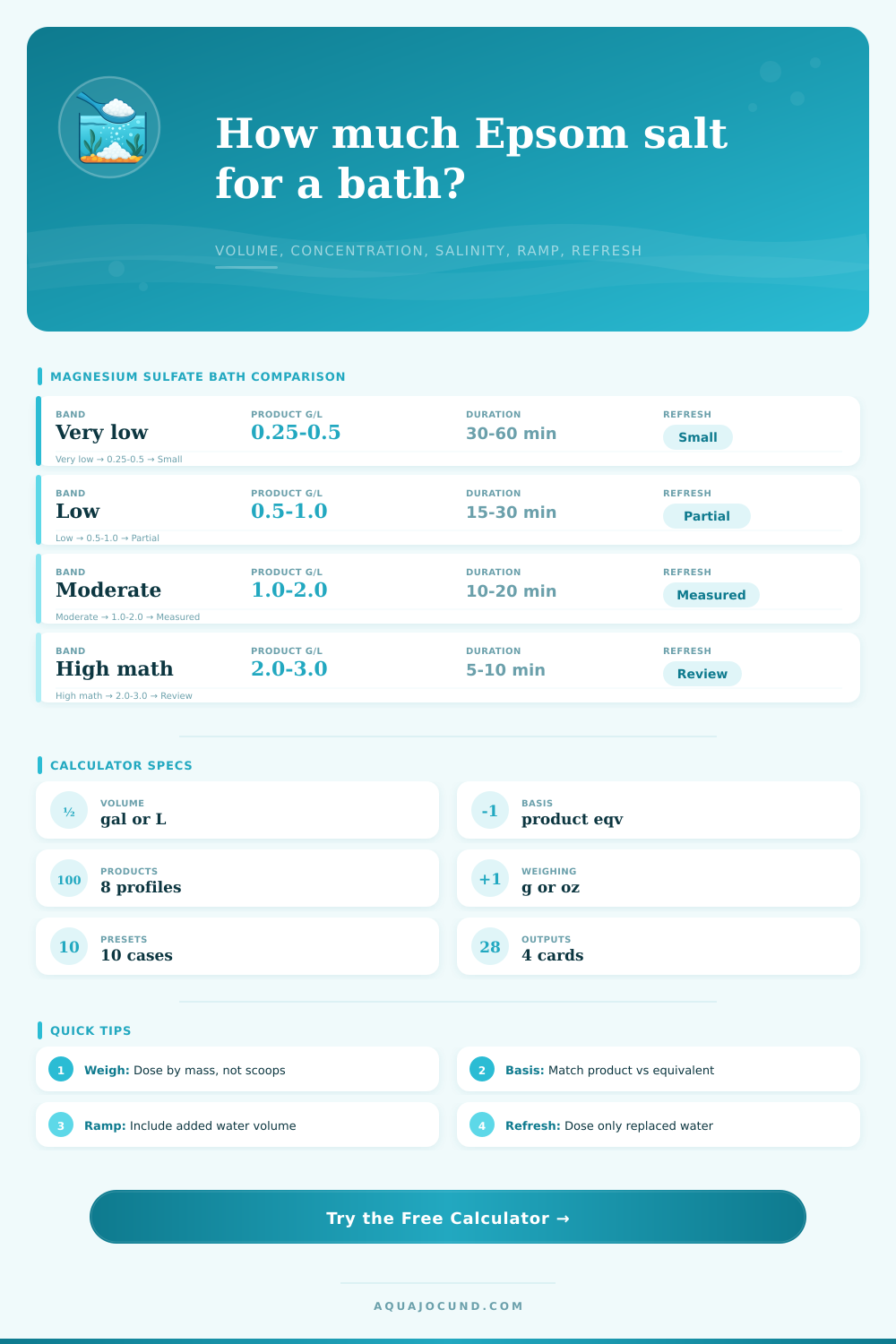
Epsom Salt Bath Dose Calculator
Size magnesium sulfate bath mass from water volume, target concentration, current salinity, weighing unit, duration preset, ramp water, sensitivity class, and refresh redose math.
🎯Quick Presets
⚙Calculator Inputs
📊Bath Concentration Comparison Grid
⚗Magnesium Sulfate Product Grid
🧪Product Profile Table
| Product profile | Calculator purity | Equivalent basis | Notes for math |
|---|---|---|---|
| Plain Epsom salt hydrate | 99% | MgSO4·7H2O | Default product-mass profile for household crystals. |
| Aquarium-grade MgSO4 hydrate | 98.5% | MgSO4·7H2O | Use label purity if supplied by the product. |
| Food-grade MgSO4 hydrate | 99.2% | MgSO4·7H2O | Similar hydration math with a slightly higher active fraction. |
| Lab heptahydrate | 99.5% | MgSO4·7H2O | High-purity profile for precise protocol calculations. |
| Anhydrous MgSO4 | 97% | MgSO4 | Requires less mass than heptahydrate for the same equivalent. |
| 90% premix | 90% | Label active fraction | Premix dose is adjusted upward by active percentage. |
| Damp crystals | 92% | Moisture adjusted | Moisture lowers active concentration by mass. |
| Custom | Entered value | User defined | Use when the label gives a known assay or purity. |
📏Common Bath Volumes
| Bath container | Working volume | Product for 0.5 g/L | Product for 1.0 g/L |
|---|---|---|---|
| Small specimen cup | 1 L / 0.26 gal | 0.5 g / 0.02 oz | 1.0 g / 0.04 oz |
| Nano dip tub | 4 L / 1.1 gal | 2.0 g / 0.07 oz | 4.0 g / 0.14 oz |
| 2.5 gal bucket fill | 8.5 L / 2.2 gal | 4.3 g / 0.15 oz | 8.5 g / 0.30 oz |
| 5 gal bucket fill | 17 L / 4.5 gal | 8.5 g / 0.30 oz | 17 g / 0.60 oz |
| 10 gal hospital tub | 34 L / 9.0 gal | 17 g / 0.60 oz | 34 g / 1.20 oz |
| 20 gal measuring tub | 68 L / 18 gal | 34 g / 1.20 oz | 68 g / 2.40 oz |
🔄Refresh Redose Examples
| Target product concentration | Refresh volume | Replacement concentration | Pure product redose |
|---|---|---|---|
| 0.5 g/L | 5 L / 1.3 gal | 0 g/L | 2.5 g |
| 1.0 g/L | 10 L / 2.6 gal | 0 g/L | 10 g |
| 1.5 g/L | 15 L / 4.0 gal | 0.5 g/L | 15 g |
| 2.0 g/L | 20 L / 5.3 gal | 1.0 g/L | 20 g |
⏱Duration And Sensitivity Planning
| Sensitivity class | Review concentration | Review duration | Calculator role |
|---|---|---|---|
| Conservative review | Above 0.5 g/L product | Above 10 minutes | Flags cautious protocol checks. |
| Standard protocol math | Above 1.0 g/L product | Above 15 minutes | Default separate-bath planning class. |
| Hardy fish planning | Above 2.0 g/L product | Above 20 minutes | Wider review limits for written protocols. |
| Brackish-tolerant planning | Above 3.0 g/L product | Above 30 minutes | For systems already managed around salinity. |
| Invertebrate or plant exposure | Above 0.25 g/L product | Above 5 minutes | Strict review flag for non-fish exposure math. |
When treating fish in a quarantine tank, how do you know if there’s too little or too much salt? You’ve probably asked yourself this question before. It’s something many of us experience when using a therapeutic bath.
Precision matter more than guess work. Too much salt can cause extra stress to an animal while not enough will mean it won’t help as effectivey.
How to Measure Salt for Fish Treatment
Magnesium sulfate. Or Epsom salt (sounds harmless), but biology is all about concentration gradients. Getting the math correct helps regulate salt balance whereas getting it incorrect causes undue stress on ill or parasitic animals.
Once you know your target concentration and volume of your treatment tub, the calculator does all the complicated math for you. You don’t have to convert ounces per gallon to grams per liter or figure out how different weights of different hydrates affect things. And it will save you from underestimating actual amount of water in your treatment tub. I see most folks do that. If you fill a five-gallon bucket to the brim and then add another two gallons during the ramp-up phase, your total volume changes significant. When you introduce an additional two gallons of fresh water when you are acclimating your fish during the ramp-up phase, that’s going to change your total volume quite a bit. You won’t get the same concentration as what you were trying for if you didn’t compensate by adjusting dose.
The ramp-in volume is taken into account automatically by the tool and your final concentration will be what you set at the beginning.
What about the product profile? Turns out that’s also important and not something you want to get wrong. Typically, standard Epsom salts found around the house are magnesium sulfate with seven water molecule per molecule of salt. Aquarium supplement products (like those intended for use in labs) is frequently dry magnesium sulfate, which has no water weight at all. By mass, anhydrous magnesium sulfate weighs less but contains a greater percentage of the active ingredient. They may say on the bottle “it’s just magnesium sulfate.” However, using it unaltered as a substitute will result in overdosing or underdosing, depending on whether you used proper coefficient for its molecular weight.
To avoid this error, you can choose which product type you’re using and the calculator will apply the proper factor for both purity and hydration. That way when the bottle says “just magnesium sulfate,” you won’t accidentally dump the entire cup in.
The other variable that is often ignored are duration. If you only want a short (five minute) dip, then the concentration has to be greater than if you plan on soaking for half an hour. Soaking for longer times at high concentrations can lead to osmotic shock where the fish body must work overtime to keep itself balanced. On the flip side, weak concentrations for short times will have no effect besides confusing the animal. Time needs to be matched with intensity.
This is where the sensitivity classes built into the tool comes into play. They will flag a proposed regime as being too harsh for more delicate species, such as sensitive tropical fish and invertebrates. In other words, it’s a safety check against your own enthusiasm.
Adding new water to the bath mid-treatment is another problem in itself. Siphoning out the old water and replacing it with clean water also dilutes the residual magnesium sulfate. Without adding additional salt, you will drop the concentration down to non-therapeutic amounts. This means calculating how much salt to add back in. However, once you understand the redose calculation, you discover it’s not so bad…though you’ll need to redose when refreshing part-way through.
Each time you perform a partial refresh, you change the chemistry entirely, and doing nothing about it makes an exact science into a roll-of-the-dice water-changing event. You should of performed the refresh math to ensure the bath maintains a constant environment over the full treatment window.
Finally, knowing exactly what’s in that bucket increases confidence in your treatment. You won’t have to worry about whether you did too much. “Did I do enough?” because you’ve measured it. No more worry for either you or the fish. When you know exactly how much is in there, you can concentrate on watching the animal and not wondering if you guessed correctly on your mix. Knowing exactly how many grams go in that particular volume of water makes standing back with a handful of crystals seem less scary. This is a careful process instead of a risky guess which is exactly what sick animals require.