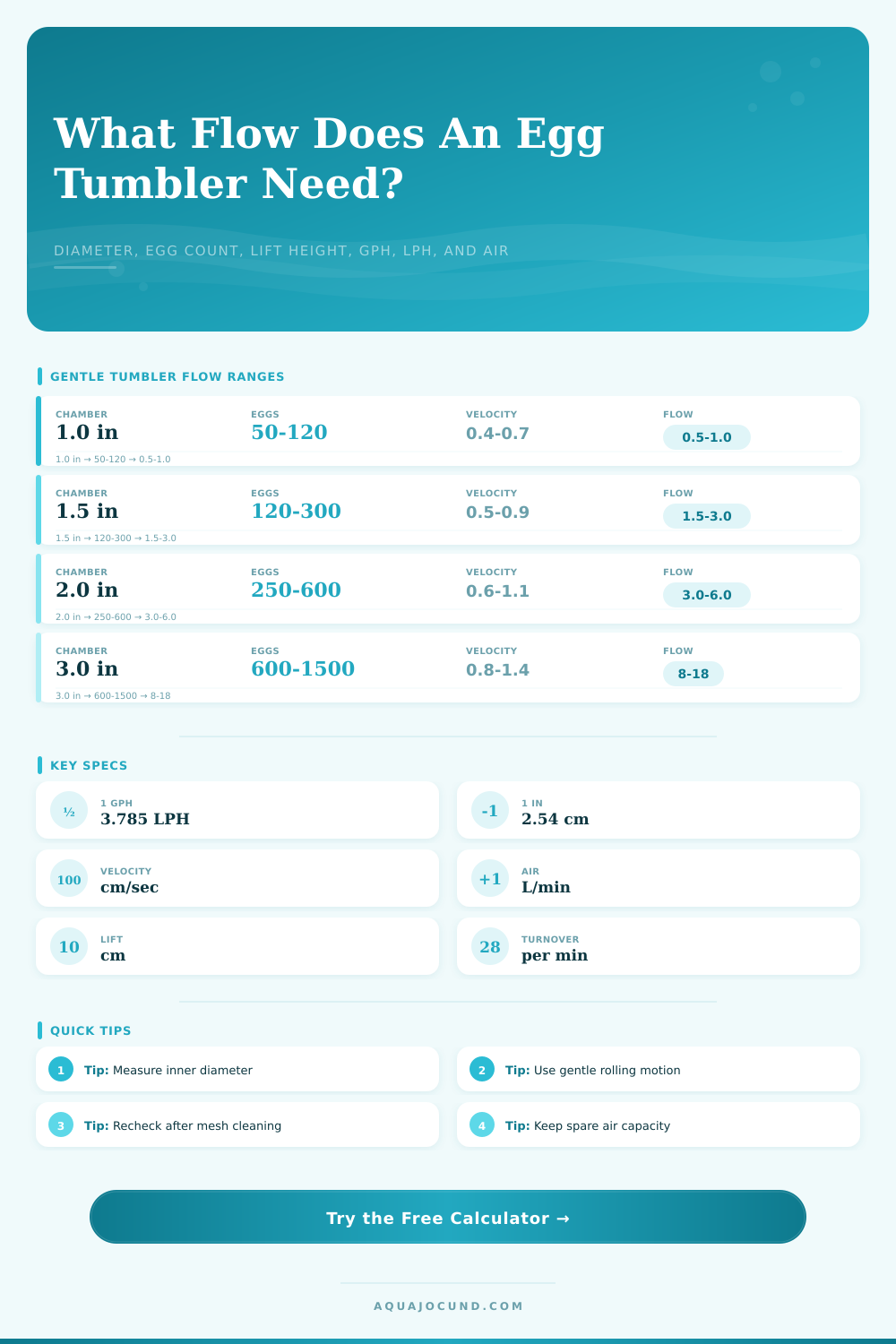
🥚 Egg Tumbler Flow Rate Calculator
Estimate gentle water flow, air pump output, chamber velocity, lift height, and turnover from tumbler diameter, egg count, egg size, and diffuser settings.
Flow Breakdown
| Egg motion profile | Default egg diameter | Target velocity | Lift behavior used by calculator |
|---|---|---|---|
| Very fine eggs, low lift | 1.0 mm | 0.45 cm/sec | Soft water rise, low bed expansion |
| Fine eggs, gentle rolling | 1.4 mm | 0.60 cm/sec | Slow continuous movement without hard suspension |
| Medium eggs, normal rolling | 1.8 mm | 0.85 cm/sec | Balanced rolling across common small tumblers |
| Large eggs, broad tumble | 2.6 mm | 1.10 cm/sec | More lift for larger diameter batches |
| Dense batch, higher lift need | 2.0 mm | 1.30 cm/sec | Extra velocity to overcome crowded contact |
| Fragile batch, soft motion | 1.6 mm | 0.50 cm/sec | Reduced velocity and lower motion multiplier |
| Separated non-adhesive batch | 1.7 mm | 0.75 cm/sec | Even rolling after clump removal or sorting |
| Diffuser profile | Water moved per 1 L/min air | Pressure factor | Best calculation use |
|---|---|---|---|
| Fine air stone | 22 LPH | 1.12 | Fine bubbles with modest air lift efficiency |
| Medium air stone | 28 LPH | 1.00 | General small tumbler baseline |
| Coarse air stone | 34 LPH | 0.92 | Higher lift with larger bubbles |
| Open rigid airline | 38 LPH | 0.88 | Simple vertical bubble column |
| Centered uplift tube | 48 LPH | 0.80 | Most efficient air-assisted flow path |
| Mesh plate diffuser | 25 LPH | 1.15 | Broad bottom spread with more resistance |
| Sponge guarded inlet | 20 LPH | 1.25 | Protective restriction and slower draw |
| Low pressure manifold | 30 LPH | 1.05 | Shared airline with valve tuning |
| Chamber size | Inside dimensions | Open area | Gentle flow at 0.85 cm/sec |
|---|---|---|---|
| Micro cup | 0.75 in / 1.9 cm diameter | 0.44 sq in / 2.8 cm² | 0.34 GPH / 1.3 LPH |
| 1 inch tube | 1.00 in / 2.54 cm diameter | 0.79 sq in / 5.1 cm² | 0.97 GPH / 3.7 LPH |
| 1.5 inch tube | 1.50 in / 3.81 cm diameter | 1.77 sq in / 11.4 cm² | 3.25 GPH / 12.3 LPH |
| 2 inch tube | 2.00 in / 5.08 cm diameter | 3.14 sq in / 20.3 cm² | 5.79 GPH / 21.9 LPH |
| 3 inch tube | 3.00 in / 7.62 cm diameter | 7.07 sq in / 45.6 cm² | 13.0 GPH / 49.3 LPH |
| Flat box | 2.5 x 1.25 in / 6.4 x 3.2 cm | 3.13 sq in / 20.2 cm² | 5.75 GPH / 21.8 LPH |
| Band | Upflow velocity | Visual motion target | Calculator flag |
|---|---|---|---|
| Holding flow | 0.25-0.45 cm/sec | Eggs separate but barely rise | Low if lift target is high |
| Soft roll | 0.45-0.75 cm/sec | Slow rolling across the lower bed | Gentle for small batches |
| Gentle turnover | 0.75-1.15 cm/sec | Continuous low lift and rollover | Target range for many entries |
| Active suspension | 1.15-1.60 cm/sec | Higher bed lift and faster circulation | Watch if coverage is low |
| Strong lift | Above 1.60 cm/sec | Eggs may climb high in the chamber | High velocity flag |
Most of the time, a new egg tumbler isn’t being used wrong due to humidity or heat. Almost all of the time it’s due to flow. You configure the thing, turn on the eggs, and they swirl around. You look away for a moment, and now they’re stuck together as one solid mass. Why? Too much motion, not enough motion. There’s a sweet spot where geometry, air, and water works together in a contained environment.
So how much water do I need? The calculator figures out the correct amount of water to move those eggs around gently without crushing them. Based off your egg chamber size and your lift height target, it calculates the optimal velocity.
Finding the Right Water Flow
Why does this matter? Because we want eggs to roll; not fly. Any upflow rate above 1.2 cm/s is battering the eggs. That force tears at their inner membranes and kills hatchability. Anything below 0.4 cm/s risks settling the bed. The top eggs will tumble, while the bottom ones doesn’t budge. Uneven development follows.
The diffuser shape alters everything. A rigid airline pushes out large bubbles quickly; these move less total water but rise to the surface fast. A fine stone makes lots of little bubbles that move more water without creating large, turbulent currents.
These considerations is what make it so difficult, and why the air pump output has pressure factors applied to it as a tool. For example, a huge air pump with a restrictive sponge guard on its inlet could be moving virtually no water. Likewise, a small pump coupled to a centered uplift tube can push a ton. Raw horsepower isn’t all it’s about, it’s how they interacts.
Similarly, the shape of your chamber can be just as misleading. The narrower the top of a tapered jar, the more resistance bubbles has escaping. On the other hand, a straight cylindrical chamber will have the same cross sectional area throughout so its math becomes easy. If you give it a tapered chamber, it averages out the open area to determine roughly where the effective lift zone will occur. That way you don’t think the large upper portion of the taper is all flow and forget about the bottleneck in the lower part of the chamber. You avoid the mistake of purchasing too large or small air pump.
Bed thickness, Because bigger eggs weigh more than smaller ones, thicker beds has to be lifted at lower velocities than thinner beds. Think about it: running a tank full of small killie eggs on a tumbler requires less lift force than when you’re packing large cichlid eggs in there. The bed resists the lifting air. You must also adjust for this by increasing your flow rate if you are running a dense batch; otherwise the weight of the bed will prevent enough lift to keep the eggs off the bottom.
Cranking the valve to maximum will cause problems though; namely channels. Cranking the valve all the way open results in channels where water blasts straight up the middle, leaving the sides stagnant. Increasing the water depth (or reducing egg count) provides a more even lift profile which help solve the problem.
The velocity banding tables links typical egg sizes with safe flow rates. The other secret variable is keeping the mesh clean. The more biofilm accumulates, the less open it is. Day one you had a nice roll going; now it’s just sitting there as day ten approaches. Uh oh! The pump must of be out of order. No. The path has changed. Clean the filter and then recalibrate. Nine times out of 10, you’ll find that your initial set points were too high for the clean, clear netting. Cleaner filters mean more flow. Often, you have to back off the air a bit post-clean because you are overshooting your velocity mark.
So what do you do? You want to control chaos. You want the eggs tumbling constantly without colliding. You start with a calculator. You know you have finished when you observe. Look at the water column. Do you see foam and white turbulence? Turn it down. Does the egg just sit on the bottom? Turn it up. When you locate that magic spot that makes the bed expand just a little and the eggs tumble slowly…you got it.
There is that slight rise. That’s what makes the difference between fry and a bunch of shells. Use the numbers to start. Then let observation take over. The math will get you close. Your eyes gets you there.