Duckweed Doubling Time Calculator
Estimate duckweed coverage, biomass increase, harvest timing, and control pressure from tank surface area, light, nutrients, temperature, and growth modifiers.
Calculation Breakdown
| Profile | Base doubling time | Wet mass at full cover | Best planning use |
|---|---|---|---|
| Low tech mixed duckweed | 6.5 days | 360 g/m2 | Low light aquariums with modest nitrate |
| Common duckweed, Lemna minor | 4.2 days | 420 g/m2 | Typical community tank surface mats |
| Fast Lemna culture | 2.8 days | 470 g/m2 | Bright nutrient-rich tubs or trays |
| Giant duckweed, Spirodela | 4.8 days | 610 g/m2 | Heavier fronds and easy hand removal |
| Wolffia / watermeal | 3.4 days | 310 g/m2 | Fine floating culture, hard to net |
| High nutrient sump culture | 2.5 days | 540 g/m2 | Nutrient export with planned harvests |
| Outdoor warm tub | 3.0 days | 520 g/m2 | Seasonal sun with warmer water |
| Crowded mixed floaters | 7.2 days | 650 g/m2 | Dense shade-limited surface cover |
No active control
Use when the goal is maximum nutrient export. Expect rapid surface closure when light and nitrate are favorable.
Routine skimming
Best general control. Remove enough biomass on schedule to reset coverage below the target cap.
Feeding ring
Preserves open water for food and gas exchange while allowing duckweed to grow outside the ring.
Reduced light
Shorter photoperiods slow doubling, but sudden changes can affect rooted plants in the same aquarium.
Lean nutrients
Lower nitrate and phosphate slow duckweed, but do not starve planted tanks or destabilize livestock systems.
Surface flow barrier
Keeps mats out of overflows and filter intakes while protecting calm areas for predictable harvests.
| Tank size | Footprint | Surface area | Approx full-cover wet mass |
|---|---|---|---|
| 5.5 gallon | 16 x 8 in / 41 x 20 cm | 0.89 sq ft / 0.08 m2 | 1.2 to 1.8 oz / 35 to 50 g |
| 10 gallon | 20 x 10 in / 51 x 25 cm | 1.39 sq ft / 0.13 m2 | 1.9 to 2.8 oz / 55 to 80 g |
| 20 long | 30 x 12 in / 76 x 30 cm | 2.50 sq ft / 0.23 m2 | 3.5 to 5.1 oz / 100 to 145 g |
| 29 gallon | 30 x 12 in / 76 x 30 cm | 2.50 sq ft / 0.23 m2 | 3.5 to 5.1 oz / 100 to 145 g |
| 40 breeder | 36 x 18 in / 91 x 46 cm | 4.50 sq ft / 0.42 m2 | 6.4 to 9.2 oz / 180 to 260 g |
| 55 gallon | 48 x 13 in / 122 x 33 cm | 4.33 sq ft / 0.40 m2 | 6.1 to 8.8 oz / 170 to 250 g |
| 75 gallon | 48 x 18 in / 122 x 46 cm | 6.00 sq ft / 0.56 m2 | 8.5 to 12.2 oz / 240 to 345 g |
| 125 gallon | 72 x 18 in / 183 x 46 cm | 9.00 sq ft / 0.84 m2 | 12.7 to 18.4 oz / 360 to 520 g |
| Input range | Growth effect | Calculator factor | Planning note |
|---|---|---|---|
| Light below 5 hours | Limited growth | 0.45x to 0.75x | Often too short for strong duckweed export |
| Light 8 to 10 hours | Balanced growth | 1.00x to 1.12x | Useful for aquarium control and nutrient uptake |
| Nitrate below 5 ppm | Nutrient limited | 0.35x to 0.70x | Growth slows before the surface looks sparse |
| Nitrate 10 to 40 ppm | Strong growth | 0.95x to 1.18x | Typical fast expansion range in planted tanks |
| Phosphate below 0.3 ppm | Often limiting | 0.45x to 0.75x | Duckweed can stall even when nitrate is present |
| Phosphate 0.5 to 3 ppm | Balanced growth | 0.90x to 1.15x | Supports fast doubling with enough nitrate |
| Goal | Usual max coverage | Harvest rhythm | What to watch |
|---|---|---|---|
| Light shade only | 20% to 35% | Small skim every 3 to 7 days | Rooted plants still receive enough light |
| Nutrient export | 50% to 70% | Skim every 5 to 10 days | Remove wet mass before growth stalls |
| Breeder cover | 40% to 60% | Skim weekly | Leave open feeding area and surface movement |
| Culture tray | 70% to 85% | Harvest 25% to 50% often | Keep thin bright green layers, not stacked mats |
| Display control | 10% to 25% | Net as needed | Remove small escape patches before they double |
Duckweed will show up unexpected in your aquarium. On Tuesday, you notice a small cluster of green specks in one corner of the tank. By Saturday morning, you’re looking at a thick layer of green covering the water surface. Exponential growth feels like linear growth until it doesn’t. Knowing how long it takes duckweed to double will help you control it. Instead of reacting to the mess, you plan ahead and harvests.
Growing duckweed is deceptively simple and logical. Each frond makes a new one through budding, so if you’re in good conditions, each day increase your population. The calculator above does the numbers for you based off the constraints of your tank. But many people stumble when trying to figure out what these parameters mean.
How to Control Duckweed Growth
Nitrate is “just” waste? Temperature don’t matter except for fish comfort? Far from it! Those are parts of engine driving growth. Even if your water is warm, if there’s little phosphate available, growth will slow even though the lights remains on eight hours per day. You’re not lacking energy; you lack building material.
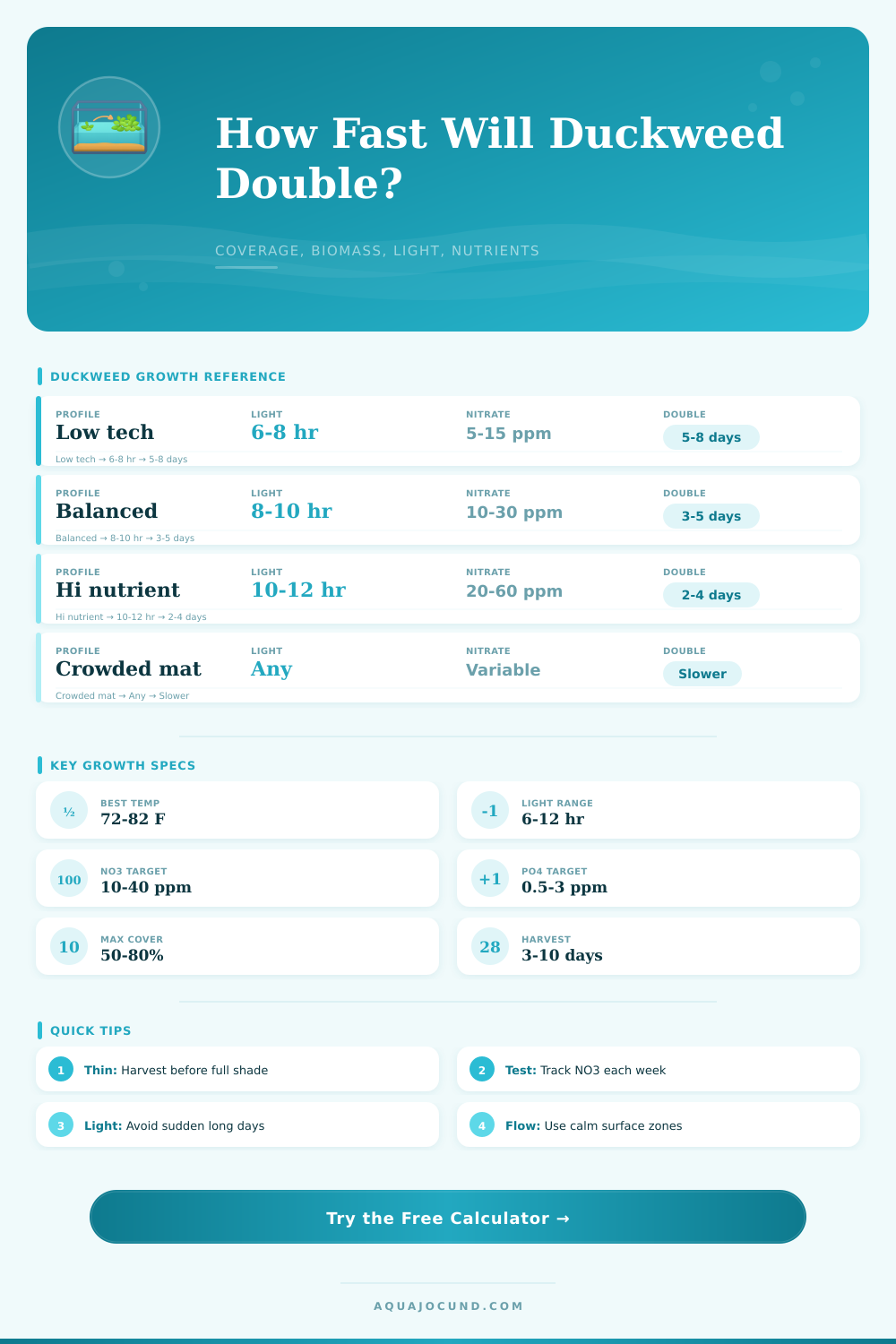
How long to let them grow in the light? That’s another easily adjusted factor that is commonly mismanaged. Does more light = faster growing? Yes… up to a point. If you’re using a strain like Lemna minor as I’m doing, much over about twelve hours per day will not accelerate growth further (it may even exhibit stress).
Why does this matter when planning to harvest? Because if you’ve got plenty of nitrates and high-wattage lights, your duckweed has plenty to eat. Together, those two conditions can cut its doubling time in half different than growing it with low tech, dim lights, and few nutrients.
The other big part of the equation is temperature. The sweet spot for duckweed are a range of 72-82 degrees Fahrenheit. Below that, it slows metabolism; above that, too-warm water can promote algal competition (and/or cause stratification). So your maintenance pace will vary greatly with the seasons. You may be skimming daily in July, but you might extend that to once weekly in December without altering your feed schedule.
The key here is not how hard you try to control the spread but when. Managing duckweed does not require harsh filtration adjustments nor chemical herbicides. All you should of do is harvest prior to reaching total saturation. When it becomes fully saturated across surface, the biomass below will start to rot. This happens because it is no longer getting light. The rot releases tannins and depletes oxygen. At this point, clarity diminishes and tank begins to reek.
Harvesting enough to remain at or under your desired cap (typically around fifty, seventy percent for nutrient export) are the secret. What kind of profile does it have? This is because behavior is different between species. While fine *Wolffia* will expand faster and be harder to manually remove, giant duckweed has larger fronds and can be easily scooped from surfaces, though it may not expand quite as quick. Having an idea of what you’re growing (fine vs. Giant) will help you better understand your expected expansion rate. Depending on your nutrient-rich sump environment vs slow-growing mixed culture, expect to see a change in base doubling time, which is represented in the reference table on the page.
Most headaches can be avoided if you treat duckweed as a dynamic system. You watch the parameters, and you adjust light or nutrients if growth gets too aggressive. You harvest on a predictable schedule. It’s not about eradicating plants. It’s about negotiating with them. Once you get to know the rhythm of their doubling cycle, that green patch doesn’t remains an emergency. It becomes part of the weekly tank choreography. You pay attention to the rate at which those tiny leaves are multiplying, and it ends up with cleaner water and fresh food for your bettas or shrimp.