Drip Rate To Fill Bag Calculator
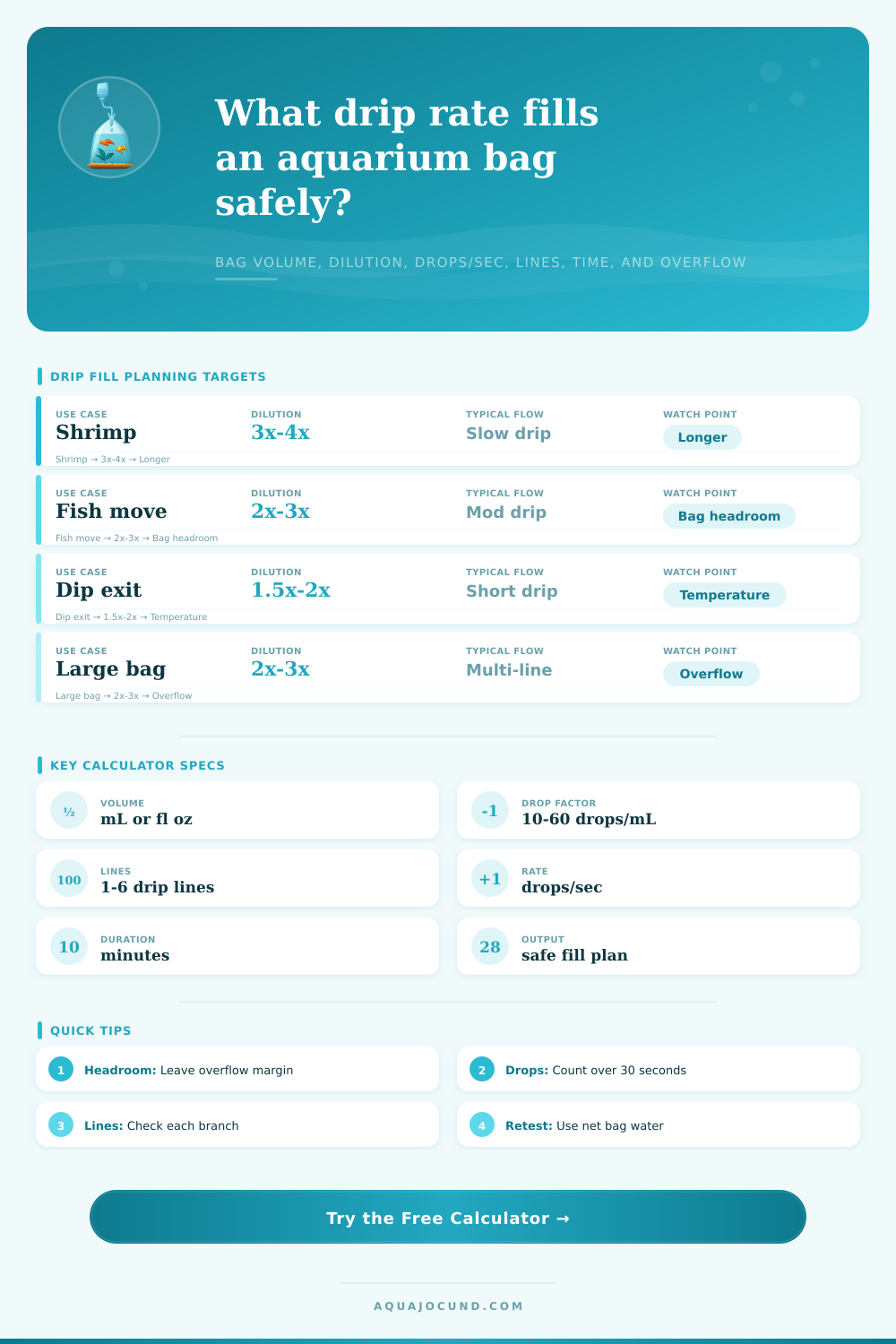
Estimate drip acclimation flow from bag capacity, starting water, target dilution multiple, drops per mL, drops per second, line count, duration, and overflow allowance.
🎯Quick Presets
⚙Calculator Inputs
📊Drip Method Comparison Grid
⏱Fill Check Schedule
| Check | Elapsed time | Added water | Bag volume | Dilution multiple | Action |
|---|---|---|---|---|---|
| Run | Calculator | - | - | - | Schedule rows appear after calculation. |
💧Drop Factor Reference
| Profile | Default drops/mL | Common use | Calculator note |
|---|---|---|---|
| Airline knot or loose clamp | 20 drops/mL | Basic drip acclimation | Variable drop size; count actual drops in the bag. |
| Airline valve controlled drip | 22 drops/mL | Most single-bag aquarium drips | Good control when the siphon height stays consistent. |
| Rigid tube siphon drip | 18 drops/mL | Short rigid tube or hard airline | Slightly larger drops than flexible airline. |
| 10 drop/mL macrodrip set | 10 drops/mL | Fast, larger medical drip chamber | Each drop is about 0.10 mL. |
| 20 drop/mL standard drip set | 20 drops/mL | Standard measured drip chamber | Each drop is about 0.05 mL. |
| 60 drop/mL microdrip set | 60 drops/mL | Fine metered drip | Needs more counted drops for the same mL/min. |
| Multi-bag airline manifold | 20 drops/mL | Several bags at once | Balance every branch because line resistance differs. |
| Coarse siphon drops | 12 drops/mL | Wide tubing or fast drip | Useful when the target volume is large. |
🛍Common Bag Size Planning
| Bag or container | Nominal capacity | Practical safe fill | Example starting water | Max dilution from example |
|---|---|---|---|---|
| Small fish bag | 500 mL / 16.9 fl oz | 400-425 mL | 125 mL / 4.2 fl oz | 3.2x-3.4x |
| Medium store bag | 1000 mL / 33.8 fl oz | 800-850 mL | 250 mL / 8.5 fl oz | 3.2x-3.4x |
| Large fish bag | 2000 mL / 67.6 fl oz | 1600-1700 mL | 500 mL / 16.9 fl oz | 3.2x-3.4x |
| Specimen cup | 750 mL / 25.4 fl oz | 600-640 mL | 200 mL / 6.8 fl oz | 3.0x-3.2x |
| Acclimation bowl | 3000 mL / 101 fl oz | 2400-2550 mL | 750 mL / 25.4 fl oz | 3.2x-3.4x |
⚖Dilution Multiple Reference
| Target multiple | New water added | Starting water share | Typical calculator use |
|---|---|---|---|
| 1.5x | 0.5x starting volume | 67% | Short coral transfer or quick parameter blend. |
| 2x | 1x starting volume | 50% | Basic fish acclimation where bag volume is limited. |
| 3x | 2x starting volume | 33% | Common steady drip target for many store bags. |
| 4x | 3x starting volume | 25% | Cautious invertebrate or salinity-sensitive transfer. |
| 5x+ | 4x or more starting volume | 20% or less | Usually needs a larger container or water removal. |
🔧Drip Method Comparison Table
| Method | Strength | Best fit | Adjustment risk |
|---|---|---|---|
| Airline knot | No extra equipment | Single small bag | Can loosen as tubing relaxes. |
| Airline valve | Fine repeatable control | Fish bags, shrimp bags, small cups | Can clog or change if bumped. |
| Measured drip set | Known drop factor | Precise planned duration | Drop factor must match the chamber type. |
| Multi-line manifold | Runs several bags from one reservoir | Multiple arrivals | Each branch needs its own rate check. |
Then there’s new livestock purchases. This is where you get panicky. You’ve got that perfect water chemistry in your tank, the water in that bag on the counter is new to those critters of yours. Nobody wants to dump it all into the tank at one time, it’s a crapshoot! Enter the solution: let nature do the work. Slowly drip the two tanks together over time. Do it so gradually that your fish or shrimp don’t know what happened until it’s too late to freak out.
But doing it manually with multiple container from the store is both inefficient and prone to human error. Once you input what size bag you’re working with and the rate you see the drip occurring, the calculator (above) do all of the work for you. You won’t have to guess if there is time left before the O2 dissapears or the store closes. Just input amount of water currently inside the bag and ratio of that start volume to the end volume you want to reach by diluting your water.
Why You Should Use This Calculator for Your Fish
People often underestimate just how important this ratio is. For example, if you’re transporting some hardy cichlids, perhaps a two-fold dilution would get them where they need to go. However, many delicate species such as shrimp require a four- or even five-fold blend to prevent sudden changes in their salt levels. That’s why we allow you to specify a target multiple so the tool knows exactly what you’re looking for. In turn, it’ll tell you the exact volume necessary to get there. It will also tell you if your current drip speed can achieves that in a reasonable amount of time.
What most aquarists don’t realize; because their thinking is in seconds instead of minutes… Is that a drop per second sounds so small that they aren’t taking into account that there are 60 of those per minute and 3,600 per hour. So even if they’re only filling a relatively small bag at a time it will fill much quicker then they expect. The reference table on the page illustrates how different clamping methods and types of tubing vary with respect to each other. You can see the difference between a precise valve versus a loose knot, and it’s not simply a matter of rate. Rather, it is also about a steady rate. A drip that begins slowly then increases as the air bubble decreases may be difficult to control whereas a drip that remains constant throughout are easier. By measuring your actual number of drips over the span of half-a-minute (thirty seconds), you have a true benchmark that factors in how the unique resistance of your tubing configuration affect the flow.
What it won’t show is how stressed out your livestock appear. You might nail all the metrics but still give the critter a heart attack. It might not be used to the temperature change, or the ammonia spike from being transported hasn’t cleared yet. It’s here where leaving some breathing room in the bag really matters. If you fill the bag to capacity, you risk pushing the water right up to the closed lip. Now there is less area for exchange and you run the risk of overfilling and spilling onto floor, ruining more than just the mood. This is why we have an overflow allowance as one of the inputs on the calculator; so you’ll know when to stop before reaching the hard edge of your container. Then you’ve got room to make last minute tweaks or just time for the animal to acclimate to its new quarters.
Just like the flow rate, planning the length is equally critical. Knowing beforehand that this should of been four hours while you actually have only forty-five does you no good. Now you can adjust accordingly and move the livestock into another bowl where you can use more control over the other variables. Rushing things won’t save your fish, so it’s best to abort and start again rather than push the process and watch your investment vanish. The tool will show the rate necessary to reach a certain target in X amount of time and it will also shows how long it will take with the current settings. Chase speed or chase precision, but you cannot often do both at the same time.
But ultimately, this is all about patience masquerading as procedure. With those tools at hand, you’re working within the safe boundaries. You don’t need to be shooting blind in the dark. There’s a certain quiet satisfaction when the bag gradually swells with fresh, clean water, while the drip finds its own steady rhythm, because you know precisely how much change is happening per minute. It’s not simply a matter of waiting anymore…it’s a matter of management. And that control transforms a potentially stressful experience into a routine success. It allows you to stop worrying if you turned the tap up too high and instead watch in wonder as your new additions explore their new home.