Drip Acclimation Drop Rate Calculator
Calculate drops per minute, added water volume, container dump points, and a practical acclimation schedule for fish, shrimp, snails, corals, and sensitive marine invertebrates.
Fast presets
Drip Acclimation Plan
| Livestock | Base Time | Typical Rate | Use When |
|---|---|---|---|
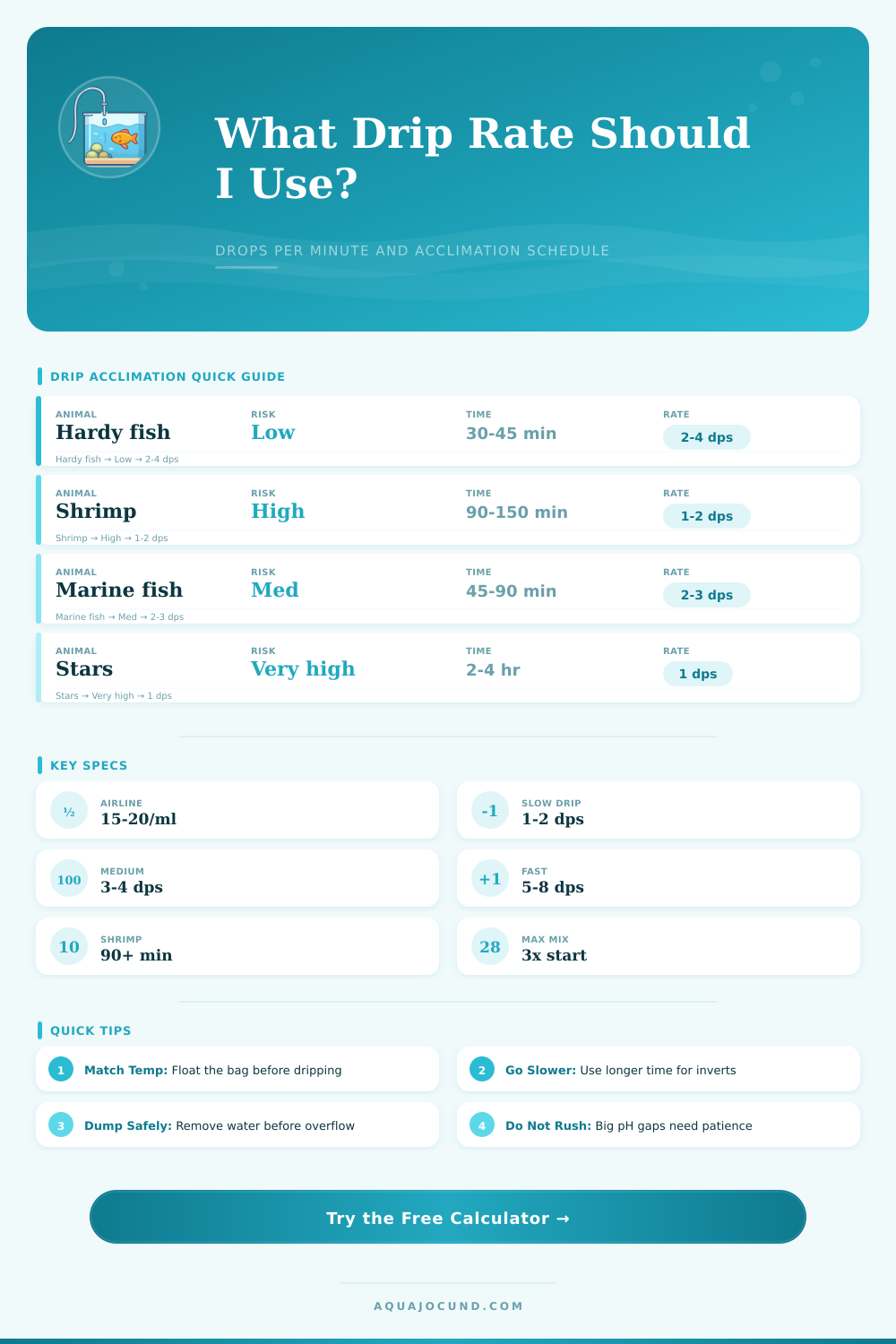
| Hardy freshwater fish | 30 min | 4-8 drops/sec | Store parameters are close and fish are active. |
| Community freshwater fish | 45 min | 3-5 drops/sec | Tetras, rasboras, corydoras, livebearers, and similar fish. |
| Delicate or wild fish | 75 min | 2-3 drops/sec | Soft-water fish, discus, imports, or stressed arrivals. |
| Shrimp and snails | 90 min | 1-2 drops/sec | Neocaridina, Caridina, nerites, mystery snails, and pH-sensitive inverts. |
| Marine fish | 60 min | 2-4 drops/sec | Salinity differs or shipping water is not extremely foul. |
| Corals and reef inverts | 75 min | 1-3 drops/sec | Frags, cleaner shrimp, crabs, snails, and small reef animals. |
| Starfish, urchins, clams | 120 min | 1 drop/sec | Osmotically sensitive animals with poor tolerance for rapid change. |
| Observed Rate | Typical Airline | Water Per Hour | Best Use |
|---|---|---|---|
| 30 drops/min | 1 drop every 2 sec | 90 ml/hr | Very sensitive shrimp, stars, and clams. |
| 60 drops/min | 1 drop/sec | 180 ml/hr | Delicate fish and most reef invertebrates. |
| 120 drops/min | 2 drops/sec | 360 ml/hr | Common fish when parameters are moderately different. |
| 240 drops/min | 4 drops/sec | 720 ml/hr | Hardy fish with close pH, temperature, and salinity. |
| 480 drops/min | 8 drops/sec | 1440 ml/hr | Fast mixing only when water values are already close. |
| Difference | Add Time | Rate Choice | Watch For |
|---|---|---|---|
| pH under 0.2 | 0-10 min | Normal species rate | Normal breathing and posture. |
| pH 0.3-0.5 | 15-30 min | Lower middle rate | Flashing, rolling, clamped fins. |
| Salinity 2-5 ppt | 20-45 min | Slow drip | Loss of grip in invertebrates. |
| Temperature 3-5°F | 15-25 min | Float first, then drip | Rapid breathing or lying over. |
| Long shipping bag | 10-30 min | Slow but efficient | Ammonia exposure after opening. |
| Scenario | Start Water | Target Added | Schedule |
|---|---|---|---|
| Small fish bag | 300 ml | 300 ml | 45 min at about 130 drops/min. |
| Shrimp cup | 250 ml | 500 ml | 120 min at about 85 drops/min. |
| Marine fish bucket | 1000 ml | 2000 ml | 90 min at about 445 drops/min. |
| Coral frag cup | 200 ml | 400 ml | 75 min at about 105 drops/min. |
| Starfish container | 600 ml | 1200 ml | 180 min at about 135 drops/min. |
When you are adding new livestocks to an aquarium, you must use drip acclimation to allow the livestock to adjust to a changes in chemistry in the aquarium water. Drip acclimation involve allowing the tank’s water to drip slowly into the container that contains the livestock. By using drip acclimation, you can control the rate of change of the water parameters in the tank.
While changing the parameters of the water too quick can lead to shock for the livestock, changing the parameters of the water too slowly can lead to problems caused by the water that was used to ship the livestock. The calculator include mathematical assistance for creating the proper acclimation schedule for the livestock when you enter information about the starting volume of water in the acclimation container, the final volume that you want to reach with the acclimation process, and the type of livestock. You must enter the type of livestock because different types of livestock can have different level of tolerance for changes in the pH of the water, the salinity of the water, and the levels of dissolved waste in the water.
How to Drip Acclimate New Aquarium Animals
For example, hardy fish can better tolerate changes in the parameters of the water then shrimp and other invertebrates. The calculator also asks for the amount of time the livestock spent in the shipping bag because the ammonia levels in the water will increase if the oxygen levels in the bag decrease during transportation of the livestock. In addition to information about the livestock and the parameters that need to be adjusted, the calculator also asks for the capacity of the acclimation container that will be used in the acclimation process.
While many people want to continue to add water to the container until they reach the target volume, the acclimation container has a limited capacity. If the volume of water that is added to the acclimation container exceed the physical limits of the container, the water will spill out of the container or the livestock will have to be transplanted into the acclimation container. To avoid this situation, the calculator provides specific dump points that indicate the volumes of water that should be added to the container during the acclimation process so that the total volume of water in the container does not exceed the working limit of the container.
Furthermore, these dump points also allow the acclimation process to still reach the target ratio of the water parameters in the tank. This is especially true for small shrimp cups, which can quickly reach the rim of the cup if additional water is added. The calculator considers the effects of temperature difference in the shipping bag and the aquarium separately because the differences in temperature will even out on its own when the bags are floated in the aquarium, but the parameters that relate to water chemistry (pH and salinity) must be physically exchanged to even out.
Thus, a larger difference in pH between the acclimation container and the tank will require more minutes of drip acclimation to even out. These minutes are automatically included in the time required for the acclimation process to account for this factor. The drip rate during the acclimation process may not remain the same throughout the entire acclimation process.
For example, the airline tubing that is used to acclimate the livestock may warm up during the process and the knots within the tubing may become loosen. In each of these cases, the drip rate may change. Therefore, it is necessary to check the drip rate again after five minutes of the acclimation process to make sure that the drip rate has not changed.
This dripping rate can be entered into the calculator to determine how long the acclimation process will take if the drip rate is different from the drip rate that was calculated. The reference tables include information about the typical time and rates for each type of livestock. These tables can help confirm if the time that the calculator calculates is appropriate for that type of livestock.
Furthermore, these tables also include information about how the rate at which water drips from the acclimation container can change based on the size of the drop that is created in the acclimation container. This information is useful when changing from fine valves to loose knots in the tubing. These reference rates and times are guidelines for the acclimation process for the user when adding new livestock to the tank.
These guidelines will help to remove guesswork from the process of acclimating new livestock to the aquarium’s water chemistry. A common mistake during the acclimation process is to rush the last step of the process. During the acclimation process, it is common and suggested that the entire volume of the acclimation container is poured into the display tank.
However, the shipping water does contain waste and chemistry that does not match that of the tank. Therefore, it is best to remove the livestock from the acclimation container and to discard the water within the container so that this waste and chemistry does not enter the display tank. By planning the drip acclimation process and using the calculator to determine each of the variable for the process, you can take what would otherwise be an unpredictable variable in the care of the aquarium and create a measurable process to ensure that the new livestock survive the introduction into the aquarium’s water.
By entering the information for the type of livestock and the variables related to that type of livestock, the calculator will allow the individual to determine how long the acclimation process should take, how much water should be added to the tank, and when during the process the drip rate should be checked again. Thus, the drip acclimation process removes those variables related to the acclimation process that the user can control prior to the entry of the livestock into the aquarium.