🗿 Dragon Stone Quantity Calculator
Estimate dragon stone weight, aquascape coverage, water displacement, and bottom-load safety from your tank dimensions.
| Stone Selection | Bulk Density | Porosity | Packing | Best Use |
|---|---|---|---|---|
| Porous dragon stone / Ohko | 0.62 kg/L, 38.7 lb/ft³ | 45% | 44% | Light shrimp and planted layouts |
| Standard mixed dragon stone | 0.88 kg/L, 55.0 lb/ft³ | 36% | 50% | Most island, ridge, and valley builds |
| Dense wet-look dragon stone | 1.08 kg/L, 67.4 lb/ft³ | 28% | 54% | Compact stacks and low profiles |
| Flat ledge and slab pieces | 0.95 kg/L, 59.3 lb/ft³ | 31% | 58% | Terraces, shelves, and retaining edges |
| Small rubble and chips | 0.78 kg/L, 48.7 lb/ft³ | 40% | 62% | Filling gaps and making bases stable |
| Arch and cave pieces | 0.70 kg/L, 43.7 lb/ft³ | 42% | 38% | Open caves, archways, and negative space |
| Tank | Dimensions | Light Layout | Medium Layout | Heavy Layout |
|---|---|---|---|---|
| 10 gallon | 20 × 10 × 12 in / 51 × 25 × 30 cm | 6-10 lb / 3-5 kg | 10-16 lb / 5-7 kg | 16-24 lb / 7-11 kg |
| 20 long | 30 × 12 × 12 in / 76 × 30 × 30 cm | 12-20 lb / 5-9 kg | 20-32 lb / 9-15 kg | 32-48 lb / 15-22 kg |
| 29 gallon | 30 × 12 × 18 in / 76 × 30 × 46 cm | 14-24 lb / 6-11 kg | 24-38 lb / 11-17 kg | 38-58 lb / 17-26 kg |
| 40 breeder | 36 × 18 × 17 in / 91 × 46 × 43 cm | 22-36 lb / 10-16 kg | 36-58 lb / 16-26 kg | 58-88 lb / 26-40 kg |
| 55 gallon | 48 × 13 × 21 in / 122 × 33 × 53 cm | 24-40 lb / 11-18 kg | 40-65 lb / 18-29 kg | 65-98 lb / 29-44 kg |
| 75 gallon | 48 × 18 × 21 in / 122 × 46 × 53 cm | 34-56 lb / 15-25 kg | 56-90 lb / 25-41 kg | 90-135 lb / 41-61 kg |
| 125 gallon | 72 × 18 × 22 in / 183 × 46 × 56 cm | 52-84 lb / 24-38 kg | 84-135 lb / 38-61 kg | 135-205 lb / 61-93 kg |
| Factor | Low | Medium | High | Calculation Effect |
|---|---|---|---|---|
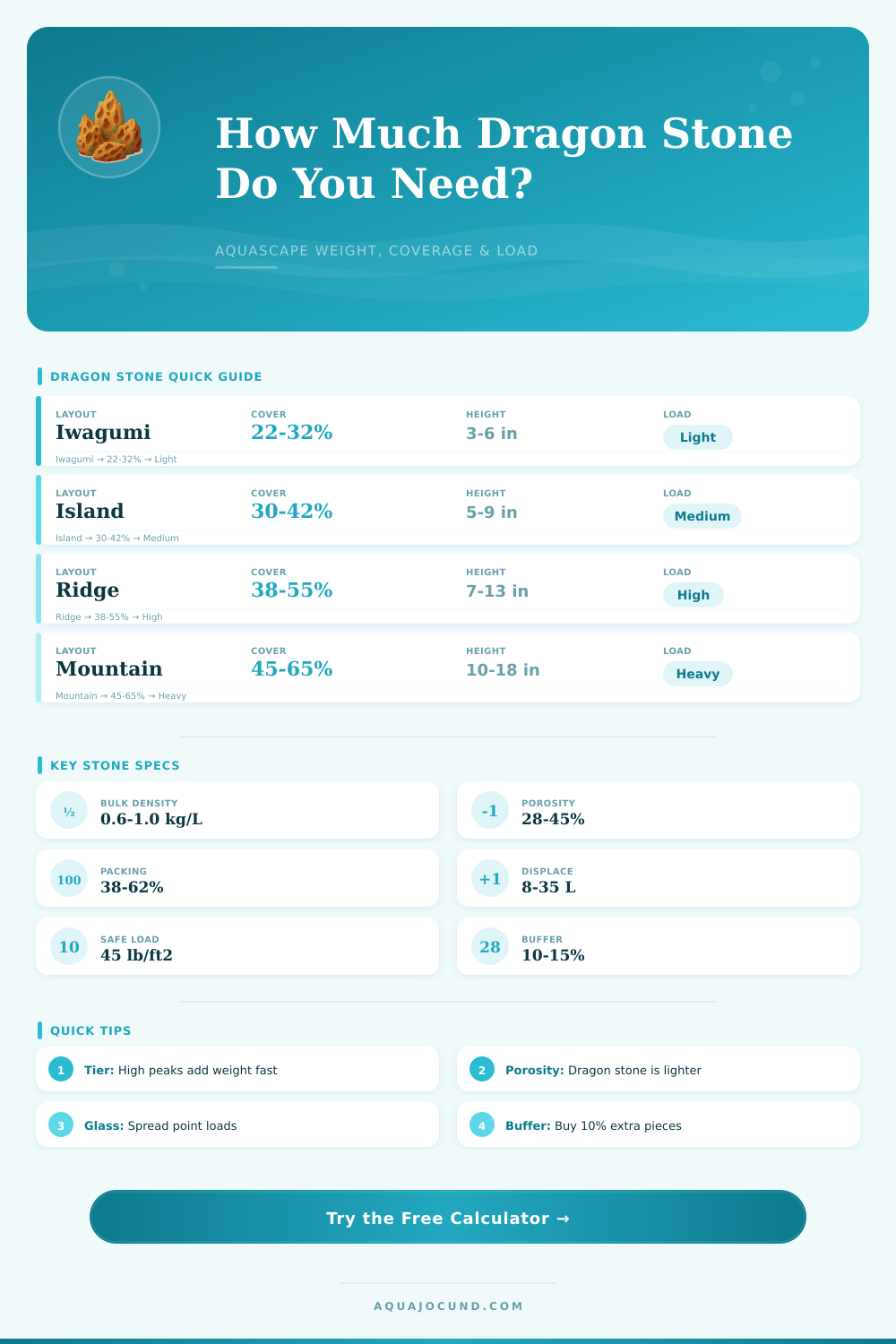
| Stone coverage | 20-32% | 33-48% | 49-70% | More covered footprint raises total volume |
| Peak tier height | 3-6 in | 7-12 in | 13-20 in | Higher tiers increase volume quickly |
| Water displacement | Under 5% | 5-10% | Over 10% | Subtracts usable water volume |
| Bottom load | Under 30 lb/ft² | 30-55 lb/ft² | Over 55 lb/ft² | High loads need better spreading |
| Selection buffer | 5% | 10-15% | 20%+ | Extra stone gives better shapes to choose from |
Calculating an amount of dragon stone that will be needed for your aquascape are a task that requires some planning. If there is to little dragon stone in the tank, then your hardscape will appear thin. However, if there is too much dragon stone, then your dragon stone will add to the weight of the tank, as well as the cost of establishing your aquascape.
Furthermore, dragon stone can sometimes make the aquascape appear to crowded. Within the dragon stone is water, but the density of that dragon stone can vary. Additionally, the amount of water that becomes trapped within the pores of the dragon stone can also vary.
How Much Dragon Stone You Need
Both of these variables impact the total weight of the dragon stone (which impacts the total weight of the tank), as well as the amount of water that the tank can hold. The type of layout that you plan to use for your aquascape will also impact the amount of dragon stone that you need. For instance, you will need less dragon stone to establish a low Iwagumi aquascape then a tall mountain wall layout.
However, the way in which you plan to stack the dragon stone within your aquascape will impact the total volume of your tank. You can calculate the amount of dragon stone that are needed by considering each of the variables related to your aquascape. For instance, the dimensions of your tank, the layout that you will use, the types of stone that you will use within your aquascape, the support method for your dragon stone, and your choice of substrate will all impact the total load that will be placed upon the bottom glass of your fish tank.
Each of these variables is a determinate of whether or not your dragon stone will remain stable within your tank once it is filled with water. Another important variable to consider is the water displacement of the dragon stone. Dragon stone is not a solid object; rather, it has pores within the stone that become filled with water.
Because of this, the dragon stone will displace less water than solid objects of the same size. Additionally, the amount of water that is displaced can become a factor in the stability of your tank, especially if your substrate slope is incorporated into your design. Dragon stone calculators consider the total external volume of your tank (created by the heights of each of the tank’s tiers), as well as the packing characteristics of the dragon stone to calculate the amount of water that the dragon stone will displace within your tank.
Another of the primary concerns of many aquascapers once their tank is running is the bottom load of the tank. Because the sharp edges of the dragon stone can apply significant point loads to the bottom of the tank, you must manage the weight of the dragon stone. One way of mitigating these loads is to spread the contact between the dragon stone and the bottom of the tank through the use of sand, foam, or a grid.
The support setting of the dragon stone calculator allows for consideration of this variable. Additionally, the safety guideline for the calculation of the amount of dragon stone that is to be used in the aquascape is not a hard limit for that aquascape; rather, it indicates whether or not the aquascape is within the normal operating range for dragon stone loads, or whether adjustments to the layout of the dragon stone are required. It is often difficult to purchase the exact amount of dragon stone that will be used within the aquascape.
For instance, it is common for some pieces of dragon stone to not appear as they may need to fit within the aquascape, or for some pieces of dragon to become cracked when you are trimming them to create the desired sizes for those pieces of dragon stone. To account for these issues, you can incorporate a buffer percentage into the calculations for the amount of dragon stone that will be required to establish the aquascape. Using a percentage as a buffer can allow for the purchase of dragon stone of the shapes and sizes that may be better for the aquascape without running out of dragon stone altogether.
In addition to the variables that can be accounted for through a dragon stone calculator, there are other variables related to the actual aquascape that cannot be accounted for by any number. For instance, the depth of the substrate often will be deeper at the back of the tank than was originaly calculated in the formation of the aquascape. Additionally, the plants and other accessories that are placed within the tank will add to the total weight of the tank over time.
For these reasons, many experienced aquascapers will purchase more dragon stone than is calculated through these formulas; the extra dragon stone allows for adjustments to be made to the height or placement of the dragon stone within the tank. The goal is to establish the amount of dragon stone needed to form the aquascape while also ensuring that the dragon stone does not create any conflicts with the physics of the tank. Through understanding each of the variables related to dragon stone and their impact on the aquascape, aquascapers can establish a better understanding of each of the steps that must be taken in the formation of their desired aquascape.