Dosing Pump mL Per Day Calculator
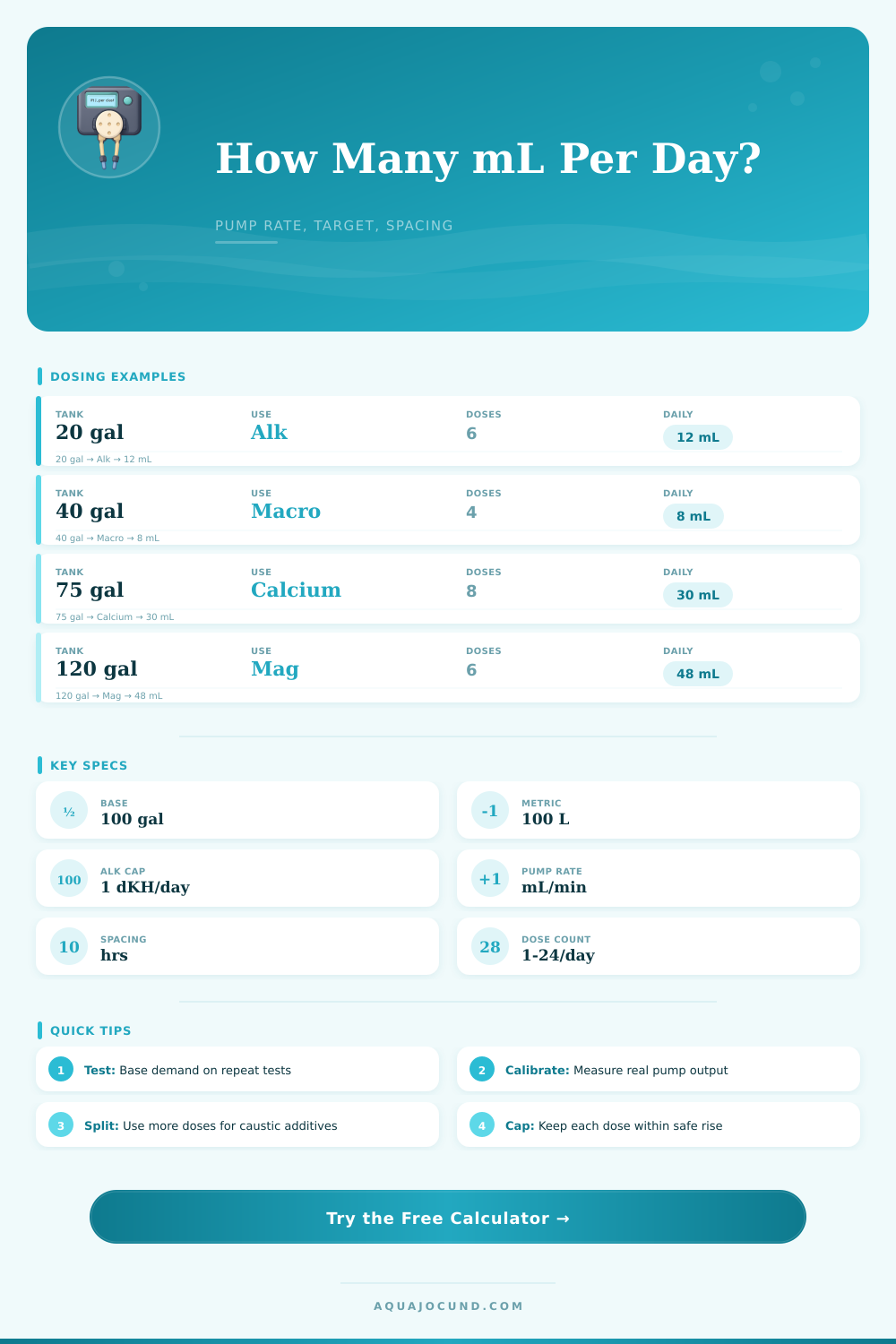
Calculate daily supplement volume, split doses, pump runtime, concentration scaling, and spacing for aquarium dosing pumps.
🧪Quick presets
⚙Dosing inputs
📊Dosing use comparison
📘Reference tables
| Dosing use | Calculator unit | Common one-day cap | Suggested split |
|---|---|---|---|
| Alkalinity buffer | dKH | About 1 dKH/day | 6-24 doses/day |
| Calcium solution | ppm Ca | About 20 ppm/day | 2-12 doses/day |
| Magnesium solution | ppm Mg | About 50 ppm/day | 1-6 doses/day |
| Nitrate stock | ppm NO3 | About 2 ppm/day | 1-4 doses/day |
| Phosphate stock | ppm PO4 | About 0.05 ppm/day | 1-4 doses/day |
| Liquid food / carbon | mL | Use label guidance | 1-12 doses/day |
| Concentration mode | Best for | Example input | Formula direction |
|---|---|---|---|
| mL per unit per base volume | Product label recipes | 20 mL / 1 dKH / 100 gal | More concentration value means more mL |
| Unit rise from 1 mL per base volume | Strong stock solutions | 0.05 dKH / mL / 100 gal | More concentration value means fewer mL |
| Direct daily mL | Foods, carbon, trace routine | 8 mL/day | Split the entered daily dose |
| Pump output | 0.5 mL dose | 2 mL dose | 10 mL dose |
|---|---|---|---|
| 0.5 mL/min | 60 sec | 4.0 min | 20.0 min |
| 1.0 mL/min | 30 sec | 2.0 min | 10.0 min |
| 1.5 mL/min | 20 sec | 1.3 min | 6.7 min |
| 2.0 mL/min | 15 sec | 1.0 min | 5.0 min |
| System size | Metric size | Typical pump use | Spacing note |
|---|---|---|---|
| 10 gal nano | 38 L | Trace or nano alk | Small doses need calibration |
| 20 gal planted | 76 L | Macro or micro ferts | Daily or lights-on window |
| 40 gal breeder | 151 L | Two-part or nitrate | 4-8 splits are common |
| 75 gal reef | 284 L | Alk, calcium, magnesium | Alk benefits from many splits |
| 120 gal reef | 454 L | High demand two-part | Check runtime per event |
For example, let’s say you go on vacation and when you get back, the computer tells you that your alkalinity dropped below the target. It happen to almost everyone who keeps reef tank. Nearly every person who maintains a reef tank eventualy lets his/her alkalinity drift low.
Often people panic immediately and want to pour a big jug of something into their aquarium all at one time. They think “if I do this quickly then my problem will be solved.” Wrong! Corals don’t like fast chemical changes any more than they like slow chemical changes.
How to Fix Low Alkalinity Safely
You can take away that fear and use an exact plan to slowly add tiny amounts throughout the day by adding them here, Then the math gets done for you. Knowing how much you lose (and I mean knowing not guessing) each day is at the heart of this math. It is not your friend’s tank. It is your tank. It come from comparing two test taken twenty-four hours apart before dosing.
So if you lose.5dKH of Alk everyday, that’s your baseline loss. That’s what you have to replace. And it will push your Alk back up slowly toward where you want it as well. That’s important because just replacing what you lose stabilizes but doesn’t fix a downward drift. You’ll need replacement amount AND correction amount in every dose.
Most hobbyists will boost their water quality overnight by taking that total and splitting it into several doses. Adding those buffers a little bit here and there are better than adding them all at one time. One big dose is a spike and stress the livestock, while many small doses form a flat line that biological processes like much better.
Once you specify how often you want each dose delivered per day, the calculator does the dividing for you. In addition, it take into account pump run time. This is very important since even rapid pumps still require some time to dispense. For example, if your pump dispenses one point three milliliters/minute then it’ll take about eight minutes to dispense a ten milliliter dose. Knowing this timeframe will allow you to space out the doses without having any overlap especially on smaller sumps where mixing will be slower.
It does take a little getting used to because various manufacturers express their dosage recipes in slightly different ways, some say “this amount will lift X amount in millimeters per every Y units of change per 100 gallons”, while others say “this much will raise your water level by Z milliliters.” Not a big deal, it just requires thinking for a second before entering the information into the tool. Luckily, the tool handles both types of expression, so you don’t need to do any hard thinking beforehand. Simply choose what format your bottle expresses the dose as and enter the value stated on the bottle. This prevents simple arithmetic errors that usually result in over-dosing. A tiny interface decision, but it’ll save several hours of headaches when you switch back and forth between different brands of trace element mixes or two-part solutions.
Another very important function is safety caps, to keep you from causing disasters when trying to make good-intentioned corrections. Even though your target may be far down the road, the calculator only allows you to increase the parameter up to a certain amount in one day. That’s like an experienced aquarist thinking because it promotes gradual change rather than quick fixes. Yes, you’d like to bump your calcium up 20 parts per million right now but do it gradually over several days so it doesn’t precipitate out of solution and paint your live rock white. The safety cap serves as a brake on your enthusiasm, keeping the chemistry at safe biological levels.
To help with those common situations (nitrate feedings, macro doses for plants), there are also reference tables on the page that provide at-a-glance splits and dose caps. You’ll be able to check if your calculated schedule seems reasonable. For example, what would be considered a normal split and cap for a hundred-twenty gallon reef system is very different than a twenty-gallon nano tank, mostly because of dilution rate and livestock sensitivity. The reference table provides benchmarks against which you can set your expectations before clicking the calculate button.
But in the end, it’s not a matter of getting the numbers just right as much as it’s a matter of being patient and consistent. It removes the need for math and allows you to do what it does best, observe. Take a water test, record the findings, let the calculator do the math, and have faith that little things done each day add up to stable water parameters. You will have healthy livestock instead of stressed-out livestock. This is much better then trying to fix every problem all at once. Dosing is like that, steady wins the race.