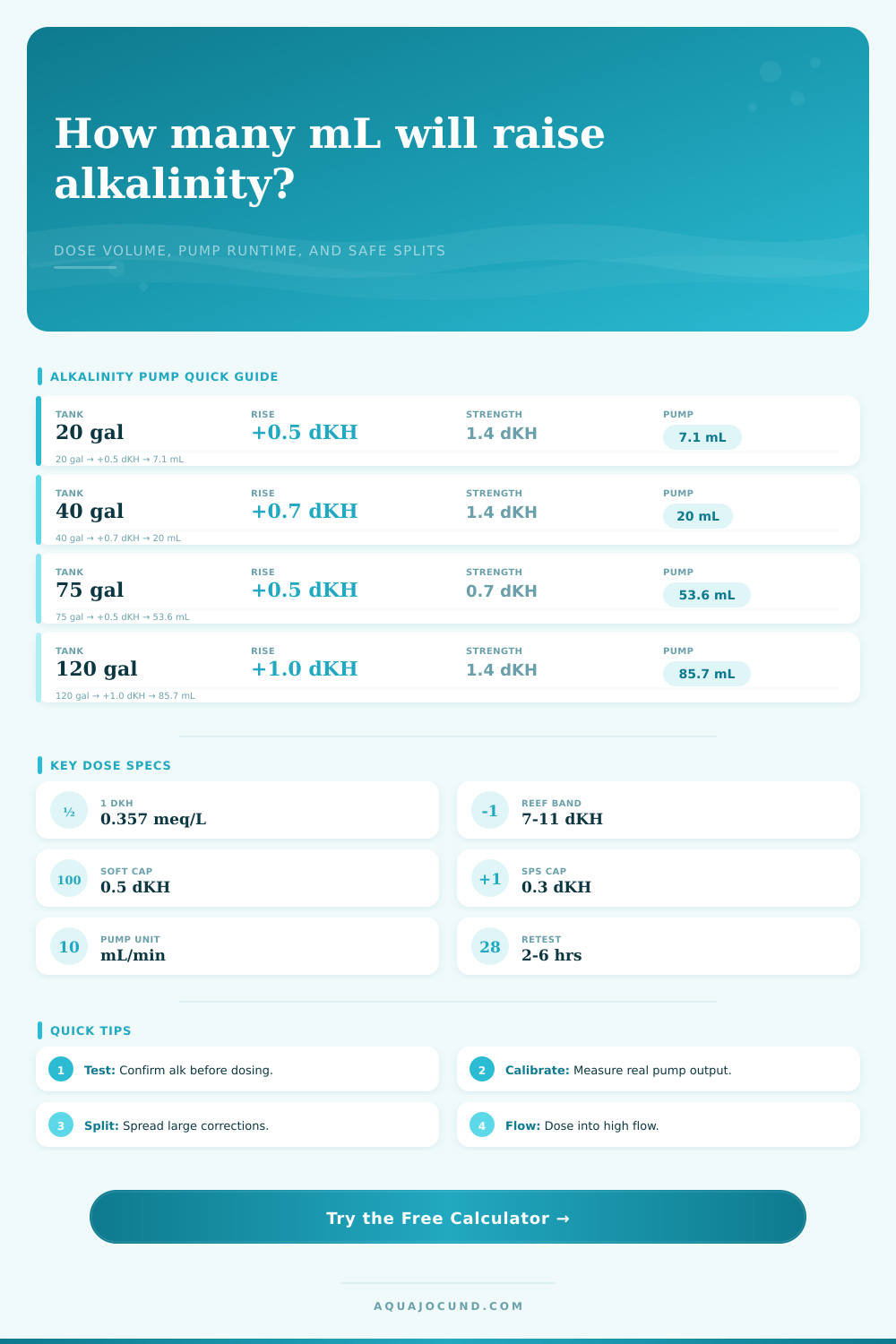
Dosing Pump mL to Raise Alk Calculator
Convert an alkalinity correction into pump milliliters, runtime, safe split doses, and a practical reef dosing schedule.
📌Reef Tank Presets
⚖Tank Volume and Alk Target
🧪Alkalinity Supplement Strength
⏱Dosing Pump Calibration
📊Alkalinity Conversion Grid
📘Solution Strength Reference
| Solution Type | Strength Basis | Typical Use | Pump Note |
|---|---|---|---|
| High-strength carbonate | 1.40 dKH per mL per gal | Common reef correction and daily dosing | Small volume, watch pH rise |
| Bicarbonate style | 0.70 dKH per mL per gal | Lower pH impact corrections | Runtime is roughly doubled |
| Balanced 2-part alk | 1.00 dKH per mL per gal | Daily reef maintenance | Match label before programming |
| Diluted daily mix | 0.35 dKH per mL per gal | Nano tanks and fine pump control | Longer run, smoother dosing |
| Concentrated solution | 2.00 dKH per mL per gal | Large systems with limited reservoir space | Verify tubing and precipitation |
🐟Common Reef Correction Examples
| System | True Volume | dKH Rise | 1.40 Strength Dose | 0.70 Strength Dose |
|---|---|---|---|---|
| Nano reef | 13.5 gal / 51 L | 0.5 dKH | 4.8 mL | 9.6 mL |
| 20 gallon mixed | 18 gal / 68 L | 0.7 dKH | 9.0 mL | 18.0 mL |
| 40 breeder reef | 34 gal / 129 L | 0.8 dKH | 19.4 mL | 38.9 mL |
| 75 gallon display | 67.5 gal / 256 L | 0.8 dKH | 38.6 mL | 77.1 mL |
| 120 gallon SPS | 108 gal / 409 L | 0.6 dKH | 46.3 mL | 92.6 mL |
🛠Pump Programming Reference
| Pump Rate | 10 mL Runtime | 25 mL Runtime | Best Use |
|---|---|---|---|
| 0.5 mL/min | 20 min 00 sec | 50 min 00 sec | Very small tanks |
| 1.1 mL/min | 9 min 05 sec | 22 min 44 sec | Common peristaltic head |
| 2.0 mL/min | 5 min 00 sec | 12 min 30 sec | Medium systems |
| 5.0 mL/min | 2 min 00 sec | 5 min 00 sec | Large reservoirs |
💡Dosing Notes
You feel that sinking sensation. Your test kit tells you that your alkalinity has once again drifted down. Been there done that. It doesn’t matter if it happened to you or one of the other experienced aquarists who swears he dosed yesterday… It’s not the chemistry. Well, I guess it could be the chemistry, but it’s typically how you translate that chemistry into pump runtime that create the issue.
Alkalinity is some number expressed as dKH, and your peristaltic pump talk in milliliters per minute. How do you bridge that gap without guessing? This is what keep your parameters stable and the coral calm. Most aquarists think to hard about it. They view alkalinity as a static number instead of a dynamic buffer system that moves in concert with your livestock.
How to Fix Your Alkalinity
Once you’ve determined your solution strength and actual water volume, then the calculator do the math for you (above). Why? Nominal tank sizes is a lie. That fancy looking seventy-five gallon display typically only hold fifty gallons of actual water when factoring in sand, live rock, sump displacement, etc. Dose for seventy-five and you’ll be overshooting. Overshoot and you spike pH and stress the nitrifying bacteria who relies on stable carbonate chemistry. The tool factors this in by allowing you to input a displacement percentage so that your dose is set for the liquid that require correction and not the acrylic walls around it.
This is when biology meets arithmetic, deciding how much you want to raise at one time each day. Do you have some corals that aren’t doing well and need their numbers fixed ASAP? No, your corals don’t follow your day. But they can shut down, reject their skeletons, or drop polyps if alkalinity swings too rapidly. However, it’s also true that certain corals (SPS) will close their polyps and even reject their own skeletons if they are subjected to more drastic an alkalinity change too fast. So small changes is mandatory for delicate setups.
This is why the calculator sets its safe limits on you; it breaks the big change into little ones so that it becomes a little bit of change every day within a reasonable time frame. It gets the needle moving in the correct direction without shocking your system all at once.
Another wrinkle: Alk solution strengths matter. Not all alk solutions are created equal. High strength carbonate solutions may have a quick bump on parameters, but if not mixed well they will spike local pH. Diluted bicarbonate mix solutions is gentler, but take far longer to run pumps. This is clear from the reference table on the page. A weaker solution require double the time to achieve same result. Know what you’re mixing. If you’re using a concentrated solution that you’ve diluted to avoid precipitation in the lines (tell the calculator). Failure to account for changes in concentration is the quickest road to wondering why your numbers don’t budge.
The last hurdle is calibrating the pump. Most manufacturers says how much water they put out per minute. That’s the flow rate. But tubing gets stiffer as time goes on and check valves create back pressure. The pump isn’t putting out what was in the box. A quick way to know is to run a simple test where you measure how much came out of the pump for ten minutes. Put that number into the tool and it accounts for the mechanical reality of what you have. It takes human error out of the equation and replaces it with measured data.
You are moving from guesswork to knowledge. You also get the satisfying feeling that letting the tank’s natural biology and physics take over has helped it stabilize. You no longer chase numbers; instead, you maintain a range. Eight point two dKH each and every single day isn’t the goal. Maintaining a steady buffer so the livestock don’t have to stress is the goal. Knowing how your pumps are calibrated, what they’re pushing, and how much volume there is will make the math easy.
You should of known this earlier. It becomes just another routine thing to check, like skimming, feeding. The corals open up, the water clears, and then you can relax.