Dose to Raise KH Calculator
Calculate dry buffer grams, stock solution mL, staged daily dosing, and planned water change reset for aquarium alkalinity.
| Stage | KH rise | Dry buffer | Stock solution | Split instruction |
|---|
| Buffer type | Calculator potency | pH tendency | Planning note |
|---|---|---|---|
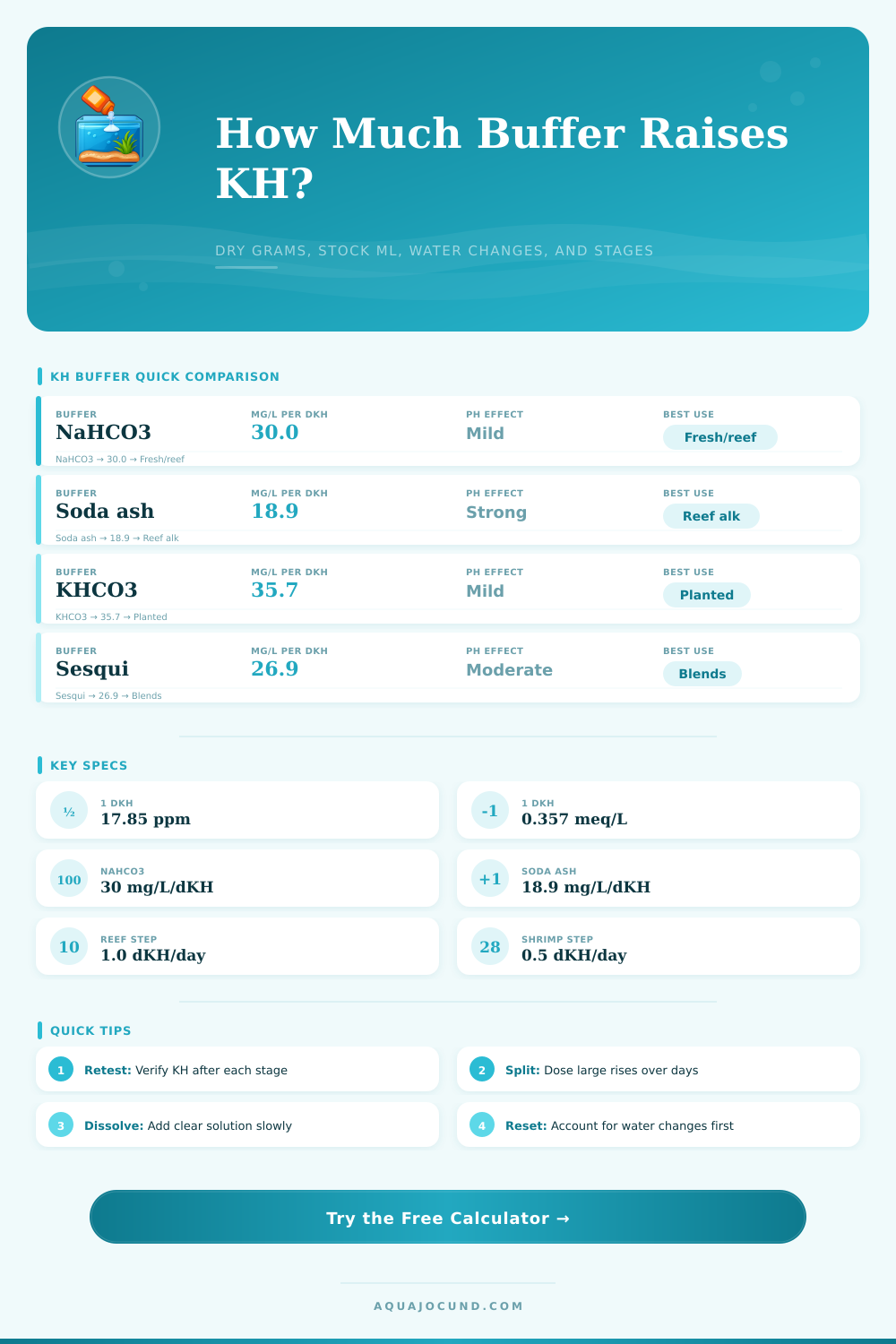
| NaHCO3 | 29.98 mg/L per 1 dKH | Mild upward or near neutral | Useful when a gentle KH rise is preferred. |
| Sodium carbonate / soda ash | 18.91 mg/L per 1 dKH | Stronger upward | More concentrated by weight; dose slowly in high-flow water. |
| KHCO3 | 35.72 mg/L per 1 dKH | Mild upward | Adds potassium instead of sodium. |
| Potassium carbonate | 24.65 mg/L per 1 dKH | Stronger upward | Concentrated potassium alkalinity source. |
| Sodium sesquicarbonate | 26.88 mg/L per 1 dKH | Moderate upward | Blend-like behavior between bicarbonate and carbonate. |
| Balanced Na/K blend | 32.80 mg/L per 1 dKH | Mild to moderate | Planning value for mixed bicarbonate buffers. |
| Commercial dry alkalinity mix | 28.50 mg/L per 1 dKH | Product dependent | Use the label strength when it is available. |
| Custom potency | User entered | User verified | Enter lab, label, or measured potency. |
| Common tank | Approx net volume | NaHCO3 | Soda ash |
|---|---|---|---|
| 10 gal nano | 8 gal / 30 L | 0.91 g | 0.57 g |
| 20 gal planted | 17 gal / 64 L | 1.93 g | 1.22 g |
| 40 breeder | 34 gal / 129 L | 3.86 g | 2.44 g |
| 55 gal community | 47 gal / 178 L | 5.34 g | 3.37 g |
| 75 gal reef | 62 gal / 235 L | 7.05 g | 4.45 g |
| 120 gal system | 100 gal / 379 L | 11.35 g | 7.16 g |
| Input unit | Equivalent | Formula | Calculator use |
|---|---|---|---|
| 1 dKH | 17.848 ppm as CaCO3 | ppm / 17.848 | Default aquarium KH scale. |
| 1 dKH | 0.357 meq/L | meq/L x 2.8 | Common reef alkalinity conversion. |
| 1 meq/L | 2.8 dKH | dKH / 2.8 | Used by some alkalinity tests. |
| 1 ppm CaCO3 | 0.056 dKH | dKH x 17.848 | Useful for lab reports and water utilities. |
| Aquarium situation | Conservative daily cap | Split pattern | Retest point |
|---|---|---|---|
| Shrimp or soft-water livestock | 0.3-0.5 dKH/day | 2-4 small doses | After each day |
| General freshwater community | 0.5-1.0 dKH/day | 1-2 doses | Next day |
| Planted tank with CO2 | 0.5-1.0 dKH/day | Before photoperiod or split | Before CO2 comes on |
| Reef alk correction | 0.5-1.0 dKH/day | 2-12 doses | Same time daily |
| Rift cichlid or high-KH system | 1.0-2.0 dKH/day | 2-4 doses | Before repeating |
Water chemistry is basicly arithmetic wrapped up with a bit of biology. So when you measure the water and notice your alkalinity buffer (KH) has dropped, your immediate instinct might be to add whatever liquid/powder you have available to boost it back ASAP. More often than not, this will backfire as adding so rapidy will shock fish and crush bacteria. Once you know how much buffer actualy ends up in the water rather than on the bottom, the calculator does math for you. Plug in your target and your volume and forget about making guesses.
Half the battle is understanding what KH is (and isn’t). KH are an expression of bicarbonate and carbonate ions that resist changes in pH. The less KH there is, the less stable things are. This means lower KH equate to those dreaded ammonia spikes that trouble beginning keeper. Without enough buffering capacity, your aquarium won’t be able to neutralize acids produced by biological activity. Bicarbonate salts like sodium bicarbonate is commonly used as they will increase KH while having a relatively minor impact on pH. Other compounds like soda ash also increases alkalinity, but they also push pH upward, which can stress sensitive livestock if not used carefuly. For this reason, you don’t just use what’s convenient, instead, select based off desired strength vs. Stability.
How To Increase KH Safely
Most homekeepers gets it wrong in volume estimation. Few people realize that a “fifty gallon” tank seldom contains fifty gallons of water. This is because you have to factor in rocks or gravel, equipment, and an inch or two of airspace above the water level. Instead of using manufacturer labels that almost always include mass of whatever they are displacing, the tool allows entry of inside dimensions and percentage full to estimate net water volume.
Why does getting the number matter? This is because dosing calculations is directly proportionate to the mass of the water. If you underestimate the volume, you’ll overdose. If you overestimate, you won’t have enough of what you want. Getting the volume precise saves you from having to do corrective partial water changes later.
The safety mechanism that everyone overlooks are staging your dose. In an established system, you shouldn’t let alkalinity jump more than a couple degrees per day. Based on how sensitive your livestock are, this will break up total amount needed into a manageable portion for each day. While freshwater plants and shrimp benefits from micro-dosing over several days, reef tanks tend to be more tolerant of larger rises. Dosing gradually gives the beneficial bacteria time to slowly shift their metabolism without killing them off too quickly. If you rush it, then you defeats the entire purpose of having a stable tank in the first place.
The other complicating factor is that pre-planned water changes dilute whatever your existing parameters are before you’ve added buffer anyway. For example, let’s say you know you’re going to do a 20% water change. The math need to consider what the KH of your incoming tap water is. When you blend together low-KH tank water and high-KH tap water, you create a new base line, not the same as what your test strips tells you. So unless you plan for this reset factor, you’ll be adding buffer to something that doesn’t exist anymore. Getting it right requires changing your calculation to reflect reality after the change so you can hit the mark without any error or waste.
For those of you who dislike liquids, there is another level of control provided by stock solutions. By pre-dissolving your buffer, you can dose exact milliliters instead of fiddling around with fraction-of-a-gram measurements on some crappy kitchen scale. Using this option will also help it distribute evenly (and reduce cloudiness) in high flow zones, while making it feel slightly less “chemistry lab” and more routine maintenance.
This is laid out nicely in the embedded reference table on the page so you can quickly compare various types of chemical agents. Each buffer type has a specific potency that determines how many milliliters or grams you need. Since sodium carbonate have a lower molecular weight it takes less mass than bicarbonate does, but will also present more alkalinity risk per unit added. That knowledge allows you to stock to match and not purchase products that may be too potent for your particular tank setup. Trial and error becomes informed planning.
To conclude, Increasing KH takes patience rather then force. It isn’t that you’re forcing a chemical reaction into existence; instead, you want to nudge it along until it finds a stable equilibrium. And there are tools to help take the guessing out of it, so you can spend less time looking at your test kits and more time looking at your livestock. Stop fighting the water; work with its chemistry and it will make sense. Maintenance becomes simple. Stability returns slowly, but once you have it, it lasts longer if you plan carefully instead of trying to fix things in a panic. That slow consistency is where life thrives behind the glass.