🧪 Dose To Raise GH Calculator
Estimate the mineral dose needed to raise aquarium GH from a current reading to a target, with Ca/Mg ratio, stock solution strength, split dosing, and species tolerance checks.
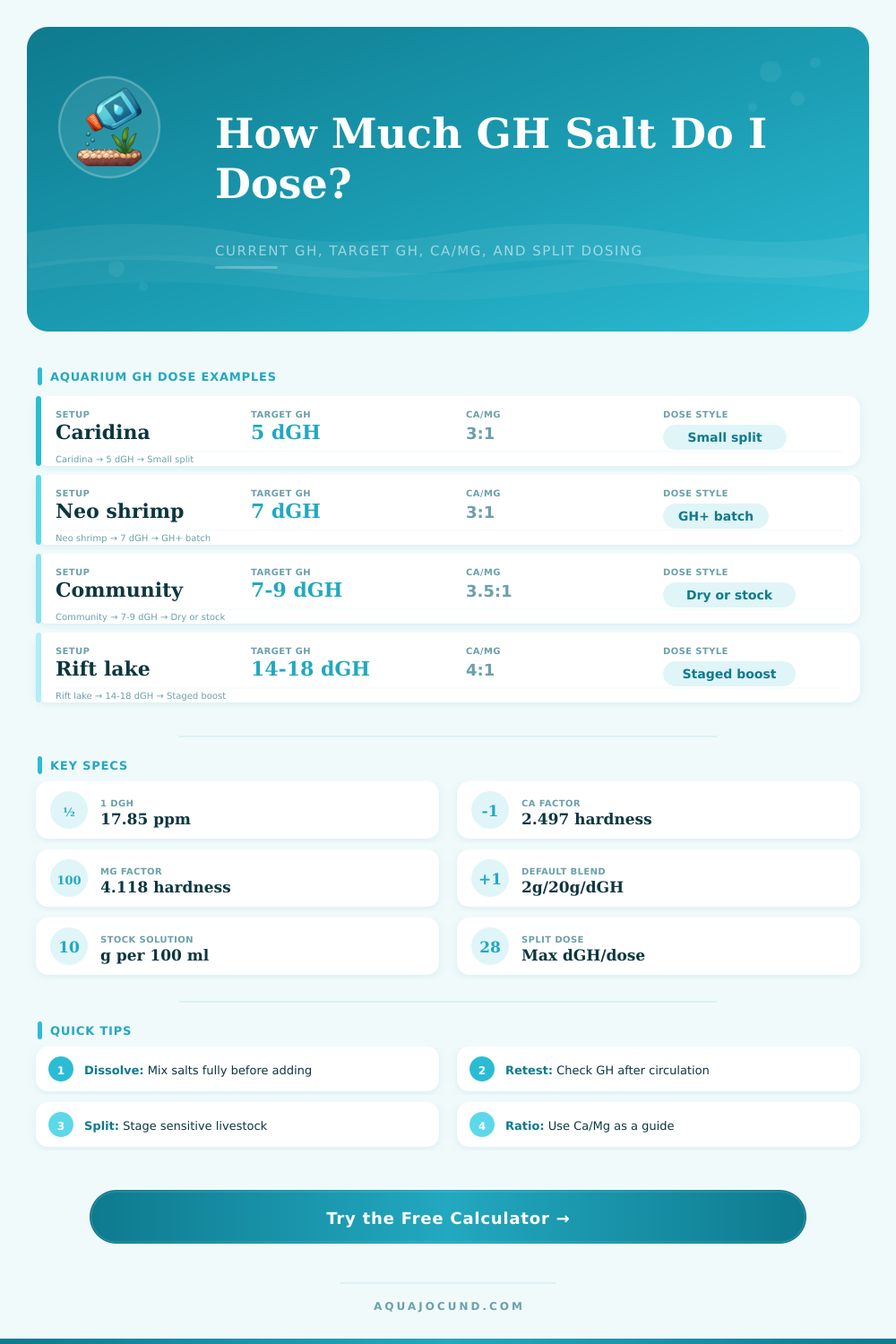
Typical Caridina shrimp target: 4-6 dGH.
Custom mode follows the rate printed on your remineralizer label.
Dose Breakdown
| GH Source | Calculator Method | Best Use | Ratio Control |
|---|---|---|---|
| Custom GH salt label | Uses g per 20 gal per 1 dGH | Most commercial remineralizers | Label based |
| Calcium chloride + magnesium sulfate | Splits Ca and Mg ppm, then converts to salt mass | Fast-dissolving freshwater GH adjustment | Direct |
| Calcium sulfate + magnesium sulfate | Uses lower calcium fraction and sulfate salts | Gentler sulfate-forward blends | Direct |
| Shrimp GH+ remineralizer | Preset label-style rate | RO or low-GH shrimp batches | Product fixed |
| Rift lake mineral blend | Higher preset dose strength | Hardwater cichlid increases | Hardwater |
| Species Target | Common GH Range | Suggested Max Split | Tolerance Note |
|---|---|---|---|
| Caridina shrimp | 4-6 dGH | 0.5 dGH | Tight band, retest before final dose |
| Neocaridina shrimp | 6-8 dGH | 1.0 dGH | Moderate range, avoid sudden jumps |
| Planted community | 4-8 dGH | 1.5 dGH | Plants and fish usually allow a wider band |
| Livebearers | 8-14 dGH | 2.0 dGH | Hardwater profile with calcium-forward blends |
| Rift lake cichlids | 12-18 dGH | 3.0 dGH | Pair GH dosing with the separate KH goal |
| Common Volume | Imperial Dimensions | Metric Equivalent | Example Dose For +1 dGH |
|---|---|---|---|
| 5 gal nano | 16 in x 8 in x 9 in fill | 18.9 L | 0.50 g at 2g/20g/dGH |
| 10 gal shrimp tank | 20 in x 10 in x 12 in fill | 37.9 L | 1.00 g at 2g/20g/dGH |
| 20 long | 30 in x 12 in x 12 in fill | 75.7 L | 2.00 g at 2g/20g/dGH |
| 40 breeder | 36 in x 18 in x 16 in fill | 151.4 L | 4.00 g at 2g/20g/dGH |
| 75 gal cichlid tank | 48 in x 18 in x 21 in fill | 283.9 L | 7.50 g at 2g/20g/dGH |
| Formula Piece | Value Used | What It Means | Calculator Use |
|---|---|---|---|
| dGH to CaCO3 | 1 dGH = 17.85 ppm | General hardness as equivalent calcium carbonate | Converts GH rise into hardness load |
| Calcium hardness factor | Ca ppm x 2.497 | Calcium ppm expressed as CaCO3 hardness | Solves Ca ppm from the Ca/Mg ratio |
| Magnesium hardness factor | Mg ppm x 4.118 | Magnesium ppm expressed as CaCO3 hardness | Solves Mg ppm from the Ca/Mg ratio |
| Stock solution conversion | grams / (g per 100 ml / 100) | Turns dry dose into milliliters of solution | Sizes the remineralizer solution dose |
The quality of your tap water depend on general hardness (GH). If you keep planted tanks, this value help plants absorb nutrients well and helps shrimp molt regularly. Wrong hardness causes other issues, stresses livestock, or stalls there growth. Adjusting it to a proper level look like a hard math problem but it’s actualy not.
Break the adjustment equation down into three components: mineral composition, target difference, and volume. To determine an accurate amount of salt, use this calculator (above). It convert tank size to salt dosage. But most folks just make their best guess on dosages. That is dangerous. You either over-dose and kill off all the nitrifying bacteria causing ammonia spikes or you under-dose and cause dead shrimp.
How to Use the Water Hardness Calculator
The calculator request water volume as the starting value. Many times tanks are labeled incorrect for their actual capacity. For example, a 20g long doesn’t have as much water in it as a regular 20 due to interior components and the stand. Put in the real dimensions and it’ll return the correct water capacity. This will also change the chemistry results.
After the volume is entered, the calculator consider the existing general hardness and where you want it to be. That depends on the species. Neocaridina are more robust but still want consistent hardness in the six to eight range. Caridina shrimp is stricter; four to six dGH is the goal. Ramping up hardness too fast will result in an osmotic shock. That’ll kill off any sensitive batch before they can complete their molt. Split dosing eliminate that issue. It will tell you how much to add every twelve or twenty-four hours, that’s gradual enough for livestock to adapt without panicking.
The mineral source choice makes it even more precise. Not all hardness increasers is created equal. Some contain calcium chloride and magnesium sulfate. Others only contains sulfates. That makes a difference when looking at the calcium-to-magnesium ratio and pH effect. Both minerals are necessary for plants and shrimps, but they want them in certain ratios. In general, a three to one ratio tends to support balanced growth for most freshwater systems. For hardwater cichlids, elevated calcium is better. Depending off which chemical mix you choose, the tool calculates how much salt to add to get correct ionic balance rather than simply increasing hardness blindly.
Lastly, should you use stock solutions or do you prefer to dose with dry? Using a good scale, dry is inexpensive and precise. However, it’s not very tidy. For routine top-off, stock solutions are easy. They are great for small (nano) tanks that measure every milliliter. Depending upon the concentration of your mixture, the calculator will tell you how many milliliters of solution to add. It will even compensate for a weak mix and instruct you to top off more.
One quick check saves you from those embarrassing moments when you’re doing daily tank care. The default dosing amounts include safety margins for a reason. Circulation isn’t immediate, water test kits aren’t always accurate. Adding the entire calculated dose all at once can cause you to overshoot your intended goal. Even your test strips might be reading high. If you only put 90% of what is recommended then you can mix it up, test again and see where you’re at. Add the remainder if you need to reach or exceed the target level. It’s a little bit of work that would of save you a lot of heartache.
Included with the tool are some reference tables that give you a ballpark idea on what to expect based off some common setups. So you’ll be able to compare dose amounts from a five gallon nano up to a seventy-five gallon cichlid tank. This gives you an idea of how much mineral you should use. For instance, if it’s telling me I should add fifty grams of salt to my ten gallons, something isn’t right. A quick cross check against the example dosages shows that the numbers makes sense based off what you input.
Keeping the general hardness is an exercise in precision and patience. You have a number to follow, and then you use your eyes to confirm it. Observe your plants’ new leaf growth. Observe your shrimps’ molting process. Your thriving livestock tell you that your chemistry is working. Measuring carefully and dosing slowly maintains stable water. The ecosystem will balance itself out. You’re creating a home for life to grow and reliably reproduce in.