💧 dKH to meq/L Converter
Convert degrees of carbonate hardness to milliequivalents per liter for aquarium & water chemistry
| dKH | meq/L | ppm (CaCO₃) | Status (Reef) | Status (Freshwater) |
|---|---|---|---|---|
| 1 | 0.357 | 17.9 | Too Low | Very Soft |
| 2 | 0.714 | 35.8 | Too Low | Soft |
| 3 | 1.071 | 53.7 | Too Low | Ideal |
| 4 | 1.428 | 71.6 | Too Low | Ideal |
| 5 | 1.785 | 89.5 | Low | Ideal |
| 6 | 2.142 | 107.4 | Acceptable | Ideal |
| 7 | 2.499 | 125.3 | Acceptable | Moderate |
| 8 | 2.856 | 143.2 | Ideal | Hard |
| 9 | 3.213 | 161.1 | Ideal | Hard |
| 10 | 3.570 | 179.0 | Ideal | Very Hard |
| 11 | 3.927 | 196.9 | Ideal (SPS) | Too Hard |
| 12 | 4.284 | 214.8 | Upper Reef | Too Hard |
| 14 | 4.998 | 250.6 | Too High | Too Hard |
| 16 | 5.712 | 286.4 | Danger | Danger |
| 20 | 7.140 | 358.0 | Danger | Danger |
| Tank Type | Ideal dKH Range | Ideal meq/L Range | ppm Range |
|---|---|---|---|
| Reef / SPS Coral | 8 – 12 dKH | 2.86 – 4.28 meq/L | 143 – 215 ppm |
| FOWLR Marine | 7 – 12 dKH | 2.50 – 4.28 meq/L | 125 – 215 ppm |
| Freshwater Community | 3 – 8 dKH | 1.07 – 2.86 meq/L | 54 – 143 ppm |
| Planted Freshwater | 3 – 6 dKH | 1.07 – 2.14 meq/L | 54 – 107 ppm |
| African Cichlids | 10 – 18 dKH | 3.57 – 6.43 meq/L | 179 – 322 ppm |
| Discus / Soft Water | 1 – 4 dKH | 0.36 – 1.43 meq/L | 18 – 72 ppm |
| RO/DI Water | 0 – 1 dKH | 0 – 0.36 meq/L | 0 – 18 ppm |
| Tap Water (typical) | 5 – 14 dKH | 1.79 – 5.00 meq/L | 89 – 250 ppm |
| meq/L | dKH | ppm CaCO₃ | mg/L HCO₃⁻ |
|---|---|---|---|
| 0.50 | 1.40 | 25.0 | 30.5 |
| 1.00 | 2.80 | 50.0 | 61.0 |
| 1.50 | 4.20 | 75.0 | 91.5 |
| 2.00 | 5.60 | 100.0 | 122.0 |
| 2.50 | 7.00 | 125.0 | 152.5 |
| 3.00 | 8.40 | 150.0 | 183.0 |
| 3.57 | 10.00 | 178.5 | 217.8 |
| 4.00 | 11.20 | 200.0 | 244.0 |
| 5.00 | 14.00 | 250.0 | 305.0 |
| 7.14 | 20.00 | 357.0 | 435.5 |
| Scenario | Target dKH | Target meq/L | Notes |
|---|---|---|---|
| New reef tank cycling | 8.0 dKH | 2.86 meq/L | Start stable, adjust slowly |
| SPS dominant reef | 9–11 dKH | 3.21–3.93 meq/L | Stable <0.5 dKH daily swing |
| LPS coral reef | 8–10 dKH | 2.86–3.57 meq/L | More forgiving range |
| Mixed reef (SPS + LPS) | 8.5–10 dKH | 3.04–3.57 meq/L | Balanced target |
| Planted community tank | 4–6 dKH | 1.43–2.14 meq/L | CO₂ injection compatible |
| Breeding discus | 1–3 dKH | 0.36–1.07 meq/L | Use RO/DI water blend |
| African cichlid breeding | 12–16 dKH | 4.28–5.71 meq/L | Crushed coral substrate |
| Tap water buffer check | Varies | Varies | Test before water change |
Now you have the number from the test kit and your corals might be fine or they might not. It happens to everyone who keeps reef tank. They use the drops and watch color change, but they still don’t know if their corals is okay.
It all comes down to understanding what your livestock require. It’s about knowing that it’s measuring the same thing (water stability) but using different units (dKH vs. Meq/L). The measurement are in meq/L. Your supplier measures it one way; you get the test kit which measure it another way.
What the Test Numbers Mean for Your Tank
Water with higher carbonate hardness buffer against pH fluctuations by resisting them. When it can no longer do so (i.e., its carbonate hardness has been depleted), pH crashes. These pH crashes is bad news, especially for coral tissues, which usually suffer damage that cannot be repaired.
More important then having the ‘perfect’ number is stability. For example, 10 dKH that varies from one day to another isn’t as good for the tank as 7 dKH that stays at 7 all day.
How do you interpret these numbers? The numbers is converted for you by calculator. The calculator above handles conversion for you.
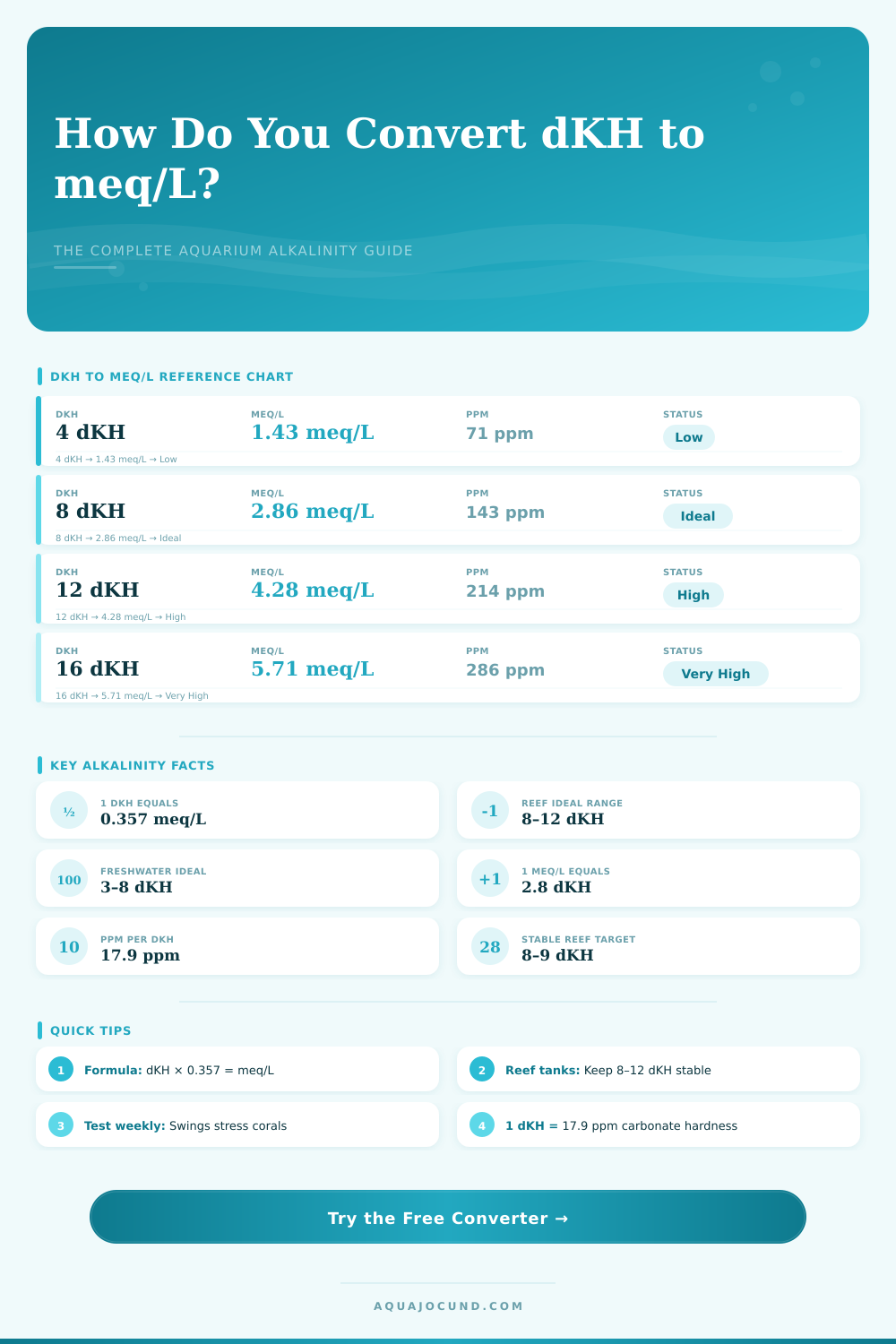
Typically reef keepers target 8 to 12 dKH. That’s approximately 2.86 to 4.28 milliequivalents per liter. If you dose, then this can be easly maintained within a narrow range.
For small polyp stony corals, the higher end of this range help them grow their skeletons. The lower half of this range are more forgiving. Large polyp stony corals will thrive in this range.
Freshwater aquarists has an advantage here as most freshwater fish prefer softer water. Many desire levels around 3 or 4 dKH. To put it another way, match your water parameters with the environment where your livestock came from. Soft blackwater rivers are where discus fish originate and they won’t do well in alkaline water necessary to sustain SPS corals.
How much? Simple. For every degree of carbonate hardness, there is approximately 0.357 milliequivalents per liter. That’s a hard number that comes from their respective molecular weights. No need to memorize…just know how it works. This comes in handy if you ever read scientific papers.
Why stick to only one unit? Because it just saves you the hassle of converting back and forth between them. Convert your target once and forget the other unit. Being consistent mean there are no errors.
When people talk about “alkalinity,” they think about increasing it. Instead of increasing alkalinity, keep it constant. Rapid changes is worse than low alkalinity. Shocks kill corals. They will adapt to new parameters over time but not rapid changes. Daily swings of more than 0.5 dKH can stress your corals. That can lead to bleaching or tissue recession.
What’s important isn’t what the number is but what the variance are around that number. This is why many hobbyists who have been doing this for a while will test at the same time each day, it also shows you how much alkalinity was consumed overnight.
It’s easy enough to see from the reference table what those values are. But in order to use the information, you need some idea of what it means. You might find that a bit more alkalinity is necessary to maintain your pH for CO2 injection in a planted tank. Or maybe much higher alk levels is required to match your African cichlid tank with the hard water of Lake Malawi. The tool allows you to switch through this quickly and get a ballpark value.
It doesn’t say how to correct the problem, however. You should of know your dosing schedule, your feeding habits, your filtration, and so on. Managing alkalinity is a balancing act. Yes, you need to replenish the carbonate used by corals, biopellets, and other organisms in the tank. And that’s a continuous process, not a one-time adjustment.
After you get familiar with how dKH relates to meq/L, those numbers will start telling a story about the health of your tank. You’ll start seeing patterns. You’ll be able to anticipate when it may drop, and then you can adjust accordingly based off information. That sense of control reduces the stress from the hobby.
The math is just the beginning.