Dissolved Oxygen Saltwater Calculator
Estimate marine dissolved oxygen saturation, altitude correction, livestock oxygen demand, aeration supply, and reserve margin.
🌊Real Saltwater Presets
💧Water and Tank Conditions
🐟Stocking and Aeration Inputs
Saltwater Dissolved Oxygen Estimate
🧪Species Oxygen Comparison Grid
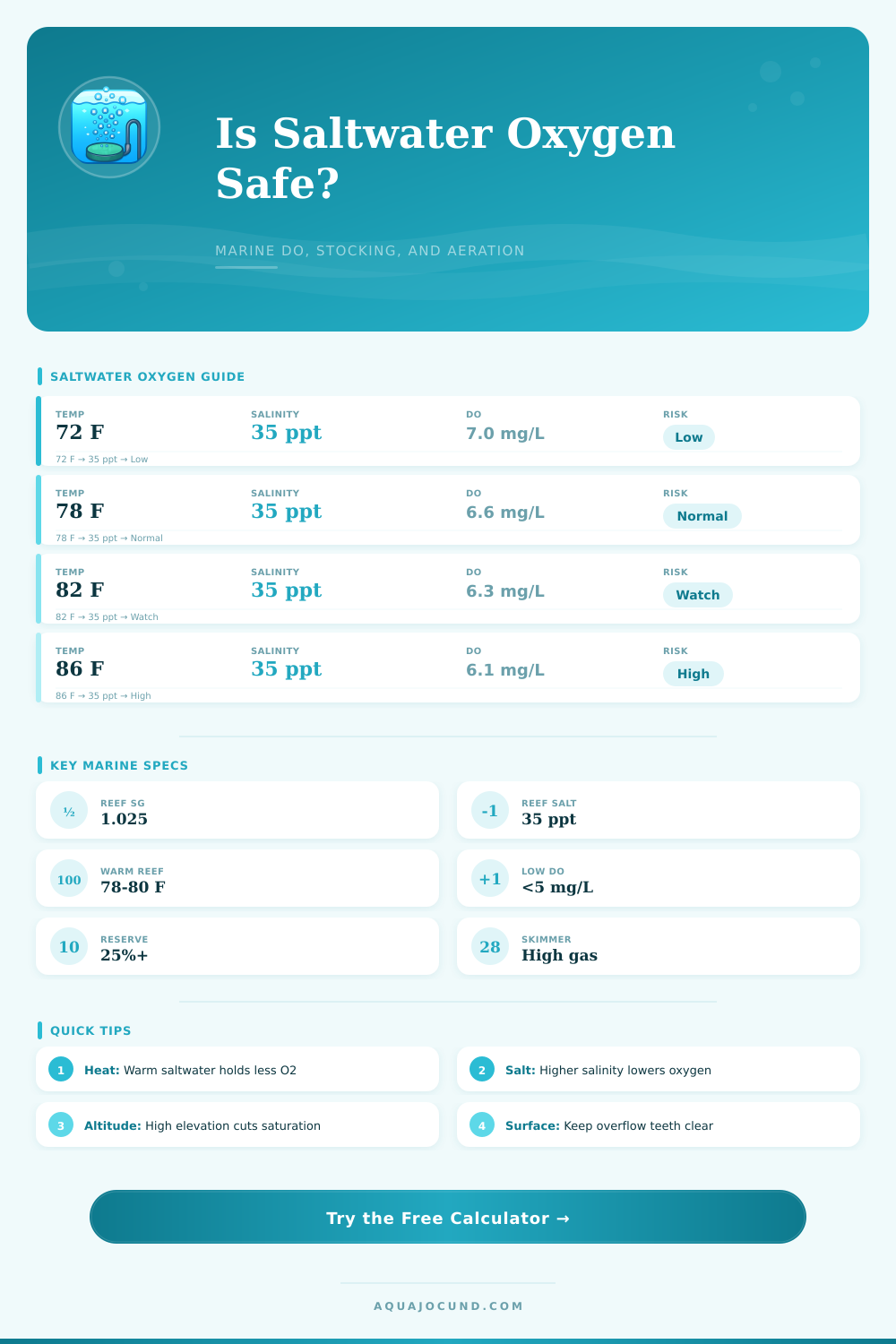
🌡Saltwater Saturation Reference
| Temperature | Salinity | Sea level DO | Planning note |
|---|---|---|---|
| 72°F / 22°C | 35 ppt | about 7.0 mg/L | Cooler marine water has better reserve |
| 78°F / 25.6°C | 35 ppt | about 6.6 mg/L | Common reef target range |
| 82°F / 27.8°C | 35 ppt | about 6.3 mg/L | Needs stronger gas exchange |
| 86°F / 30°C | 35 ppt | about 6.1 mg/L | Heat stress can shrink margin fast |
🌍Altitude Pressure Effect
| Altitude | Pressure factor | Saltwater effect | Adjustment |
|---|---|---|---|
| Sea level | 1.00 | Full saturation | Standard reef planning |
| 2,500 ft / 762 m | 0.91 | About 9% less DO | Favor open surface movement |
| 5,000 ft / 1,524 m | 0.83 | About 17% less DO | Add skimmer or air backup |
| 7,500 ft / 2,286 m | 0.76 | About 24% less DO | Use conservative stocking |
⚙Aeration and Gas Exchange Modes
| Setup | Exchange level | Typical marine use | Watch point |
|---|---|---|---|
| Still covered surface | Very low | Temporary holding only | Film and lids trap CO2 |
| Return nozzle ripple | Low-medium | Light nano reefs | Keep nozzles near surface |
| Powerheads breaking surface | Medium-high | Most reef displays | Avoid dead surface corners |
| Overflow and sump | High | Reef-ready aquariums | Clean overflow teeth |
| Protein skimmer plus overflow | Very high | Heavy reefs and FOWLR | Keep air intake open |
📏Common Saltwater Tank Benchmarks
| System | Surface area | Typical biomass | Oxygen planning note |
|---|---|---|---|
| 13.5 gal nano | about 176 sq in | 0.10-0.18 lb | Small volume changes quickly |
| 20 gal reef | about 288 sq in | 0.18-0.35 lb | Good ripple is important |
| 40 breeder reef | about 648 sq in | 0.45-0.90 lb | Wide footprint helps exchange |
| 75 gal reef | about 864 sq in | 0.80-1.60 lb | Overflow or skimmer recommended |
| 125 gal FOWLR | about 1296 sq in | 1.80-4.00 lb | Plan for large fish oxygen load |
Dissolved oxygen is an ingredient that most reef keepers don’t think about but is essential for keeping your livestock alive. It’s invisible. You can’t see it and standard test kits don’t include a way to measure it directly. If it drops, then your fish struggles to breathe and will be gasping at the water’s surface.
Dissolved salts take up space that air molecules would otherwise fill so saltwater has less oxygen then fresh water. If you keep active fish like anthias and tangs or if you run your tank warmer, your safety margin get pretty thin. Water is a fluid; its properties changes with temperature. In particular, warm water contain less gas than cool water. Your tank will behave differently in winter different than in summer based off the physics of those water temperature change. An 80 degree Fahrenheit system has less capacity for saturation then say seventy two degree water.
Why Oxygen Is Important for Your Reef Tank
Also, your oxygen levels is impacted by altitude. As you go higher up there is less atmospheric pressure, so fewer oxygen molecules dissolves into the water. Use a calculator to adjust for both temperature and local elevation and you’ll know exactly what reserve remains.
Oxygen demand varies based on stocking density. The amount of oxygen needed in your setup depend on what you stock. If you keep a nano tank with clownfish, its oxygen needs will be very different than a hundred-gallon predator tank. Oxygen demands also vary depending upon fish size; larger fish requires more oxygen per lb. This refers to the weight of the fish’s body. Active swimming fish expend their reserve quicker then inactive bottom dwellers. Total fish biomass are a good indicator of how much oxygen your livestock requires in an hour.
Metabolic load is something many hobbyists fail to take into account when they thinks about their tank’s need. For example, you may have lots of water but not enough surface area for gas exchange. The surface might also be covered with films or lids and this can suffocate your fish. Gas exchange occurs only at the air-water interface; surface agitation help oxygenation. Even with a strong return pump you still can’t increase intake without a smooth surface. Protein skimmers, wave makers, and overflow boxes breaks up that boundary layer, helping exchange. Tables is available that detail how much exchange each setup offers (light reef vs. Heavily stocked). When you rely on just a gentle ripple in a heavily stocked tank, you run into trouble when power outages occur or when it’s really hot. Consistent gas exchange depends less on upgrading equipment than keeping those teeth on your overflow free from debris.
Dissolved oxygen (DO) is finicky and hard to measure. The amount change daily due to photosynthesis from algae and corals during the light cycle. This increase DO until it is saturated over 100%. Respiration occur 24/7 and will be at its low point just as dawn breaks. That’s the danger zone if you’re on a narrow margin every day.
Use an oxygen calculator to determine how much you need as a minimum percentage safety reserve. It’s easier to keep it right initially than fix the situation once you see gasping fish. You should of watch your temps, have some activity at the surface, and respect the boundaries of saltwater chemistry… And let your livestock thrive.