Denitrator Flow Rate Calculator
Size a reactor drip rate from nitrate level, usable media volume, target contact time, effluent nitrate target, oxygen phase, and ramp schedule.
Use actual water volume after rock, sand, sump level, and displacement.
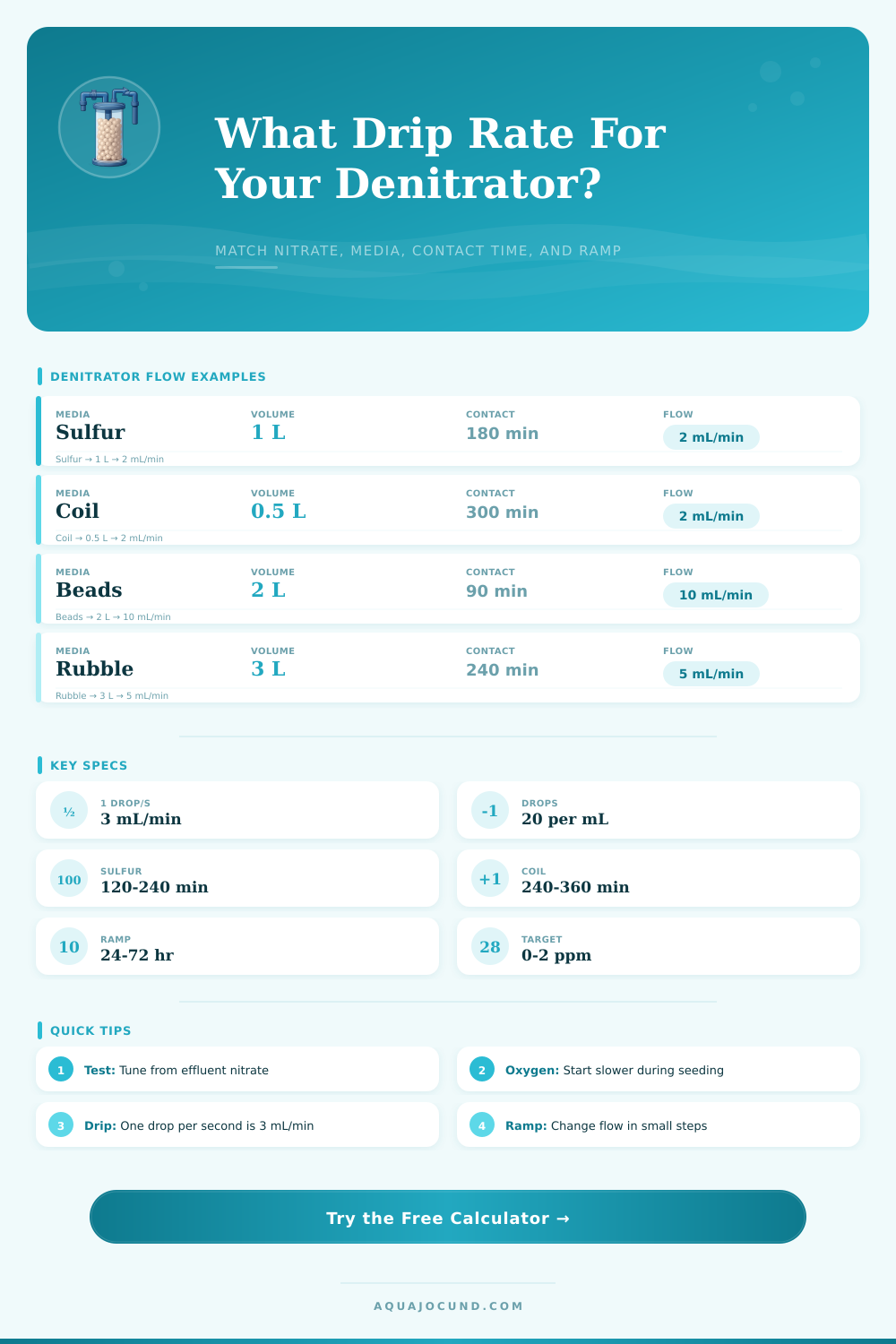
One drop per second is about 3 mL/min using 20 drops per mL.
Recommended Flow
Sulfur reactor
Slow drip, autotrophic bacteria, often paired with aragonite media to buffer acidic effluent.
Coil denitrator
Uses long tubing to consume oxygen before water enters a low oxygen bacterial zone.
Carbon-fed chamber
Can run faster, but the dose and effluent must be managed to avoid bacterial carryover.
Porous media bed
Depends on deep pore anoxic zones; flow is tuned by effluent nitrate rather than pump rating.
| Media style | Void factor used | Starting contact target | Flow behavior | Effluent note |
|---|---|---|---|---|
| Sulfur granules | 0.42 of media volume | 180 min | Very slow ramp | Watch pH, alkalinity, nitrate, and sulfur odor. |
| Sulfur aragonite mix | 0.40 of media volume | 210 min | Slow ramp | Aragonite can help buffer acidic sulfur effluent. |
| Ceramic anaerobic media | 0.52 of media volume | 240 min | Slow to moderate | Deep pores matter more than fast basket flow. |
| Glass sintered media | 0.48 of media volume | 180 min | Moderate | Best tuned by effluent testing after each change. |
| Beads carbon-fed bio media | 0.45 of media volume | 90 min | Can run faster | Carbon-fed reactors need careful dose control. |
| Coil tubing path | 1.00 of tube water volume | 300 min | Drip only | Long tubing strips oxygen before the low oxygen section. |
| Rubble live rock chamber | 0.38 of media volume | 240 min | Slow | Irregular voids can channel if flow is too high. |
| Sand deep reactor bed | 0.35 of media volume | 360 min | Very slow | Use a conservative ramp to avoid disturbing zones. |
| Drip setting | Approx mL/min | Liters per day | Contact with 500 mL usable volume | Best use |
|---|---|---|---|---|
| 1 drop every 4 sec | 0.75 | 1.08 L/day | 667 min | First low oxygen seeding on small reactors. |
| 1 drop every 2 sec | 1.50 | 2.16 L/day | 333 min | Early sulfur or coil denitrator startup. |
| 1 drop per sec | 3.00 | 4.32 L/day | 167 min | Common slow drip reference point. |
| 2 drops per sec | 6.00 | 8.64 L/day | 83 min | Mature small reactor with clean effluent. |
| 5 drops per sec | 15.00 | 21.60 L/day | 33 min | Only for large or faster carbon-fed reactors. |
| System | Water volume | Typical media | Starting flow | Ramp target |
|---|---|---|---|---|
| 10 gal nano coil | 38 L | 0.2 L tubing water | 0.4-0.8 mL/min | Effluent below 2 ppm before increasing. |
| 20 long planted | 76 L | 0.4 L ceramic media | 0.8-1.5 mL/min | Keep measurable nitrate for plants. |
| 55 gal community | 208 L | 1.0 L porous media | 2-4 mL/min | Increase after 48 hour effluent checks. |
| 75 gal reef sulfur | 284 L | 1.5 L sulfur mix | 3-6 mL/min | Watch alkalinity and reactor odor. |
| 125 gal display | 473 L | 3.0 L sulfur or beads | 5-12 mL/min | Ramp until effluent nitrate rises slightly. |
| 300 gal pond loop | 1136 L | 8.0 L bio media | 15-35 mL/min | Use bypass valve and frequent testing. |
| Effluent result | Likely condition | Flow action | Retest timing |
|---|---|---|---|
| Nitrate near tank water | Too much oxygen or not colonized | Hold or reduce flow | 24-72 hours |
| Nitrate above target but falling | Reactor is catching up | Hold flow steady | 24-48 hours |
| Effluent 0-2 ppm NO3 | Working contact time | Increase by ramp step if more capacity is needed | 48 hours |
| Sulfur odor or very low nitrate | Nitrate-limited or too slow | Increase flow slightly and aerate effluent | 12-24 hours |
| Nitrite appears in effluent | Incomplete transition | Reduce or hold flow, retest before sending to display | 24 hours |
Most aquariums has elevated levels of nitrates, a stressor, despite good-looking fish. Unlike an ammonia spike which harms instantly, nitrate damage slowly by weakening immune function and slowing growth; it accumulates over months. To eliminate nitrate without performing water changes, you must establish special biological environment within a reactor that’s different than the rest of your tank. The difference? Oxygen content in the water. Because bacterial workhorses will only survives at certain speeds, flow rate becomes most important.
To calculate your own flow rate and convert volume to drips (which the calculator above do for you), lets understand how those figures affect the process. To make nitrate safe (nitrogen gas), denitrifying bacteria need low oxygen (anaerobic) conditions. They will do nothing with nitrates if there’s a lot of oxygen. So when the water pass through the media, you don’t want it moving too fast or you’ll have oxygenated display water wash over them before the oxygen is stripped from the water. It will keep your bacteria operating in aerobic mode, doing nothing for the nitrate. Instead, you want some kind of optimal residence time. Ideally, each milliliter of water spends just enough minutes in reactor to pass by the bacteria that gobble up its waste.
How to Control Flow Rate for Low Nitrates
Pushing flow aggressively depends off the media type. Slow growing self-feeding bacteria in sulfur granules require extended contact time to convert nitrate, which mean long dwell time and slow flow rates. Rush them and they become unforgiving; they’ll release acidic effluent if oxygen invades or flow rate increase. Heterotrophic bacteria supported by carbon-feed bio beads can withstand greater velocity, as they’re faster-reproducing. But this presents its own set of problems. Overfeed carbon and you’ll promote bacterial growth, causing media to clog, and increasing the organic load elsewhere in your tank.
It’s all about finding balance between speed and stability. And the chart on the page above provide a general guide for where to begin with each style of media. As you can see, bead systems may be able to sustain a steady stream whereas sulfur reactors typically begins trickling.
The biggest mistake most hobbyist make is not being patient, there’s no “patience” number on your test kit. If you change out old sulfur or add new media, the reactor will be biologically inactive. The instant you send full volume through it, you’ll flood the thing and remove oxygen faster then any colonizing bacteria can handle. Also, you’ll wash out those early settlers before they have time to take root. If instead you gradually ramp up flow, the bacterium can catch up as the biological load increases.
Start slowly, check your effluent nitrite & nitrate, and only bump up flow if output water indicates that the reactor is operating efficienty. Any sign of nitrite in the output indicates an unstable transition zone between bacteria that live without oxygen and those that live with oxygen, which tells you to back off (or maintain) rather than push harder.
The other important consideration is oxygen control. Today’s powerheads and canisters introduces a lot of dissolved oxygen into the water. There needs to be a way for that oxygen to be used up before it enters the last chamber, which contain the bacteria. For a denitrator, this is typically done with a long length of tubing (a coil denitrator), which simply gives the oxygen time to be used up naturaly. For a sulfur reactor, the process of the slow drip help deoxygenate the water (either in the headspace, or while passing slowly over the bed). If your source water has a lot of aeration in it, you need to use longer tubing pathways or just run lower flows to offset. That will help ensure the anoxic zone remains truly anoxic.
Tuning a denitrator is less about getting it exactly right and more about listening to how chemical feedback loop responds. Run the effluent through some tests. Is nitrate decreasing? Do you have clean effluent water? Then turn up the flow a little. Do you get high nitrate in effluent, or can you tell its not flowing by smell, then back it down? You should of used your test kit and eyes are the last ways to check, but the tool is the baseline.
Smooth is slow, and slow will get you the low nitrate you want without killing the system you sweated so hard to create.