Degassed pH Calculator
Estimate aquarium CO2 ppm, pH drop, KH-based carbonate effect, and confidence in your gas-off sample.
Degassed pH Results
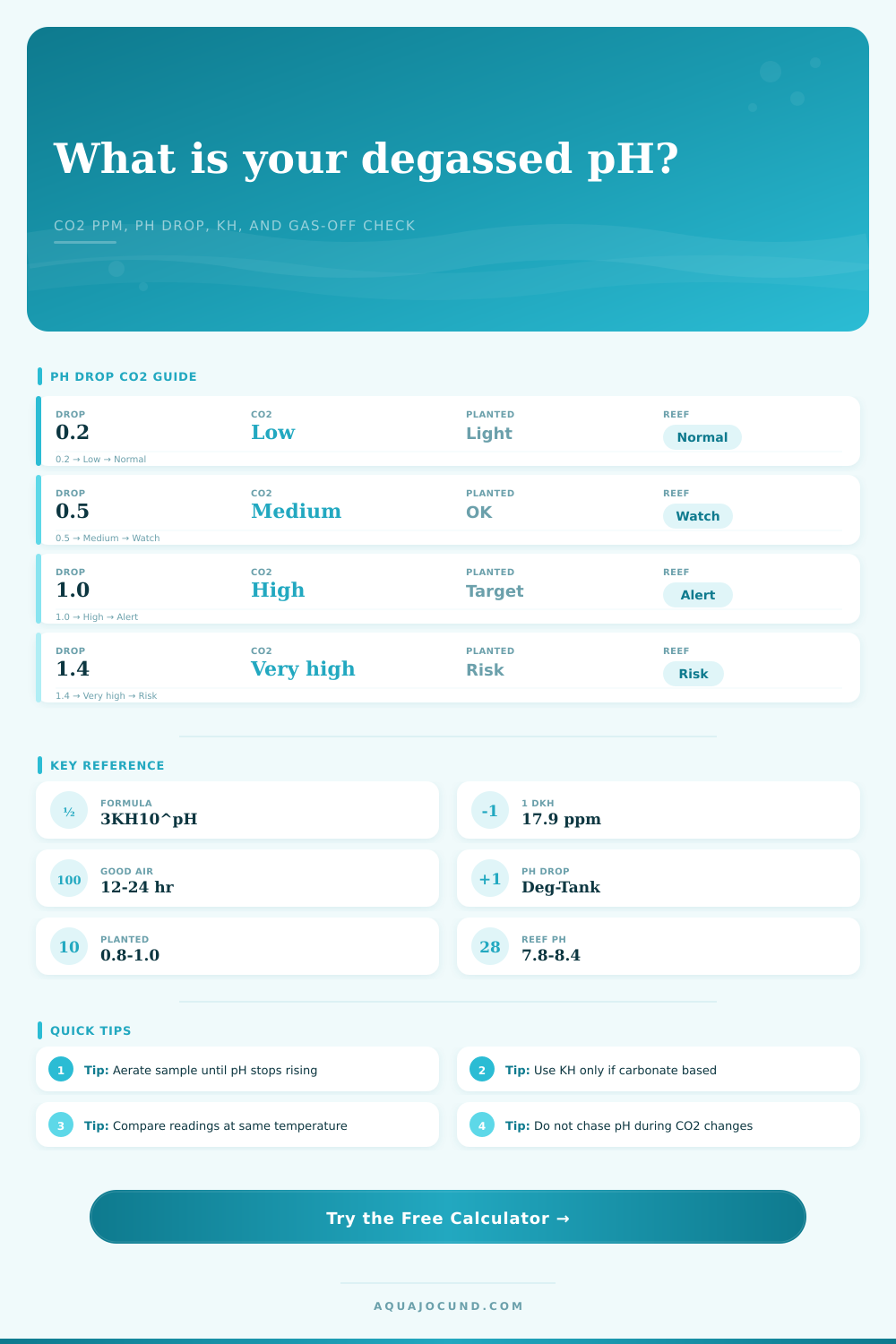
| Measured pH drop | CO2 ratio | Planted tank reading | Reef / marine reading |
|---|---|---|---|
| 0.10 to 0.30 pH | 1.3x to 2.0x | Low Light CO2 effect or off-gassed tank. | Normal Day-night pH swing range. |
| 0.40 to 0.70 pH | 2.5x to 5.0x | Moderate Useful for low to medium plant demand. | Watch Check aeration and nighttime lows. |
| 0.80 to 1.00 pH | 6.3x to 10.0x | Common target Often near injected CO2 range. | Alert Usually excessive for reef animals. |
| 1.10 to 1.40 pH | 12.6x to 25.1x | High Verify livestock behavior and test accuracy. | Risk Investigate gas exchange immediately. |
| Context | Usual KH reliability | Useful pH drop range | Adjustment note |
|---|---|---|---|
| Injected planted tank | Good if KH is carbonate based | 0.6 to 1.0 pH | Degassed pH helps separate CO2 from baseline water chemistry. |
| Active soil shrimp tank | Often reduced | 0.1 to 0.5 pH | Soil acids can make KH-pH CO2 math read high. |
| Blackwater tank | Often low | 0.1 to 0.4 pH | Tannins and organic acids weaken chart confidence. |
| Reef aquarium | Partial carbonate plus borate | 0.1 to 0.4 pH | Use alkalinity and pH trend as aeration clues, not CO2 dosing targets. |
| High-KH cichlid tank | Usually strong | 0.1 to 0.5 pH | Large KH buffers pH, so small pH shifts can still reflect gas exchange. |
| Tank size | Dimensions | Approx volume | Degassed sample plan |
|---|---|---|---|
| 10 gallon | 20 x 10 x 12 in / 51 x 25 x 30 cm | 38 L | Small cup with air stone, retest after 12 hours. |
| 20 long | 30 x 12 x 12 in / 76 x 30 x 30 cm | 76 L | Compare same-day tank pH and overnight degassed pH. |
| 40 breeder | 36 x 18 x 16 in / 91 x 46 x 41 cm | 151 L | Useful planted-tank size for 0.8 to 1.0 pH drop checks. |
| 75 gallon | 48 x 18 x 21 in / 122 x 46 x 53 cm | 284 L | Log lights-on timing because CO2 changes quickly. |
| 120 gallon reef | 48 x 24 x 24 in / 122 x 61 x 61 cm | 454 L | Use skimmer-aerated sample and compare to pH trend. |
| Method | Typical time | Confidence clue | Best use |
|---|---|---|---|
| Air stone in cup | 12 to 24 hours | pH changes less than 0.03 in 30 minutes | Most freshwater planted tanks. |
| Vigorous aeration | 6 to 12 hours | Strong surface churn and stable temperature | Fast checks when a pump is available. |
| Open cup swirl | 24 to 36 hours | Slower pH rise, repeat if still drifting | Backup method without an air pump. |
| Skimmer aerated sample | 6 to 12 hours | Outdoor or room-air comparison is useful | Reef aeration and indoor CO2 checks. |
How do you know if that carbon dioxide is floating around in your tank or actualy doing something? You can’t tell from looking at it. The bubbles is rising. The fish are OK. The water is clear. Maybe the plants aren’t growing like they should of.
So some folks resort to the degassing method to take away the guesswork. There’s no guessing; it’s based off chemistry. How does it work? Simply put, you collect some water from your tank and force air bubbles through it for a long time. Watch as the extra dissolved carbon dioxide leaves the water, leaving you with water that has no more CO2 then the atmosphere. Then you measure the pH of this air-free water and compare it to original pH measurement of your tank. If they’re different, then you know there’s extra CO2 present and how much.
How to Check Your Tank’s CO2 Level
You simply input the initial tank pH and KH into the calculator and let it do the math. No need for you to mess around with logarithms when your eyes is too tired. Convert the pH decrease into an actual ppm value. Determine whether you’ve fed your plant or have suffocated your shrimp.
This is where most beginners go wrong. They pick a number, and then use that as the law. Thirty ppm, ok that’s good. Not so fast! There is several variables to water chemistry. Your tank might have high levels of tannins, maybe some active soil. That change how your carbonates react compared to hard water. You’re able to change the carbonate part of your alkalinity using this tool. Why? Because other buffering agents like phosphates and organic acids can throw off calculation. And if you think all your alkalinity is carbonate then the calculator mislead you.
Another factor is time. Running a test means you can’t put it under a bubbler for a few minutes and say “it’s science”. Let it settle down. Leave it there gently bubbling from an air stone for at least 12-24 hrs. You don’t want the pH to continue to rise. So if it does keep going up then you started out wrong. Your drop will appear lower than actual. And that error compound rapidly. Starting off small on the baseline results in very large errors on your final ppm estimate. Measurement take patience.
But it depends on the context of the tank. If you are running a high tech planted tank, a drop of almost a full pH unit may be your goal. That indicates a healthy CO2 injection system. On the other hand, if you’re running a reef tank, that same drop is cause for concern. Gas exchange problems is something marine livestock can’t tolerate. A big change in pH during the day is likely more indicative of insufficient aeration at night different than a beneficial additive. The same data point becomes an alert in one hobby and a target in the other. In short, biology sets the goal, not the spreadsheet.
Then there’s temperature. Gas has less solubility in warm water than it does in cold water. It also affects both the pH and the saturation levels. So you have two variables: temperature and gas saturation. To take readings at multiple temperatures introduces noise into equation. Whether you are using a color change kit or a probe, maintain consistency. For example, if you use a color change kit one time and a probe another time, you’ve lost the thread. Better to have a calibrated probe than a color change kit but consistency is king.
It’s intuitive. Do the test, see the number, watch the livestock. Watch the plants grow. See the fish gasp. This was a snapshot of the water chemistry at that time. Support your eyes, but it doesn’t replace them. After seeing the correlation between the health of your aquascape and the pH drop, the numbers are no longer abstract. They’re part of the tank’s story. The invisable cloud is no longer a mystery.