🐟 Daphnia Culture Harvest Calculator
Estimate how many daphnia to harvest, how long the culture needs to rebound, and whether the pull matches fish demand.
Harvest Estimate
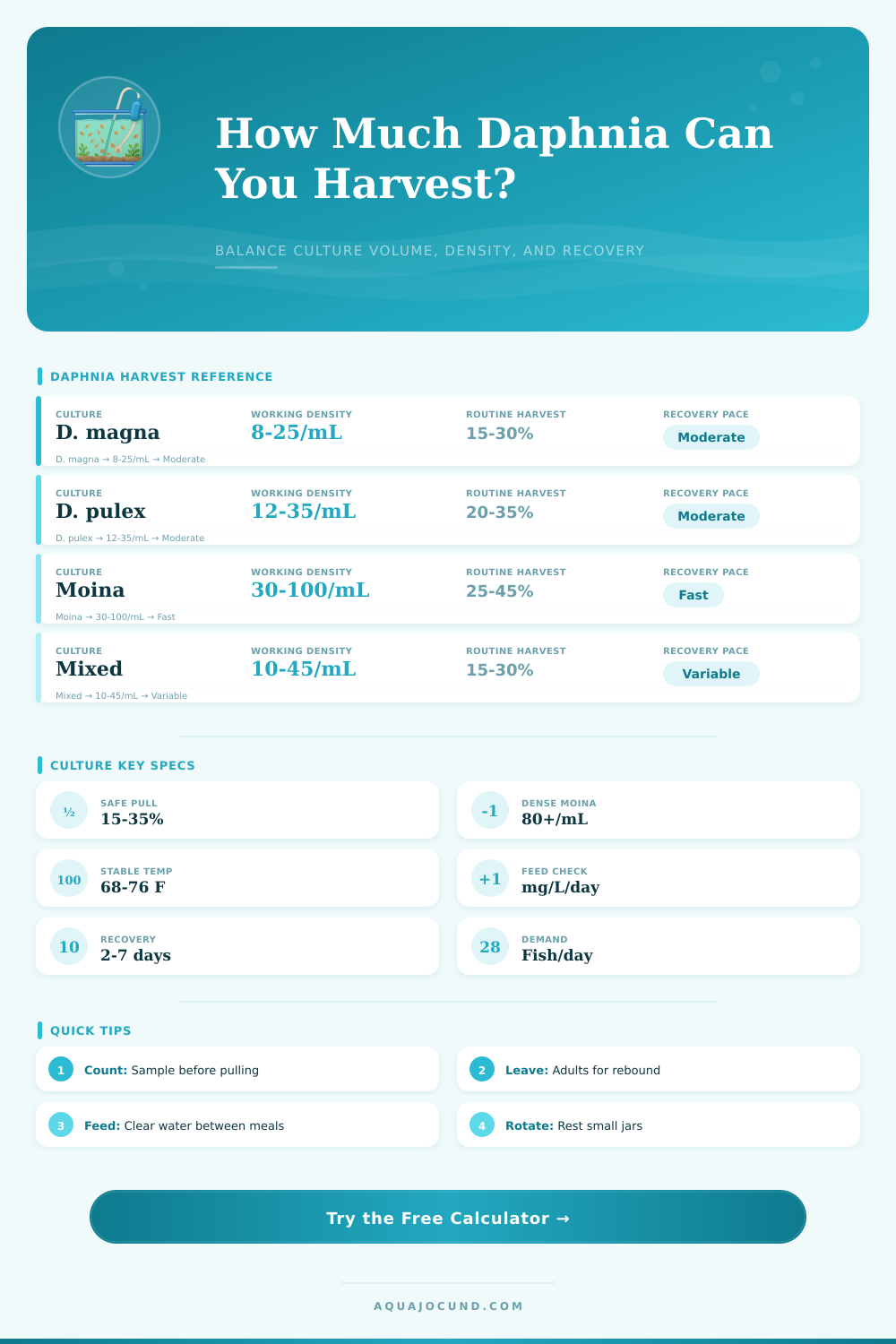
| Profile | Typical density | Routine harvest | Growth pace | Best use |
|---|---|---|---|---|
| Daphnia magna | 8-25/mL | 15-30% | Moderate | Large fish treats, easy netting |
| Daphnia pulex | 12-35/mL | 20-35% | Moderate-fast | General aquarium feeding |
| Moina | 30-100/mL | 25-45% | Fast | Small fish, fry, warm rooms |
| Mixed daphnia | 10-45/mL | 15-30% | Variable | Low-maintenance backup culture |
| Starter culture | 2-10/mL | 5-15% | Building | Seeding more containers |
| Dense peak culture | 40-120/mL | 25-40% | Slowing | Short harvest window |
| Harvest level | Percent pulled | Culture response | Use when | Recovery note |
|---|---|---|---|---|
| Seed pull | 5-10% | Very stable | Starting a second jar | Often rebounds in 1-2 days |
| Light routine | 10-20% | Stable | Small daily treats | Good for young cultures |
| Normal routine | 20-35% | Manageable dip | Regular fish feeding | Rest until density visibly returns |
| Heavy pull | 35-50% | Noticeable slowdown | High demand or dense Moina | Needs strong feed and clean water |
| Emergency pull | 50%+ | Crash risk rises | Only with backup cultures | Expect a longer rest period |
| Temperature | Culture speed | Oxygen caution | Feeding note | Calculator effect |
|---|---|---|---|---|
| 60-64°F / 16-18°C | Slow | Low stress | Feed lightly | Longer recovery |
| 65-70°F / 18-21°C | Moderate | Stable | Normal light feed | Balanced recovery |
| 71-76°F / 22-24°C | Fast | Watch clouding | Feed when water clears | Best rebound for many cultures |
| 77-82°F / 25-28°C | Very fast | Oxygen can dip | Use gentle aeration | Fast but higher risk |
| 83°F+ / 28°C+ | Unstable | High stress | Avoid heavy feed | Risk penalty applied |
| Fish group | Treat demand | Heavy demand | Typical prey size | Harvest planning note |
|---|---|---|---|---|
| Nano fish | 20-50 each/day | 60-120 each/day | Moina / small pulex | Small frequent pulls work well |
| Guppies and endlers | 40-80 each/day | 100-180 each/day | Pulex / Moina | Demand rises in colony tanks |
| Betta or gourami | 30-80 each/day | 100-200 each/day | Medium to large daphnia | Use as a portion of diet |
| Fry grow-out | 80-200 group/day | 300-800 group/day | Moina / small daphnia | Match prey size to mouth size |
| Goldfish or large fish | 150-400 each/day | 500+ each/day | D. magna | Needs larger tubs or rotation |
It happens. Your daphnia jar is empty and your fish are looking hungry. They’re counting on you to take care of them, so you reach in and greedily scrape up all the remaining live food. At least I feel like I’m doing something at the time. Unfortunatley, most of the time it result in a dead culture three days later.
While it’s human nature to try to get the most output for our input as quickly as possible, we tend to overlook biology: These little shellfish requires resources (and time) to make more. A living culture take some self-restraint, and having an idea of what amount is “safe” will allow you to harvest without guesswork, or at least good guesswork.
Why You Should Not Harvest All Daphnia
Balancing harvest volume with population density are an abstract thing until you consider what’s really occurring in the jar. This isn’t simply removing some animals from the water…it’s removing breeding adults along with their food source. If you yank too far, there won’t be enough survivor left to produce enough offspring to replace what was lost. They might die from starvation or other waste build-up first.
The calculator (above) figures all this for you based off your selected settings for volume, density, and temperature and then displays exactly how much biomass you can safely pull off while maintaining ecosystem health. It takes a guessing game and turns it into a planned operation where you know the answer to the question, will I have enough left to sustain growth after pulling that twenty percent?
This equation also hinges heavily on temperature, since that determine the rate of reproduction and metabolic activity. The warmer the water, the faster it runs through both. That’s all well and good if you want to produce faster; but it will require more oxygen and generate waste faster too. If you forget about that tank for a week, a seventy-five degree culture will crash hard but rebound much faster, while a sixty-two degree culture take longer to bounce back.
This leads to the question about ambient temperature: We’re not going to assume that you keep every tank in a standard room environment, so we adjust the recovery time to match. Two days? Five days? How long should you wait for the population to level off before feeding again? That information lets you manage your feed schedule according to how far your system can actualy stretch.
In addition to volume, which most hobbyists assess based on cloudiness instead of numbers anyway, we know that density make a difference. Thirty daphnia per milliliter in a half gallon jar will yield considerably more edible food than ten in a five-gallon bucket. You may have harvested too little from a sparse culture or fed your fish too little if you didn’t check density and counted the organism directly.
This takes time, it requires a little sample to get an accurate number, but it’s necessary so you don’t discover at feeding time that your supposedly robust culture is running on fumes. The reference tables on the page gives you some benchmarks against which to compare your raw numbers and determine what a healthy density should be for certain species (e.g., Daphnia magna vs. Moina).
Another variable that is easy to neglect until it’s too late is feed. In order for daphnia to continue reproducing they require food. If you are underfeeding and pull hard, all of the survivors will either starve or eat their own young. You can use the tool to see if the amount of food you expect to provide will keep the remaining population alive after you remove some. It also serves as a reminder that everything you remove will not be replaced unless you replace it with sufficient nutrition.
Maintaining greenwater (or even yeast suspension) at appropriate levels require keeping it clear enough to allow oxygen exchange, yet rich enough to support growth. Many people has a vending machine mentality. They view their daphnia cultures as vending machines: you add work, turn the crank, then collect results. It’s not a vending machine; it’s a living system, and living things need time and attention.
Rotating them and setting up several jars means you’ll always have a jar resting while another set produces. This minimizes the risk of losing everything and helps you maintain a consistant supply of food for your livestock. The idea isn’t to extract every single animal from the liquid, but rather provide enough food so it continues feeding itself in order to continue reproducing. Achieving that equilibrium makes it more of a hassle-free routine, not a frantic series of emergency chores and a source of live food for your healthy livestock.
You should of planned better.