💧 Custom Dimension Tank Volume Calculator
Estimate aquarium water volume for custom rectangles, cubes, cylinders, bow fronts, L-shaped tanks, and direct volume entries with glass thickness, freeboard, and displacement.
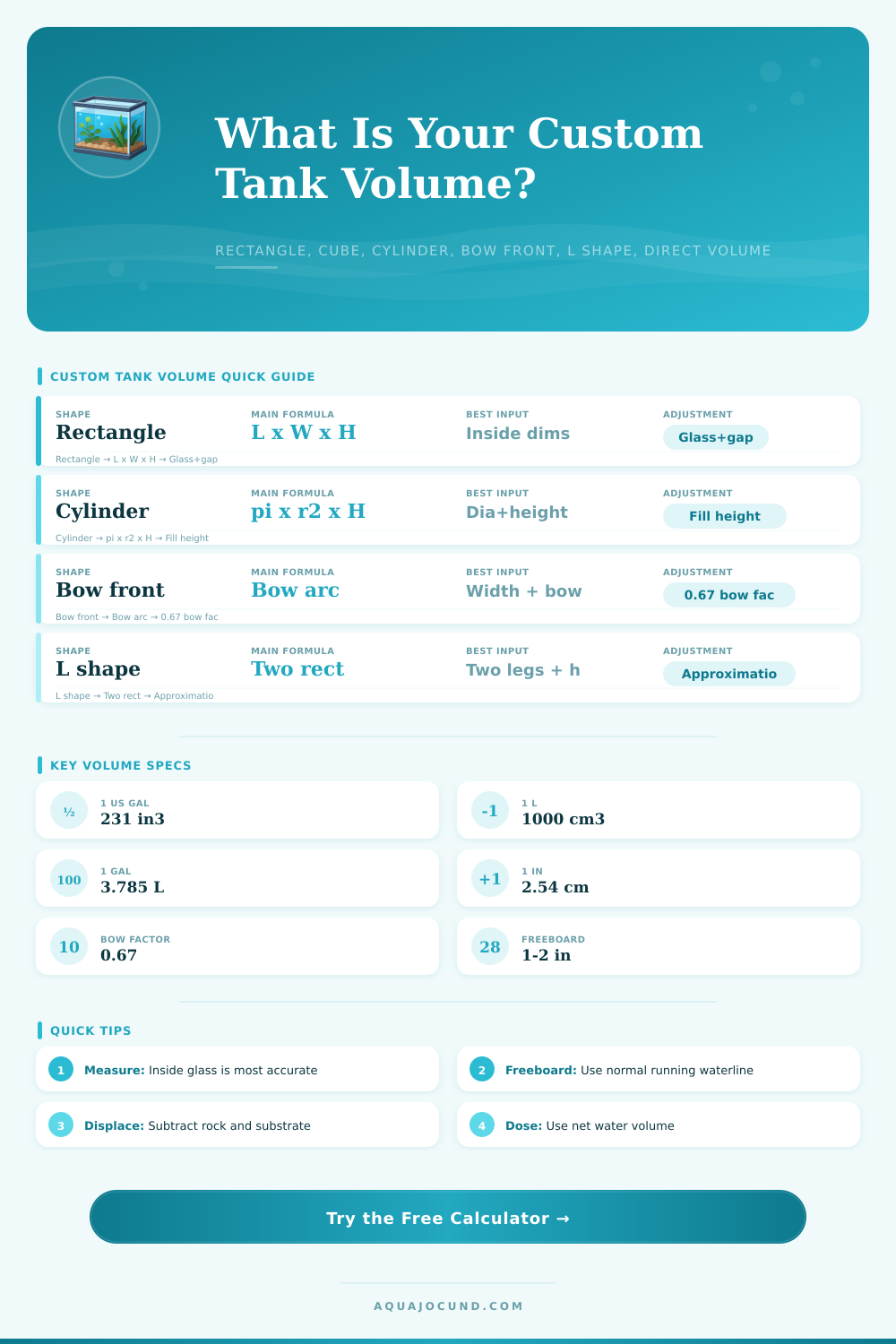
| Shape | Formula used | Inputs shown | Best use |
|---|---|---|---|
| Rectangle | L x W x filled H | Length, depth, height | Standard aquariums and sumps. |
| Cube | Side x side x filled H | Length as side, height | Cube aquariums that are filled below the rim. |
| Cylinder | pi x r2 x filled H | Diameter and height | Round columns and cylindrical displays. |
| Bow front | (L x W + L x bow x 0.67) x filled H | Length, depth, bow bulge, height | Approximate curved-front aquariums. |
| L-shaped | (L1 x W1 + L2 x W2) x filled H | Main leg, second leg, height | Corner tanks and custom desk footprints. |
| Direct volume | Known volume minus displacement | Known volume, surface area | Manufacturer volume, sump chambers, or measured bucket fill. |
| Preset tank | Nominal dimensions | Typical gross volume | Calculator note |
|---|---|---|---|
| 10 gal rectangle | 20 x 10 x 12 in / 51 x 25 x 30 cm | About 10 gal / 38 L | Small errors in fill height matter. |
| 20 long | 30 x 12 x 12 in / 76 x 30 x 30 cm | About 20 gal / 76 L | Large surface area makes freeboard visible. |
| 40 breeder | 36 x 18 x 16 in / 91 x 46 x 41 cm | About 40 gal / 151 L | Measure inside width for dosing volume. |
| 60 cm cube | 60 x 60 x 60 cm / 24 x 24 x 24 in | About 57 gal / 216 L full cube | Glass and freeboard reduce net volume. |
| 46 bow front | 36 x 15 x 20 in with bow | About 46 gal / 174 L | Bow factor is an approximation. |
| 120 cm reef | 120 x 50 x 50 cm / 47 x 20 x 20 in | About 300 L / 79 gal full box | Rock displacement often changes dosing volume. |
| Glass thickness | Approx metric | Outside-dimension adjustment | Volume effect |
|---|---|---|---|
| 1/8 in | 3 mm | Subtract 0.25 in from length and depth | Small but noticeable on nano tanks. |
| 1/4 in | 6 mm | Subtract 0.50 in from length and depth | Common mid-size estimate. |
| 3/8 in | 10 mm | Subtract 0.75 in from length and depth | Can remove several gallons on large tanks. |
| 1/2 in | 12 mm | Subtract 1.00 in from length and depth | Important for large rimless or tall tanks. |
| Adjustment | Typical range | How calculator applies it | When to refine |
|---|---|---|---|
| Freeboard | 0.75-2.00 in / 2-5 cm | Limits filled water height or reports reserve. | Use actual running waterline for overflow tanks. |
| Equipment displacement | 1-3% | Profile deduction from gross filled water. | Skimmers, pumps, and baskets may be measured directly. |
| Planted aquascape | 5-9% | Profile deduction plus known manual displacement. | Sloped substrate and large wood deserve a bucket test. |
| Reef rock | 8-12% | Profile deduction before the net water result. | Dense rock or ceramic structures can vary widely. |
| Heavy stone | 12-16% | Profile deduction for large hardscape mass. | Use measured displacement for precision dosing. |
The issue is that tanks is sold by nominal capacity (a convenient marketing number) as well as external footprint (also convenient). Neither of these are useful for chemistry; they’re useful only for buying a tank. Since you want fish, you buy a tank. You don’t buy empty air space above the surface, or glass, or rock. You buy water space. So if you dose something, salt mix, medication, based off the label, you’ll almost certainly overdose your livestock since you’re treating volume that doesn’t exist. This calculator removes the package and finds real thing (the water). It work with cylinders, cubes, rectangles, bow fronts, L-shapes, and more. It also allows you to enter direct volume if you happen to know gross amount but still need to account for what’s displacing it.
Outside dimensions aren’t everything, The very first thing to know about these calculators is that outside dimensions are deceptive. Trim increase the width, and the glass thickness does too. Before you’ve poured anything into the tank, a half-inch thick glass panel on a big rimless tank will consume an inch of inside depth and an inch of inside length (on both sides). That may not sound like much but it’s volume. Volume is 3 dimensional. If you shrink the base by two inches all told, you’ll cut out a pretty healthy chunk of your capacity before you pour a single drop in there. If you choose outside dimensions and input the glass thickness, it take this into account automatically, reducing the width and length by depth of the panels to arrive at true internal box. This is a minor tweak that will save you from purchasing too much of one thing or another.
Why You Need Accurate Water Volume
Which leads to the next issue: How much do you really put in? Unless you like to mop up the drips of evaporated water on your floor, no one fills it all the way. That area between the rim and the water line is called freeboard, a safe zone used for headroom, overflows, or preventing surface skimmers from sucking in air. By entering an exact fill height or saying how far below the rim you want the water to be (in inches), you create the freeboard. This is important if you have a skimmer at the surface, since you don’t want it to suck air. It’s also important if you’re running an overflow system, which requires some headroom. You can enter that reserve and the amount it subtracts from total height, which is what gets fed into the volume calculation. It makes the max capacity more practical (what you can operate at), not what it could hold if filled to overflowing.
Most of us hobbyists blow lots of money here: Displacement. Heaters, filters, rocks, sand, and driftwood take up space that’s no longer available for water. Even just dirt in a planted tank with a heavy substrate layer will take away 10% of the capacity of that tank. A reef tank stacked with live rock could lose twenty percent or more if the structure is dense. The tool has profiles for those kinds of situations and it estimate how much was lost by typical aquascaping density. Alternatively, you can enter a custom value for what the displacement was because perhaps you’ve measured your rocks in a bucket before putting them into the tank. That way, when you’re calculating your dosage rates, you’ll know you’re dosing for water molecules and not the stones that surround them.
Certain geometries (e.g., L-shapes & bow fronts) also needed specific treatment that’s beyond simple multiplication. For instance, a flat panel front doesn’t add any volume to the tank while a bowed out one does. However, figuring out precise amount of the curve requires CAD software. Instead, the calculator assumes a percentage increase in volume based on how deep the “bulge” is. That’s not exact but good enough for our dosing needs. Likewise, the calculator treats L-shaped tanks as just two rectangles joined at the corner. Enter both sets of dimensions. It will sum their areas together and then apply the fill adjustment and tank height. In short, it makes awkward shapes easier to work with by reducing them to something you can do math with, even if you don’t have a degree in geometry.
You get displacement removed, freeboard reserve, gross filled volume, and net water volume as output. The one you’ll use for all other purposes is the net volume. That tells you how many fish you can keep. How much remineralizer should you mix? How much CO2 do I need to run the system? Gross volume lets you know how big this thing is going to be physically before you add any hardscape. Reserve will tell you if you have a safe margin from splashovers. Displacement will show you how much you’re paying for water capacity with those decorations.
The label on the box is all anyone goes by. And that’s where they go wrong. Once you add your own configuration of substrate, rocks, etc., your tank isn’t a standard product any longer. Instead, it becomes your custom container with special constraints. Knowing your inside dimensions, not the outside ones, provides precision. Not accounting for glass thickness avoids the overestimation error. Noting the displacement ensures accuracy. Often a few gallons can mean the difference between knowing and guessing. But those few gallons hold the chemistry necessary for maintaining stability in your system. Getting the volume correct makes everything else in the hobby so much easier. You end up treating water instead of air. That is where you want to be.