Coral Feeding Dose Calculator
Estimate coral food dose from tank volume, coral count, polyp size, nutrient export, food type, and feeding frequency.
🧪 Feeding Presets
⚖ Tank And Coral Inputs
Coral Feeding Results
🥄 Food Type Comparison
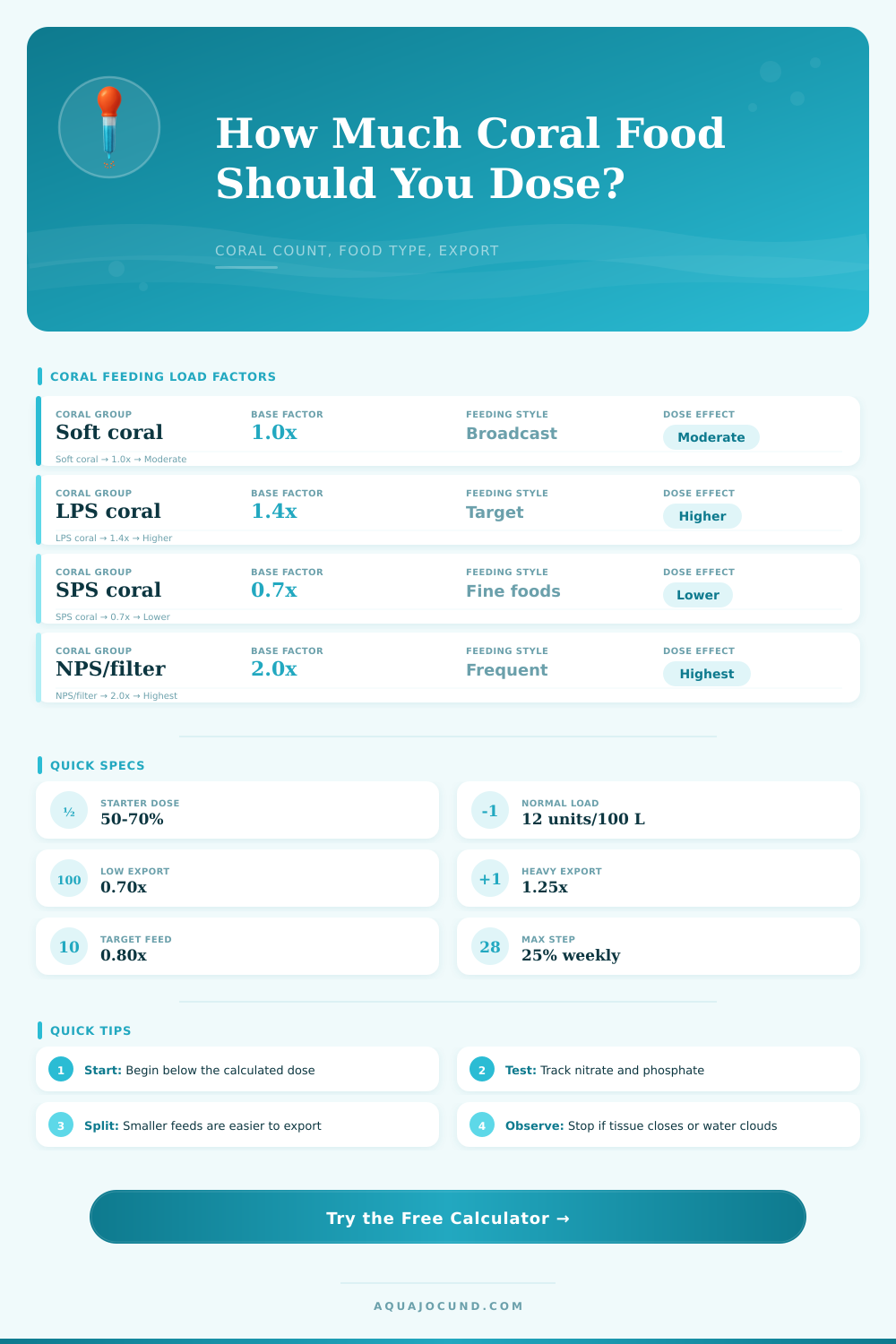
📊 Coral Load Factors
| Coral group | Load factor | Typical food size | Calculator use |
|---|---|---|---|
| Soft corals | 1.0 per colony | Fine particles and dissolved foods | Moderate broadcast dose |
| LPS corals | 1.4 per colony | Powder, slurry, mysis, pellets | Higher target-feeding demand |
| SPS corals | 0.7 per colony | Very fine foods, amino, phyto indirectly | Lower per-colony feeding load |
| NPS and filter feeders | 2.0 per colony | Phyto, rotifers, oyster eggs, fine slurry | Highest repeated feeding load |
📝 Coral Food Reference
| Food type | Base dose per 100 L | Best fit | Nutrient impact |
|---|---|---|---|
| Powder coral food | 0.25 tsp | Mixed reef, LPS, SPS | High if overused |
| Live phytoplankton | 5 ml | Filter feeders and pods | Low to moderate |
| Amino acid liquid | 2 ml | SPS and low nutrient systems | Low |
| Oyster egg liquid | 3 ml | SPS, gorgonians, small-mouth LPS | Moderate |
| Rotifer / copepod blend | 4 ml | NPS, fish fry, filter feeders | Moderate |
| Minced mysis / meaty food | 0.8 g | Large LPS and anemone-adjacent feeding | High |
| Micro pellet / granule | 0.5 g | Target-fed LPS | High |
| Mixed reef food slurry | 3 ml | General mixed reef feeding | Moderate to high |
🧮 Common Tank Size Examples
| Tank | Typical dimensions | Working volume | Base powder dose |
|---|---|---|---|
| Nano cube | 18 x 18 x 18 in / 46 x 46 x 46 cm | 22 gal / 83 L | 0.21 tsp before coral load |
| Breeder reef | 36 x 18 x 16 in / 91 x 46 x 41 cm | 40 gal / 151 L | 0.38 tsp before coral load |
| Standard mixed reef | 48 x 18 x 21 in / 122 x 46 x 53 cm | 75 gal / 284 L | 0.71 tsp before coral load |
| Large reef | 72 x 24 x 24 in / 183 x 61 x 61 cm | 180 gal / 681 L | 1.70 tsp before coral load |
⏱ Feeding Frequency Guide
| System style | Feedings per week | Export setting | Calculator note |
|---|---|---|---|
| New reef or low export | 1 to 2 | Low export | Use 50% to 70% starting strength |
| Moderate mixed reef | 2 to 4 | Moderate export | Normal ramp for stable nutrients |
| Heavy skimmer / refugium | 3 to 6 | High export | More feeding room but test weekly |
| NPS or filter-feeder system | 5 to 14 | High or ultra low | Split into small repeated feeds |
💡 Practical Feeding Tips
This is where food calculator comes in handy (see above). Once you know how many corals you have, and your tank size, it will give you a reliable starting point for how much food to feed them. You won’t have to guess with conversions or coefficients, as both is easy to get wrong and can hurt your system. Instead, you’ll have a solid baseline to work based off of; one that’s grounded in the biological aspects of your tank residents.
Different corals consume different amount of food and in different ways. Zoanthids are soft corals that primarily use photosynthesis and dissolving nutrients. As such, they don’t need much direct food. For that reason, tool assigns a smaller load factor to them. On the other end of the spectrum, LPS corals actively hunt down particles by stretching out their polyps. Because of this, they needs more energy supplied from water column. SPS corals sits somewhere in the middle, they’re highly dependent on light but also appreciate some fine particulates. If you assume all your corals has the same requirement, you’ll either be starving the hungry ones or overfeeding the passive ones. By sorting corals into categories, tool reveals how many nutrients each group actualy needs, not simply headcounts.
Why Use a Coral Food Calculator
Colony size makes a difference. Most people don’t realize how much. The surface area of an oversized fleshy LPS colony is a lot larger then that of a small piece of acropora. Entering the approximate colony size adjusts dose accordingly. An entire hammer coral consumes considerably more energy than a three inch fragment of the same species. This helps to avoid underfeeding adult colonies and wasting food on small frags. Match the size of engine with amount of fuel.
The flip side is export capacity. If you run an active refugium and/or have a strong protein skimmer, then you can get away with exporting more nutrients from your tank before it crashes. This is reflected in the calculator, it adjust based on low, moderate, and high export levels. Inefficiently filtered tanks require less dose and they must be delivered at longer intervals (e.g., daily small feedings vs. Weekly large feeding) to prevent nitrate spikes. Small frequent amounts are better for water chemistry compared to one large amount once per week. Spreading the dose keeps a manageable nutrient curve that allows your skimmer and bacteria to keep up with what the corals don’t catch.
The nature of the food also matters. Oyster eggs or live phytoplankton suspend longer than powdered foods, which can be over-dosed easy, break down rapidly, and foul the water. Different food bases has different nutrient loads, as the reference table on this page illustrates. When you feed, you’re adding nitrogen and phosphorus to your system that need to get exported somehow. This is not just a matter of calories, but if you pick a lighter food it gives you more options to feed more often without worrying about an algae bloom.
If the math says one dose, start there but go slow. To be on the safe side, try half of that dose initially. Try splitting up small daily feeds instead of one big weekly meal. Observe your coral extension & water clarity within the next 24 hrs. If things remain clean with no retracted tissue, increase by just a little. If you notice mucky glass at the bottom or retracted tissue, stop. Feeding is as much about restraint as it is about nutrition; remember you need to pay attention to what the tank tells you every time you feed.
It’s not enough just to have live coral. You want healthy corals living within a stable environment. It shouldn’t of be poisonous to them from an overload of their own waste products, nor should it be a war zone where there aren’t enough resources for each individual coral. Once you’ve dialed everything into a balance between too little and too much, everything calms down. Your corals will flourish, your water remains crystal clear, and you won’t think twice about another drop of water. Strive for this balance… it’s well worth setting yourself up right at the beginning.