💧 Copper Sulfate Pond Calculator
Estimate crystal copper sulfate dose from pond volume, alkalinity, water conditions, fish sensitivity, and treatment margin.
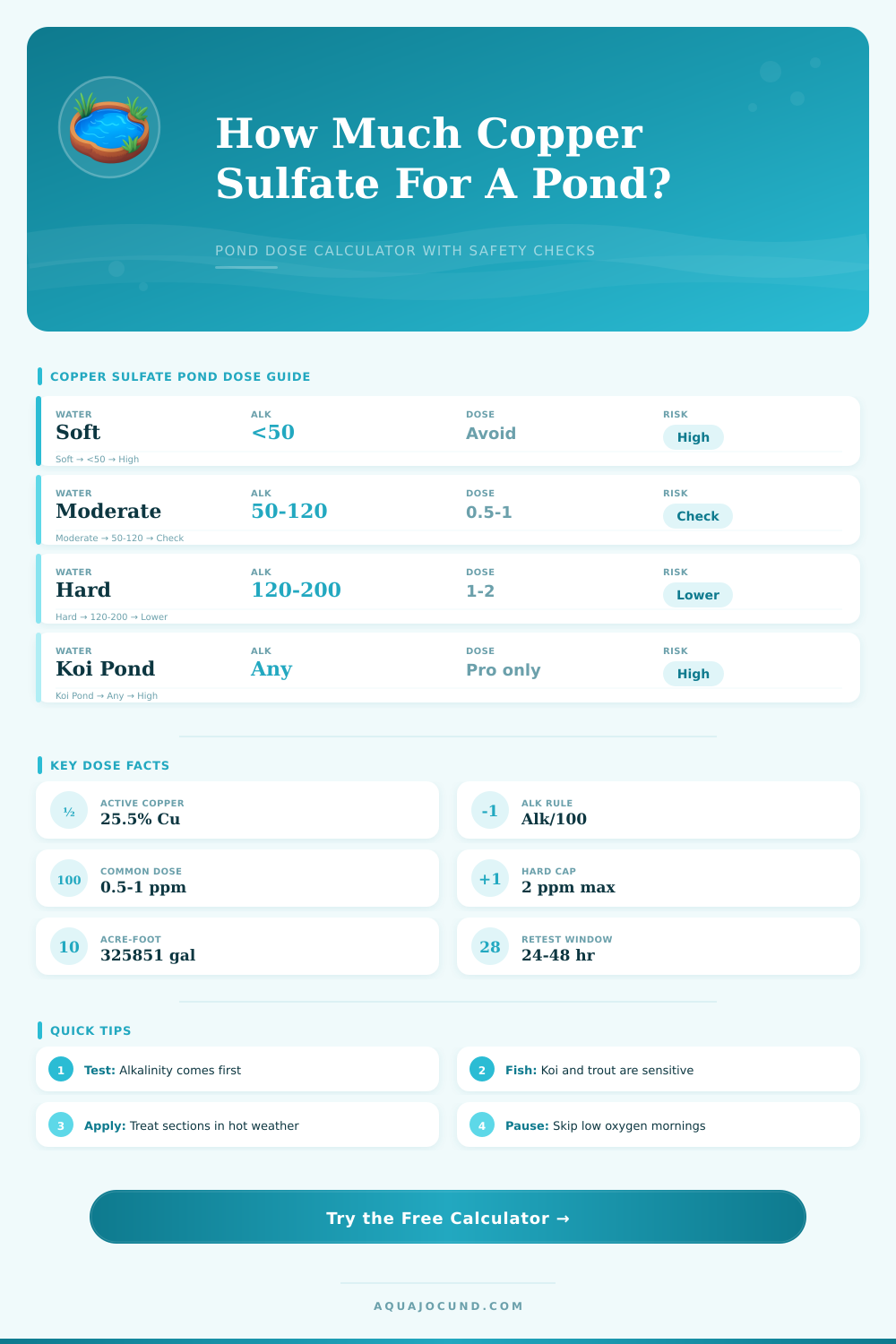
| Total Alkalinity | Crystal Dose Ceiling | Active Copper Approx. | Pond Use Note |
|---|---|---|---|
| Below 50 mg/L | Avoid routine dosing | Not recommended | High risk Copper toxicity risk rises quickly in soft water. |
| 50 to 80 mg/L | 0.5 to 0.8 ppm product | 0.13 to 0.20 ppm Cu | Cautious Use partial-pond treatment and retest. |
| 80 to 120 mg/L | 0.8 to 1.2 ppm product | 0.20 to 0.31 ppm Cu | Typical Common range for many non-sensitive ponds. |
| 120 to 200 mg/L | 1.2 to 2.0 ppm product | 0.31 to 0.51 ppm Cu | Watch pH Hard water buffers copper, but algae die-off can lower oxygen. |
| Above 200 mg/L | Do not exceed label cap | Depends on product | Verify More copper may bind, but overuse still harms fish. |
| Material / Method | Typical Strength | Best Use | Calculation Adjustment |
|---|---|---|---|
| Copper sulfate pentahydrate crystals | About 25.5% elemental copper | Measured pond algae treatment | Baseline product amount |
| Fine soluble crystals | 95% to 98% product equivalent | Fast dissolving spray solution | Increase amount by purity factor |
| Diluted liquid copper sulfate blend | Varies by label | Small ornamental ponds where label permits | Use label equivalent, not crystal math |
| Spot treatment spray | Same ppm on treated section | Floating filamentous algae mats | Multiply by treated fraction |
| Full pond treatment | Whole water body exposure | Only when oxygen and fish risk are controlled | Use full calculated volume |
| Pond Type | Example Volume | Acre-Feet | 0.5 ppm Product Amount |
|---|---|---|---|
| Small garden pond | 500 gal | 0.0015 | 0.95 g crystals |
| Backyard koi pond | 1,200 gal | 0.0037 | 2.27 g crystals |
| Large ornamental pond | 4,000 gal | 0.0123 | 7.57 g crystals |
| Quarter-acre pond, 4 ft avg | 325,851 gal | 1.00 | 1.36 lb crystals |
| Half-acre pond, 5 ft avg | 814,628 gal | 2.50 | 3.40 lb crystals |
| One-acre pond, 6 ft avg | 1,955,106 gal | 6.00 | 8.16 lb crystals |
| Condition | Safer Range | Pause Range | Why It Matters |
|---|---|---|---|
| Morning oxygen | Above 5 mg/L | Below 4 mg/L | Algae die-off consumes oxygen. |
| Water temperature | 55°F to 80°F | Above 85°F | Warm water holds less oxygen. |
| pH | 6.8 to 8.5 | Above 9.0 | High pH increases stress during treatments. |
| Algae coverage | Under one-third | Heavy whole-pond mats | Treating too much biomass can crash oxygen. |
| Rain forecast | Stable 24 hours | Heavy rain soon | Runoff changes hardness, pH, and dilution. |
Confirm alkalinity before measuring product. The calculator caps the treatment against an alkalinity-based ceiling, then lowers it for sensitive fish, pH stress, hot water, and your selected safety margin.
Treat sections when algae is heavy. Large algae kills can drop dissolved oxygen within hours. Avoid early morning treatments, hot afternoons, and ponds with koi, trout, shrimp, snails, or weak fish.
Copper sulfate is a chemical compound that is often used to kill the algae that can grow within a pond. However, copper sulfate must be used careful because copper sulfate is lethal to the organisms that live within the pond. If you use copper sulfate in excessive amount, it can lead to the death of the fish that live within the pond.
To ensure that copper sulfate is properly use to kill the algae without killing the fish, it is important to understand how the chemistry of the pond affect the efficacy of copper sulfate. One of the factors that determine how copper sulfate affects the pond is the ponds alkalinity. Alkalinity determine how bioavailable the copper sulfate is to the organisms within the pond.
How to Use Copper Sulfate Safely in Your Pond
In ponds with low alkalinity (soft water), copper sulfate remains highly bioavailable and, therefore, is more toxic to the fish within the pond. In ponds with high alkalinity (hard water), the water molecule will bind with the copper sulfate, which will reduce the toxicity of the copper sulfate but also its effectiveness in killing the algae. It is, therefore, essential to check the alkalinity of the pond to determine the safety ceiling for the copper sulfate treatment.
The type of animal in the pond will also impact the amount of copper sulfate that can be safely introduced into the pond. The sensitivity of fish to copper sulfate vary between species. For instance, koi fish may be more sensitive to copper sulfate than bluegill fish, and trout may be more sensitive than bluegill fish.
The amount of copper sulfate added to the pond will, therefore, have to be adjusted according to the most sensitive type of fish in the pond. Other invertebrate life forms like snails and shrimp is also very sensitive to copper sulfate; hence, if these animal species lives in the pond, a lower dose of copper sulfate should of been used. The temperature and the amount of dissolved oxygen in the pond will also affect the safety of using copper sulfate.
Copper sulfate will kill the algae in the pond. When the algae die, decomposition take place. Decomposition use up the dissolved oxygen in the pond.
If the dissolved oxygen levels are too low, the fish in the pond will suffocate. If the pond to be treated with copper sulfate has high water temperatures, the dissolved oxygen level may be low. Using copper sulfate in such a pond can lead to the death of the algae but also the fish due to the lack of dissolved oxygen in the pond.
To avoid such a problem, the treatment should only occur in a small section of the pond. This will allow the dissolved oxygen in the pond to stabilize before you introduce copper sulfate into the pond. The form in which copper sulfate is introduced into the pond may also affect the chemistry calculations.
Different products contains different amounts of copper sulfate. To ensure that the copper sulfate is effective in killing the pond algae without harming the life in the pond, it is critical to know the concentration of copper sulfate that the product contain. Using the wrong amount can be detrimental to the pond life.
A copper sulfate chemistry calculator will help determine the parts per million (ppm) of copper sulfate needed for the pond. The calculator will automatically calculate the correct amount of copper sulfate based on the product type. Finally, when calculating the dose for copper sulfate, it is also important to use a conservative estimation.
Using a conservative amount ensure that the dose of copper sulfate used will not kill the fish in the pond. Using a lower dose may require treating the pond multiple times to kill the algae; however, treating the pond multiple times is a safer alternative to treating the pond once with a high dose of copper sulfate. By adding copper sulfate to the pond, the dissolved oxygen levels must also be monitored.
Additionally, it is important to respect the alkalinity of the pond to ensure that copper sulfate does not harm the ecosystem of the pond.