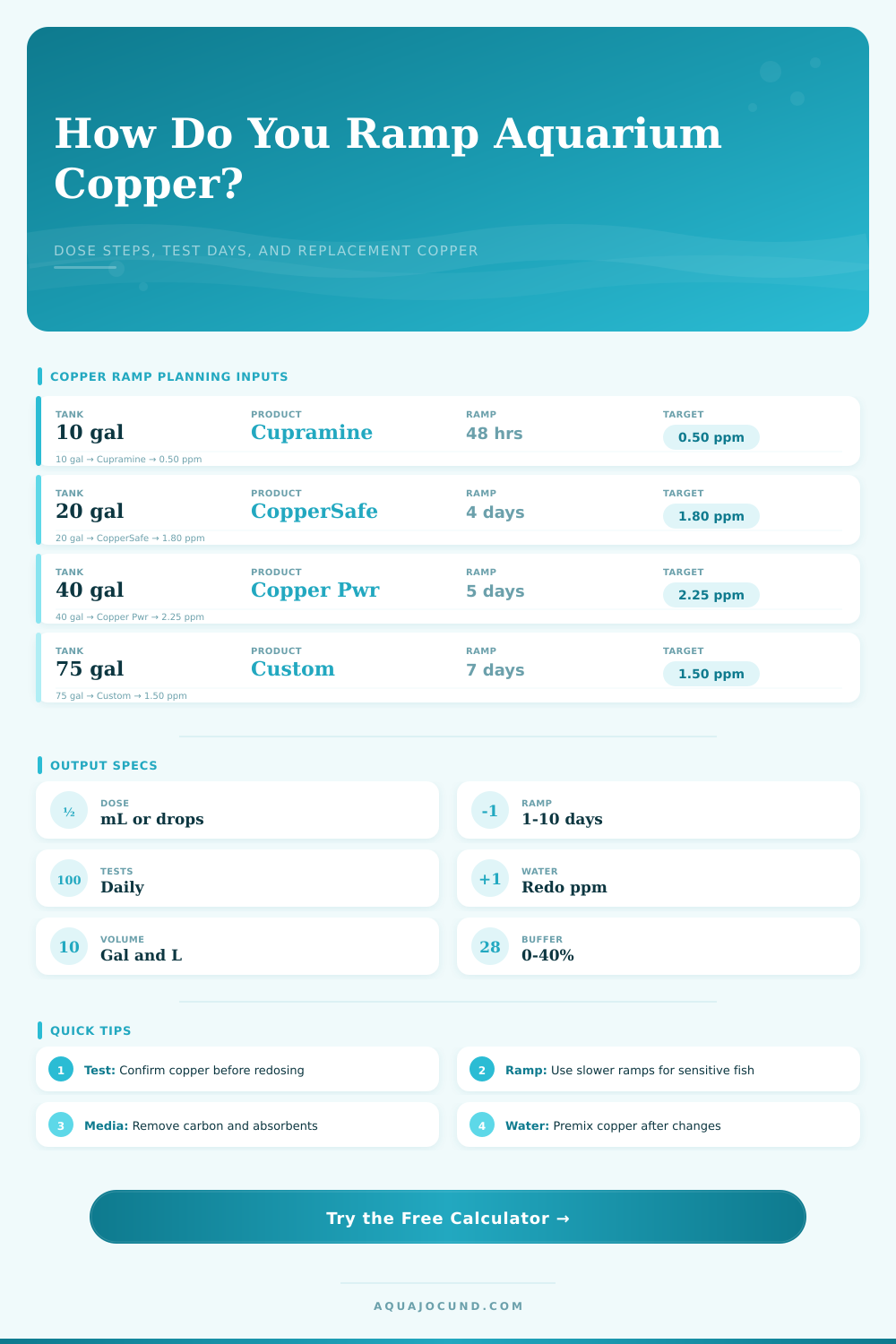
Copper Ramp Schedule Calculator
Plan staged quarantine copper dosing from tank volume, product strength, target ppm, water changes, and daily test checkpoints.
| Product / method | Typical target | Default strength used | Best schedule use |
|---|---|---|---|
| Seachem Cupramine | 0.50 ppm saltwater, 0.25 ppm freshwater | 0.25 ppm per mL per 10 gal | Two half doses about 48 hours apart |
| Fritz/Mardel CopperSafe | 1.5 to 2.0 ppm total copper | 0.20 ppm per mL per 10 gal | Single dose or staged chelated ramp |
| Copper Power blue | 2.0 to 2.5 ppm total copper | 0.1695 ppm per mL per 10 gal | Measured multi-day ramp for marine quarantine |
| Ionic copper sulfate | 0.15 to 0.25 ppm free copper | 0.10 ppm per mL per 10 gal | Precise low range with compatible test kit |
| Custom solution | Entered by user | Editable strength field | When label strength differs from defaults |
| Scenario | Active volume | Target | Ramp shape |
|---|---|---|---|
| Small clownfish QT | 10 gal / 38 L | 0.50 ppm Cupramine | 2 days, 2 splits per day |
| Wrasse observation tank | 20 gal / 76 L | 2.25 ppm Copper Power | 5 days, 2 splits per day |
| Community fish hospital | 29 gal / 110 L | 1.80 ppm CopperSafe | 4 days, 1 split per day |
| Predator fish vat | 75 gal / 284 L | 2.10 ppm chelated copper | 7 days, daily test before each add |
| Freshwater hospital tank | 20 gal / 76 L | 0.25 ppm Cupramine | 3 days, conservative staged dose |
| Math item | Formula | Why it matters | Calculator output |
|---|---|---|---|
| Active gallons | Measured volume x displacement factor | Prevents overdosing small hospital systems | Gallons and liters |
| Needed ppm rise | Target ppm - current ppm | Avoids stacking copper after a test reading | Increment ppm |
| Total mL dose | ppm rise / strength x gallons / 10 | Converts label strength into tank dose | Total mL and drops |
| Per split dose | Total mL / ramp splits | Makes a gradual ramp easier to follow | mL per split |
| Water change dose | Changed gallons x target ppm / strength | Replaces copper removed with changed water | mL after change |
A quarantine tank is where new fish live. Hidden in the corner of your set up, it waits patiently to handle newcomers before letting them into showtank.
Often, the stress of transport conceals infection or parasite infestation until treatment process starts. And that’s where the trouble start. Fish are sensitive creature, and you cannot just dump the medicine in and hope for best. A sudden increase in copper, for example, can be harmful.
How to Use a Quarantine Tank Safely
That is why ramping exists. It keep the therapeutic level constant but gives other life in the water time to acclimate slow. You select the product you’ll use and plug in dimensions of your tank and let the tool do the math. You don’t need conversions, coefficients, or guesswork.
That’s the hard part; deciding what to input. Begin with how much water you have in the tank. Not volume of the tank. Equipment, rocks, gravel, all of that takes space. You can’t underestimate how much they displaces. If you ignore displacement, you’ll overestimate the water and underdose copper. Enter the percentage asked by the calculator to account for that. A packed tank doesn’t hold as much water as an empty one. Screw this up and your dosing schedule go right out the window.
All copper is not created equal… Product choice does matter Some copper come as an ionic salt (raw), which may be rapidly effective but must be monitored carefuly. Other copper are bound to a chemical (so it remains stable & safe to use on sensitive species). The reference table also illustrates the strength of each brand in terms of strength per milliliter.
Match the product form with the test kit. For instance, if you’re treating with ionic sulfate then don’t use a kit calibrated for chelated copper. It won’t give you accurate result. You want to know exactly what’s in the water.
Patience, That’s what a ramp is all about. On Day 1, you don’t hit full dose of that target concentration. You go slow by gradually increasing the dose each day for X days (days you define). When I say “splitting” a dose, I mean putting in smaller increments multiple times per day. That way, the level doesn’t shock your system and stays steady. You don’t hit it with maximum all at once, you let it climb up.
If you’re sensitive (e.g., puffers/wrasses), then you want a slow ramp because mistakes can lead to serious health problems that take months to correct.
That doesn’t work so well when you have water changes. Long term, you must keep the water clean. But that means every time you change water you are diluting the copper. The calculator adjusts for this as well. It tells you how much to add back after each water change. So how does it do that? It determines the replacement dose according to the concentration you want AND the percent of water changed.
If you don’t adjust for the water change, then you go below therapeutic and the parasites can rebound. To get around this, you must premix the new water with some copper before adding it. Otherwise, you will end up with a dangerous low spot in the concentration.
Testing is non-negotiable. That’s non-negotiable. The schedule assume daily checks of levels. Believe the kit. Don’t believe the timer. Don’t dose if the kit tells you that you’re already at the target.
The tank isn’t different than what the calculator has. It’s real. Poly filters and other absorbent media (e.g., carbon) will pull out copper from the water. Remove them prior to dosing. Leaving them in is a waste of time and money. The copper goes right into the filter bag where it won’t treat the fish.
Keep running the treatment as long as it takes to kill all parasites. Some will be dead in three days, some take two weeks. Don’t stop too soon because some survive and replicate later. A little extra time on the treatment is preferable to stopping sooner than you should of.
After you’re clean of parasites, you can drop down the treatments gradually or treat with a binding agent to eliminate the copper safely. Then you’ll be ready to move the fish into the display. Use the quarantine tank as a bridge. Cross over cautiously, using small amounts and being careful, and your main tank remain free.