🧪 Copper Power Dosing Calculator
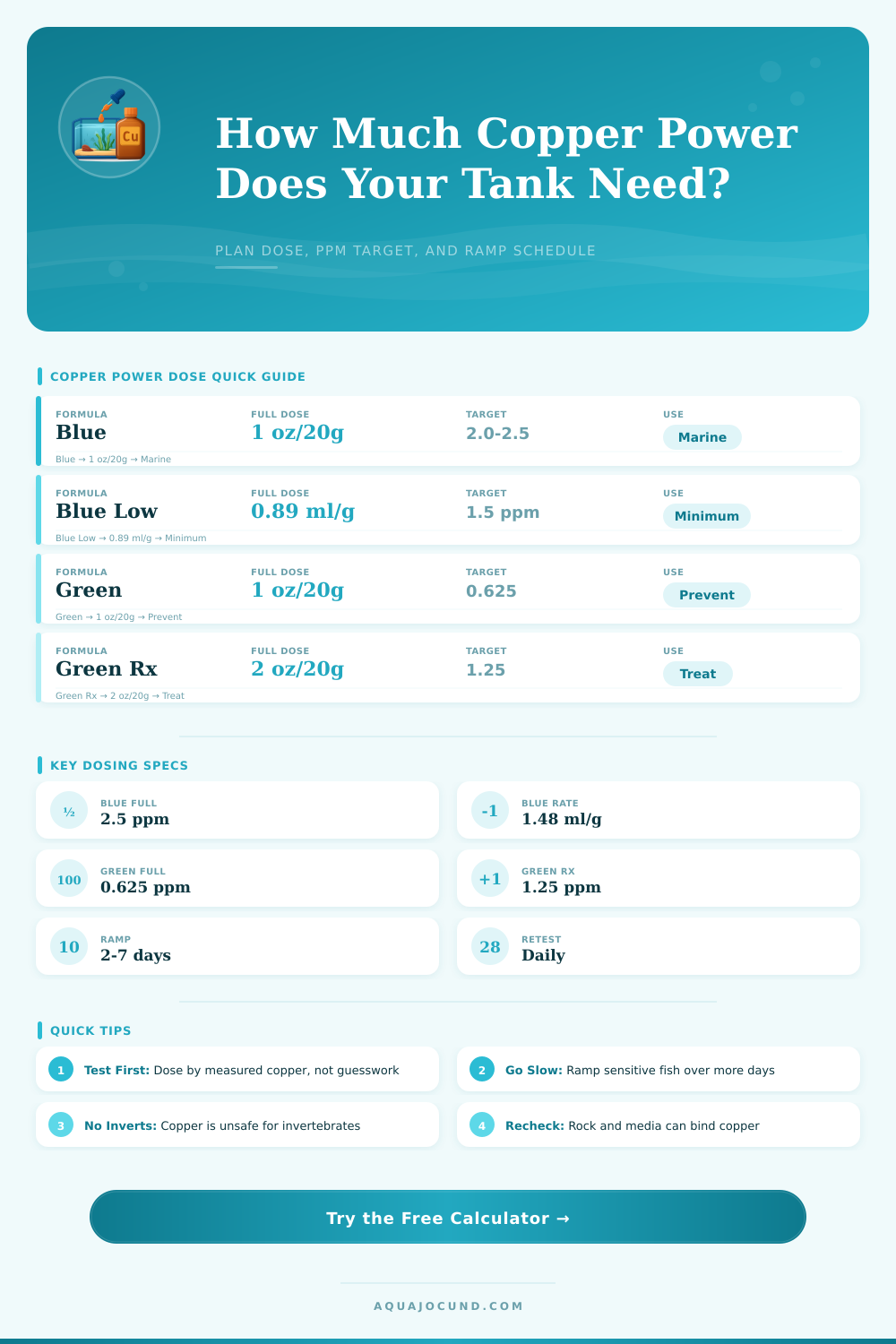
Plan Copper Power dose volume, target ppm, ramp timing, water-change replacement, and test-based adjustment for quarantine aquariums.
| Product | Label Dose | PPM At Label Dose | Calculator Rate |
|---|---|---|---|
| Copper Power Blue | 1 fl oz per 20 gal | 2.5 ppm | 0.591 mL per gal per ppm |
| Copper Power Blue | 1.48 mL per gal | 2.5 ppm | 1 mL in 1 gal adds 1.691 ppm |
| Copper Power Green | 1 fl oz per 20 gal | 0.625 ppm | 2.365 mL per gal per ppm |
| Copper Power Green treatment | 2 fl oz per 20 gal | 1.25 ppm | Double the prevention dose |
| Use Case | Common Target | Ramp Pace | Notes |
|---|---|---|---|
| Blue marine conservative | 1.50-1.75 ppm | 3-7 days | Used when fish are sensitive or already stressed |
| Blue marine standard | 2.00-2.25 ppm | 2-5 days | Common hobby planning range with daily testing |
| Blue label strength | 2.50 ppm | 2-7 days | Label endpoint; avoid overshooting on weak fish |
| Green freshwater prevention | 0.625 ppm | 1-3 days | Freshwater product only; not Blue saltwater math |
| Green freshwater outbreak | 1.25 ppm | 1-4 days | Freshwater product only; watch sensitive species |
| Event | Copper Removed | Re-dose Logic | Best Check |
|---|---|---|---|
| 10% water change | About 10% | Replace 10% of target dose | Retest after mixing |
| 25% water change | About 25% | Replace 25% of target dose | Retest same day |
| 50% water change | About 50% | Replace half of target dose | Split for sensitive fish |
| Media absorbs copper | Variable | Dose only to measured gap | Test daily until stable |
| Livestock / System | Copper Concern | Suggested Pace | Calculator Setting |
|---|---|---|---|
| Clownfish, damsels, many tangs | Moderate | Standard ramp | Standard or robust |
| Wrasses, anthias, butterflies | Stress during fast increases | Longer ramp, smaller splits | Sensitive marine pace |
| Angels and larger tangs | Appetite suppression possible | Measure and observe closely | Robust hospital tank |
| Loaches, rays, sharks, scaleless fish | High copper sensitivity | Specialist protocol only | Copper-sensitive warning |
| Corals, shrimp, snails, crabs | Copper toxicity | Do not dose | Copper-sensitive warning |
Copper treatments requires the use of precise copper concentrations within the tanks. The copper treatments can either aid in the control of the parasite that infest the fish or negatively impact the health of the fish if too much copper is introduced into the water. In order to maintain a proper level of copper within the tanks, a dosing calculator is used to determine the amount of copper that should be added to each tank.
The dosing calculator remove the guesswork regarding the amount of copper to add. This helps to ensure that the copper treatment is both effective and safe for the fish. The actual volume of water that is contained in each tank is a critical factor to consider.
How to Use a Copper Dosing Calculator
The nominal size of the tank is not the same than the volume of water that is contained within the tank. The volume of water is less than the nominal size of the tank because the rocks, sand, equipment, and substrate within the tank will displace some of the water. A dosing calculator must account for this displaced water.
Additionally, the dosing calculator must also account for the volume of the filters or the sump. These areas must also be treated with copper. If they are not treated with copper, the copper concentration will drift from the target parts per million that is required for the fish.
Media, porous rock, and sand will bind to the copper. This binding of the copper to these media items will cause the copper levels to change within the tank. An absorption allowance field is provided in the dosing calculator to allow the user to account for this.
By adding an allowance to the initial dose of copper, the copper will still reach the target concentration after the substrate has absorbed some of the copper. However, despite the absorption allowance field, daily testing is still require to monitor the copper levels in the tank. Not all fish has the same sensitivity to copper.
Therefore, a dosing calculator should allow the user to adjust the treatment plan according to the type of fish that are contained within the tank. For example, species like wrasses or anthias can tolerate the same levels of copper as clownfish. However, the wrasses and anthias may need a slow increase to the copper levels each day so as to avoid stress the fish.
The dosing calculator allows the user to select a sensitivity level for the fish. By selecting a sensitivity level, the copper target concentration can be capped or spread over more days. While a dosing calculator is helpful in determining the copper schedule, it cant replace the need for physical observation of the health of the delicate fish species.
If water changes are performed in the tank, the copper levels will change. By changing the water, the same percentage of copper will be removed from the water. A dosing calculator can determine how much copper should be added to the water to be replaced to bring the copper levels back up to the target.
The dosing calculator can determine how much copper is needed if the user enters the percentage of the water change that is to be performed. The dosing calculator will also determine the amount of copper that is required in the refill water if the water change has already been performed. The formulas that are used for treating freshwater fish are not the same as those that are used for treating saltwater fish.
The math within the dosing calculator will change according to the type of product that is to be used. Each product has a different type of mathematical calculation that can be used to determine how much copper should be added to the tank. The user must select the type of product that will be used.
If the wrong formula are used according to the type of fish that are contained within the tank, the copper levels can be either ineffective or excessively high. Reference tables are included within the dosing calculator to illustrate the rate for each product and the coefficients for the calculations. These tables can be used in case the individual would like to verify the calculations that the dosing calculator made.
The copper that is added to each tank should not be something that is set and forgotten about each day. The copper levels can change for multiple reasons. For instance, the test kits that are used to measure the copper levels may read low after the copper has been mixed with some of the water in the tank.
Additionally, the amount of copper that is bound to the substrate may change each day. Finally, the copper levels could change with the evaporation of the water in the tank or if water is added to the tank. While the dosing calculator will help the user to determine the initial copper level for the tank, the daily test kit will help to ensure that the copper is still within the required range.