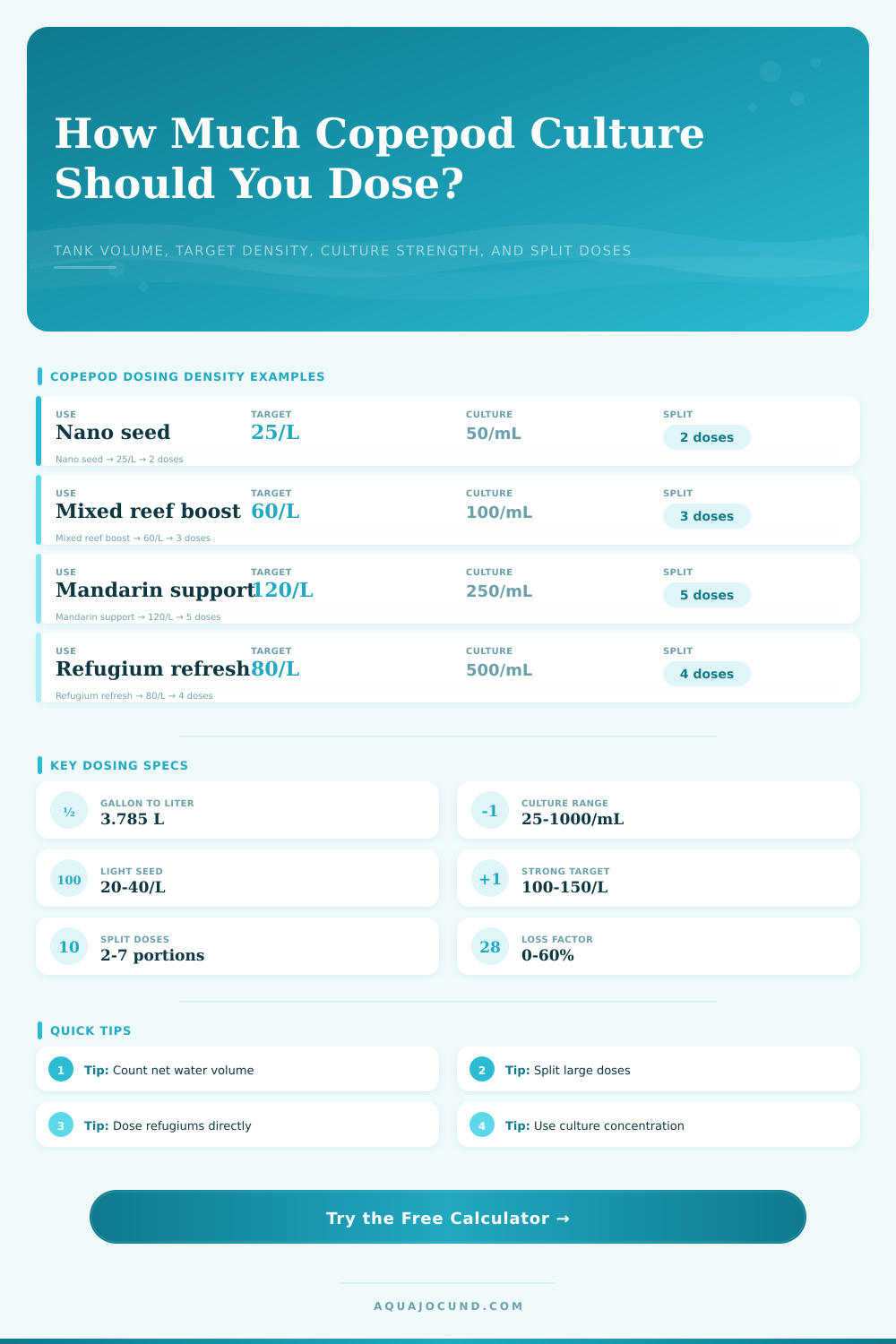
Copepod Dosing Calculator
Estimate copepod culture volume from tank water volume, target pod density, refugium volume, culture concentration, split dosing, and display/refugium allocation.
Calculation breakdown
| Profile | Modeled concentration | Best calculation use | Planning note |
|---|---|---|---|
| Light live culture | 25 pods/mL | Gentle seed dose | Large liquid volume, low density |
| Standard live culture | 100 pods/mL | General population boost | Balanced default for mixed cultures |
| Dense live culture | 250 pods/mL | Targeted split dosing | Less liquid for the same pod count |
| Fresh sieve harvest | 500 pods/mL | Concentrated culture harvest | Useful when dosing large systems |
| Mixed plankton culture | 75 pods/mL | Mixed small live foods | Use counted pods, not total plankton |
| Benthic-heavy culture | 150 pods/mL | Rock and refugium seeding | Often allocated more to protected habitat |
| Pelagic-heavy culture | 125 pods/mL | Display-water dispersal | Often split across multiple additions |
| Manual concentration | User value | Microscope or sample count | Use when you counted pods per mL |
| System | Approx dimensions | Net volume | Dose at 60 pods/L from 100/mL culture |
|---|---|---|---|
| Nano reef | 24 x 12 x 14 in / 61 x 30 x 36 cm | 21 gal / 79 L | 47 mL from 10 pods/L current |
| Breeder display | 36 x 18 x 16 in / 91 x 46 x 41 cm | 48 gal / 182 L | 109 mL from 10 pods/L current |
| Four-foot reef | 48 x 18 x 18 in / 122 x 46 x 46 cm | 70 gal / 265 L | 159 mL from 10 pods/L current |
| Large display | 72 x 24 x 20 in / 183 x 61 x 51 cm | 145 gal / 549 L | 329 mL from 10 pods/L current |
| Target band | Pods per liter | Pods per gallon | Calculator fit |
|---|---|---|---|
| Light seed | 20-40/L | 76-151/gal | New or low-pressure systems |
| General boost | 50-80/L | 189-303/gal | Mixed reef population lift |
| Refugium emphasis | 70-110/L | 265-416/gal | Protected habitat dosing |
| Heavy grazer support | 100-150/L | 379-568/gal | Frequent split additions |
Whether it’s your first reef or your tenth, most reef keepers has stared into the dark water of a new tank wondering if the tiny ecosystem they are trying to build will actualy take hold. Purchase some live rock. Cycle that filter. Wait.
Microscopic crustaceans called copepods play an important role in distinguishing a sterile aquarium from a thriving, self cleaning reef. Copepods helps regulate nitrates & phosphates, process nutrients, and feed more delicate livestock.
How to Calculate the Right Amount of Copepods
Math is needed to determine the number of copepod required. Why? These animals are too small for the human eye to see, so it is impossible to make an informed guess about their population size.
This calculator (above) calculates the density target and can convert volume for you too. No need to guess if you’re using too much culture water or if your refugium is big enough to support a population.
The most common misstep newbies make is dose a ton of culture all at once (more must be better), right? Not so much. When you dump in lots of food, it cause a bloom. However, there’s no grazing pressure yet and not many places to hide, so those little guys will swim out your skimmer outlet and dissapears.
That’s why this tool takes that into account and lets you split your doses across a few days. That mirrors how nature spreads and allows the animals to seek refuge in the algae mats of your refugium or crevices inside rockwork.
The challenge is that first you need to understand what volume the tank has (which is not what you care about). The volume of water that actualy exists in the tank, which I call the net water volume, is all that really matters. Most people assume they have capacity of the tank’s rated size (the number on the side by the manufacturer). Typically, these sizes includes the volume of the sump, any live rock, and substrate used. All those solids displace water. So total amount of liquid inside the tank is much smaller than what’s stamped into the side.
To adjust for this, the calculator requests a displacement percentage. Setting this value too low will cause you to overdose the culture based off the actual water volume. That results in waste and even worse, can cause oxygen depletion. It’s a minor adjustment, but important if you’re trying to reach a certain biological target.
How many seeds do I put in? The answer is completely dependent on what’s living in your tank. For example, if it’s just a fish only tank, then seeding at 20, 40 pods/liter will do the trick and clean up all waste. But if you have brittle stars, harlequin rasboras, or mandarin fish, then you know they’re voracious predators and will destroy a weak pod population. So, you’ll want to be going into high-density territory. Aim for well over one hundred pods per liter so they reproduce faster then they are eaten in these scenarios.
Most of the time, more than one-hundred pods/liter is a good idea here. That is outlined in the reference table on the page. This allows you to determine whether you want to seed for support or maintenance.
The other key factor is the density of the culture you’re adding. A freshly sieved harvest from a full grown bucket is concentrated. Sometimes it’s five-hundred pods per milliliter. When you buy a dilute and ready-to-ship culture, it may be twenty-five.
If you plug the wrong number into your calculation, you’ll either add gallons of wasted water or not add enough organisms to do any good. This input change the needed amount of liquid to match. It ensures you’re measuring the right amount of biological stock rather than just adding liquid.
And then there’s where it starts to get interesting: Refugium allocation. You can send most of your culture straight into the display? Sure. But because there are no currents (lower flow) and plenty of macro algae (protection), the refugium will have better survival.
That is where the tool helps. It lets you divide the dose between the refuge and the display. It uses a retention multiplier on the protected environment. That acknowledges the fact that a small but dense population in safety is often worth more than a big, spread-out one in the open waters.
The convenience factor aside, splitting a dose also avoids shocking the established biological balance and gives time for the newly introduced inhabitant to adjust. If the calculator tells you to give a large amount at once, you can split it into more doses, making every dose manageable. Each will be less likely to overwhelm the filter(s) and cloud the water with too much organic material. What was one mega-intervention becomes a viable feed regimen.
In conclusion, there’s no magic one-dose-fits-all formula for growing copepods. Rather, it involves small, measured inputs to suit your system’s capabilities over time. It’s not just introducing bugs. It’s investing in an eco-system.
Divide your doses correctly, let things click into place with numbers, then back off and let your tank run itself. That’s when it starts becoming a livig, breathing world instead of just a display of life. Your tank gets clear. Algae levels balance out. And those little guys go to work.