DIY CO2 Yeast Sugar Calculator
Estimate yeast bottle CO2 output, aquarium demand, bubble rate, gel mix behavior, and refresh timing from sugar, yeast, temperature, and tank size.
🧪Named DIY CO2 Presets
🍾Bottle Recipe Inputs
🌿Aquarium Demand Inputs
DIY CO2 Output Estimate
⚗DIY Recipe Comparison Grid
📊Sugar, Yeast, and CO2 Yield Reference
| Recipe input | Planning value | Effect on output | Calculator use |
|---|---|---|---|
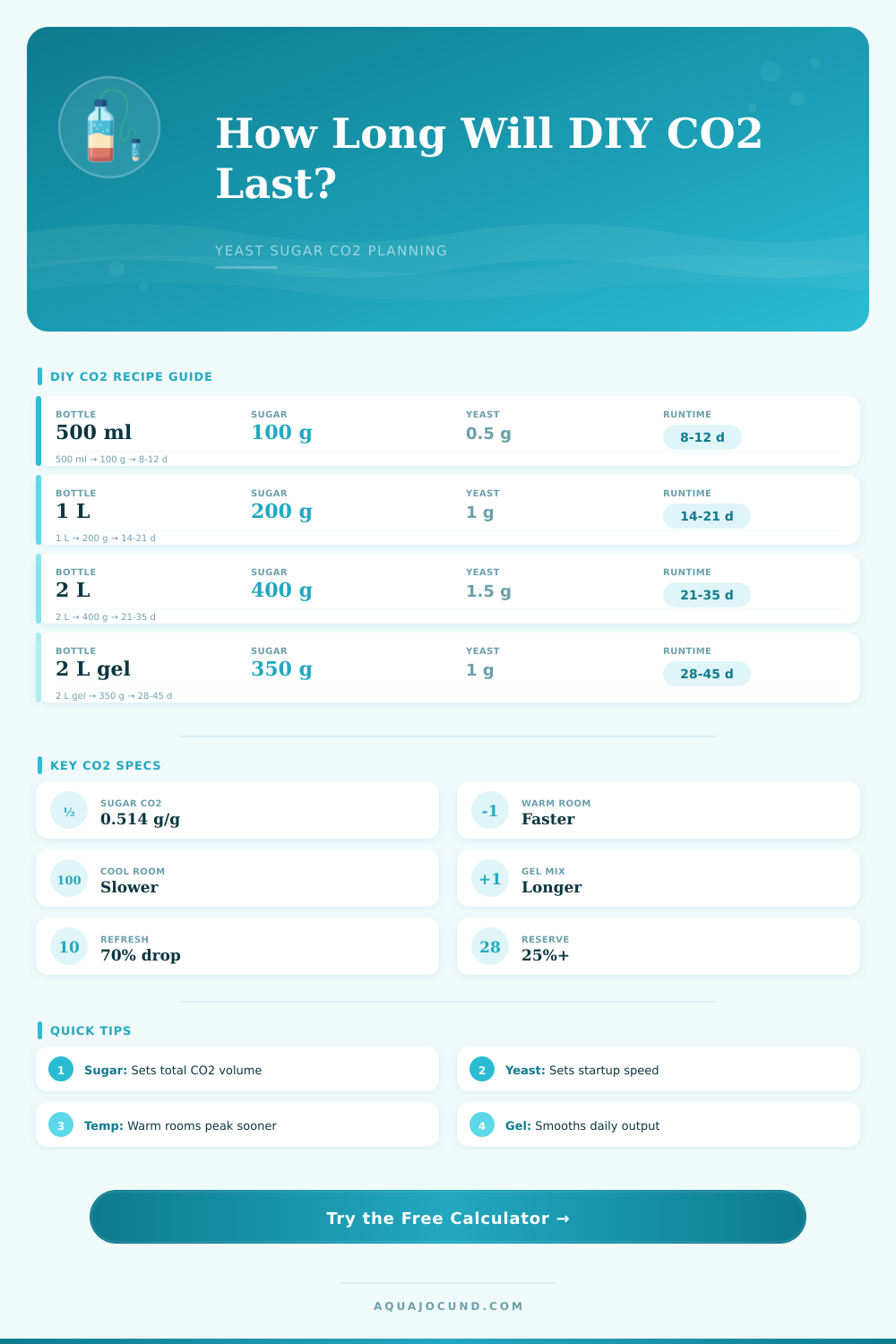
| Sucrose sugar | 0.514 g CO2 per g | Controls total possible gas | Total CO2 volume |
| Yeast amount | 0.5-2 g typical | Controls startup and peak | Activity factor |
| Room temperature | 68-78°F common | Warm rooms ferment faster | Q10 rate model |
| Gel restriction | 1.1-1.6 factor | Slows and extends release | Runtime multiplier |
| Efficiency | 65-85% typical | Accounts for leftovers and slowdown | Usable CO2 |
🍼Common Bottle Size Planning Table
| Bottle setup | Working volume | Common sugar | Typical aquarium use |
|---|---|---|---|
| Small soda bottle | 0.5 L | 75-125 g | 5-8 gallon nano tanks |
| One liter bottle | 1.0 L | 150-250 g | 10 gallon planted tanks |
| Two liter bottle | 1.6-2.0 L | 300-450 g | 20-30 gallon aquariums |
| Two bottle pair | 2 x 1.5 L | 250-350 g each | 40 breeder stability |
| Gel bottle | 1.5-2.0 L | 300-400 g | Longer refresh schedule |
🌡Temperature and Fermentation Pace
| Room temperature | Relative pace | Output shape | Refresh note |
|---|---|---|---|
| 62°F / 17°C | Slow | Delayed startup | Use patience or more yeast |
| 68°F / 20°C | Moderate | Steady curve | Good baseline planning |
| 74°F / 23°C | Active | Strong output | Watch peak bubble rate |
| 80°F / 27°C | Fast | Earlier peak | Refresh sooner |
| 86°F / 30°C | Very fast | Short run | Use less yeast or gel |
🌿Aquarium CO2 Demand Reference
| Tank style | Daily CO2 rise | Diffusion need | DIY fit |
|---|---|---|---|
| Low light moss | 4-8 mg/L | Low | Small bottle can work |
| Moderate community | 10-18 mg/L | Medium | Classic DIY range |
| Carpet and stems | 18-25 mg/L | Medium-high | Use stable diffuser |
| High surface ripple | 20-30 mg/L | High | May need paired bottles |
| Large high light tank | 25-35 mg/L | Very high | DIY output can swing |
This DIY carbon dioxide generator has to be managed. That’s because in order for the yeast to create gas, it must be in just the right conditions. For your tank, you want the yeast to be active only as long as necessary. Too little energy and the yeast cease production prematurely. Too much energy means the yeast overproduces and creates an unsafe buildup of pressure. Or, the yeast kill itself off too fast.
Using the calculator, you don’t have to guess. It translates these chemical reactions into a simple schedule. Yeast is the engine; sugar is the fuel. The temperature adjust the speed. A lot of people fuss over size of bottle or how much yeast they use, when really it’s room temperature that determines how fast fermentation occurs. Fermentation will happen faster in warmer rooms. Cooler rooms will take more time before kicking into gear but also longer to burn out.
How to Manage Your DIY Carbon Dioxide Generator
You must match the sugar load with the rate at which yeast can breaks it down for you in your environment. If you dump four hundred grams of sugar in your cold basement, the energy will not be released until the plants least need it. This happens during their photoperiod. This ratio isn’t something you can just look at. After all, yeast doesn’t convert every single gram of sucrose perfect into gas. Yeast only converts some of that. That’s where fermentation efficiency comes into play: some of the sugar will remain in solution and alcohol will accumulate until it knock the yeast out. By including those elements in its balance, the tool allow you to know when to replenish the bottle before output plummets. Don’t wait for the plants’ condition to deteriorate due to lack of carbon dioxide; do it while it’s still going strong.
The reason the mix behave differently when made with either gelatin or agar is because it slows the rate at which sugar is released. It avoids big pops of bubbles that would change the pH level and overpower the diffuser. What happens instead is a slow trickle of gas for several weeks. It’s a smooth approach, but restarting becomes difficult in the event of a problem. Water + nothing is more volatile but more easily fixed.
The choice comes down to whether you want flexibility or stability. If you’re checking your drop checker every day like an experienced fish keeper, you should of be able to manage an unstable mix. If you’re a beginner, a gelatin buffer provides stable conditions so you can learn the ropes regarding lighting and fertilization.
Output from the bottle is only half the story. You also need to match what your aquarium needs. Moss in a tiny nano tank requires limited carbon dioxide, not an explosion of bubbles. Carbon dioxide overdose will temporarily increase pH but result in a crash after the lights go out and the plants no longer consume the gas. To get the right dosage, the table below correlates tank types with maximum daily increases in pH. People often focus on things like yeast amount or bottle size instead of what actualy drives the pace. What matters is what volume of CO2 can be dissolved by the aquarium.
Before reaching the water column, diffusion efficiency greatly reduces the volume of the gas. This part is important: do not cap these bottles with a permanent cap. Instead use something like a weighted lid system or a proper pressure relief mechanism. The gas will build up pressure inside the capped bottles rapidly. This happens even more in warmer temperatures when fermentation occur faster. A plastic bottle, under pressure, can explode forceful. This is not good for your hands or face. Don’t skimp here and risk your body to save pennies on a pressure release valve.
The primary reason most hobbyists fail is their failure to understand when the mix need refreshing. They wait for no bubbles at all, and by then the plants are stressed and there’s probably some algae growing too. It is better to refresh the solution when the output has slowed down significantly but hasn’t completely stopped. The calculator will give you the day number but also keep an eye on your bubble counter. Often a change in rate is more noticeable than a date on the calendar.
More of an art than a science, this all comes down to managing your expectations. Remember: Kitchen ingredients are not as precise as lab instruments; however, this isn’t an exact science. It’s a close-enough-for-plants-to-thrive kind of thing. Protect the yeast by keeping the room temp stable and using clean water (no chlorine). Have a back up plan. When the initial bottle empties, what then?
Consistency, not perfection, is key. Occasional dips in supply don’t bother plants much. Long gaps do. Understand that the generator is a living system needing regular attention. Feed it, and it’ll feed healthy plants.