💧 CO2 Reactor Sizing Calculator
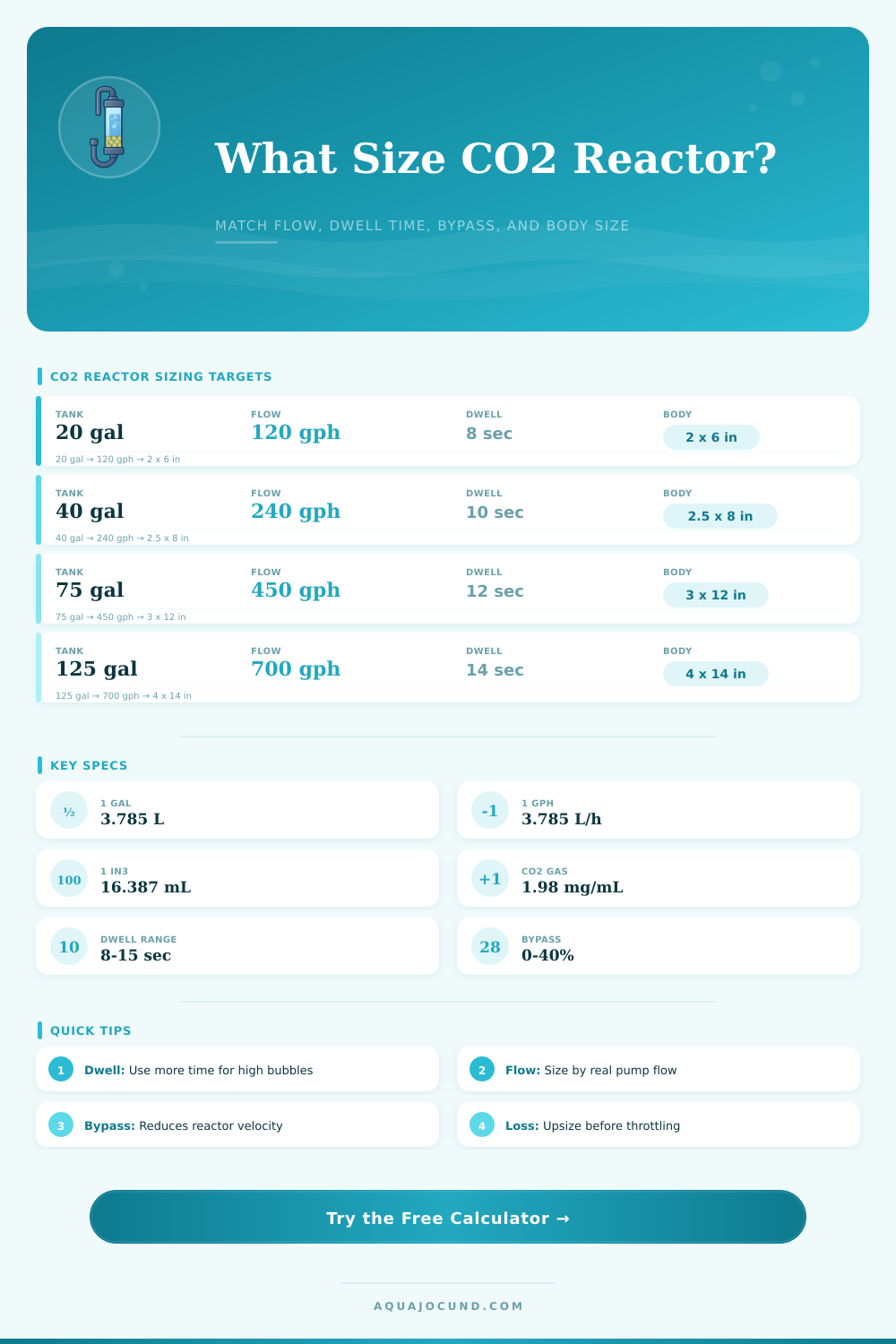
Size an aquarium CO2 reactor from real tank volume, filter flow, target dwell time, reactor diameter, reactor length, bubble rate, bypass percent, and pressure-loss class.
| Inside Diameter | Volume Per Inch | Volume Per 10 cm | Best Use |
|---|---|---|---|
| 1.5 in / 3.8 cm | 1.77 in3 / 0.029 L | 0.115 L | Small tanks, low flow, short hose runs |
| 2 in / 5.1 cm | 3.14 in3 / 0.051 L | 0.203 L | Nano to 30 gal canister lines |
| 2.5 in / 6.4 cm | 4.91 in3 / 0.080 L | 0.317 L | Common 40 to 75 gal reactors |
| 3 in / 7.6 cm | 7.07 in3 / 0.116 L | 0.456 L | Higher flow planted displays |
| 4 in / 10.2 cm | 12.57 in3 / 0.206 L | 0.811 L | Large tanks, sump branches, manifolds |
| Reactor Flow | 8 Sec Volume | 12 Sec Volume | 15 Sec Volume |
|---|---|---|---|
| 100 gph / 379 LPH | 0.084 gal / 0.32 L | 0.125 gal / 0.47 L | 0.156 gal / 0.59 L |
| 200 gph / 757 LPH | 0.167 gal / 0.63 L | 0.250 gal / 0.95 L | 0.313 gal / 1.18 L |
| 350 gph / 1325 LPH | 0.292 gal / 1.10 L | 0.438 gal / 1.66 L | 0.547 gal / 2.07 L |
| 500 gph / 1893 LPH | 0.417 gal / 1.58 L | 0.625 gal / 2.37 L | 0.781 gal / 2.96 L |
| 750 gph / 2839 LPH | 0.625 gal / 2.37 L | 0.938 gal / 3.55 L | 1.172 gal / 4.44 L |
| Tank Size | Typical Real Flow | Bubble Rate Range | Starter Reactor Body |
|---|---|---|---|
| 10 gal / 38 L | 60-100 gph / 227-379 LPH | 20-60 bubbles/min | 1.5 x 5 in / 3.8 x 13 cm |
| 20 gal / 76 L | 100-180 gph / 379-681 LPH | 50-120 bubbles/min | 2 x 6 in / 5.1 x 15 cm |
| 40 gal / 151 L | 180-280 gph / 681-1060 LPH | 90-180 bubbles/min | 2.5 x 8 in / 6.4 x 20 cm |
| 75 gal / 284 L | 300-500 gph / 1136-1893 LPH | 160-320 bubbles/min | 3 x 10 in / 7.6 x 25 cm |
| 125 gal / 473 L | 500-800 gph / 1893-3028 LPH | 260-520 bubbles/min | 4 x 12 in / 10.2 x 30 cm |
| Loss Class | Velocity Signal | Typical Cause | Adjustment |
|---|---|---|---|
| Low | Under 1.5 ft/s / 0.46 m/s | Wide chamber, open core, clean hoses | Usually fine for canisters and small returns |
| Medium | 1.5-3 ft/s / 0.46-0.91 m/s | Moderate packing, elbows, medium bypass | Check output flow after installation |
| High | Over 3 ft/s / 0.91 m/s | Narrow body, dense media, static inserts | Use larger diameter, shorter packed section, or bypass |
| Gas lock risk | High bubbles with short dwell | Gas accumulates faster than it dissolves | Increase dwell, add purge, or reduce bubble rate |
Watch carbon dioxide bubble up in a reactor and shoot white streaks of gas into your tank. Why? Because the gas doesn’t dissolve rapidy enough. Your plants loses those nutrients, and since the water isn’t saturated, they won’t grow strong.
Most hobbyists view their reactors as nothing more than an accessory, something they slide into their hose line to make their tanks look good. Instead of picking size based off looks alone, they should of considered contact time. Some sort of turbulence are required to properly break down the gas and combine it with the water. Also, if the water flow too fast, the bubbles will just speed right through without breaking down.
How to Pick the Right Reactor Size
All you need to do is input your flow rates and the calculator will take care of the rest. It’ll help you figure out whether or not your pump can moves water without reducing pressure.
People gets confused about flow rate. Maybe they buy a filter that’s rated at 400 gph on the box. But then they run it through hoses, around corners, up a bit and realize the actual amount isn’t what was listed. If you size your reactor based on the sticker rating, you’ll end up with an oversized body. Because the flow velocity will be low, there won’t be enough agitation to break down bubbles. Instead, they’ll just float upward and out… They won’t react.
Substrate Displacement allows you to put in amount of rock you have in the tank so it can help bridge this gap. A tank full of rocks doesn’t hold as much water as you might think from looking at it externally. This makes a big difference because your reactor volume depends on how much liquid it holds different than the air space.
The second aspect of the equation is Dwell time (how long the water remains within the body of the reactor). For most planted tank, it should be between eight and fifteen seconds. Longer then that, and you risk having the flow stagnate, while stressing your pump. Shorter, and the gas can not dissolves into the water effectiveley. The calculator compares dimensions versus your desired dwell time. Does a two inch tube work? Or do you need a larger three-inch body to get enough mixing?
Reactor systems is highly sensitive to pressure drop. A reactor adds resistance to the loop. Resistance decreases the speed at which water flows through the filter. It also decreases clarity throughout the rest of the system. You want to find that sweet spot between pump limitations and dwell time.
The type of reactor make a difference in the needed size. Turbulent flow inside an inline chamber depends on water turbulence. It offers minimal resistance but must be longer to dissolve well. If you pack a bed full of bio balls, they forces the gas into smaller areas. This creates more surface area and does things better in less space. But it creates a lot of drag. Tables shows how different diameters affects volume per inch of length. Converting to a packed design lets you get away with a shorter reactor doing the same job. You want enough that the pump pushes water well but not so much that bubbles don’t have time to dissapears.
Bypass valves provides control over what goes through your reactor, even though many folks don’t consider them. Rather than everything go through your reactor, you could have some of it diverted around the reactor. That allows more dwell time for water in the reactor chamber while not creating extra resistance in the overall loop. For those using too strong of a filter to use an inline reactor, this can work out nicely. Just adjust the bypass % in the sizing tool to see how it affects the required volume. You might discover you need a smaller reactor with a higher bypass ratio. That means fewer parts and easier service. It also saves money.
The science of fluid dynamics apply to building a good planted tank. It’s not guesswork; it’s a matter of measurement. You want healthy plants and you don’t want to see any bubbles. Good math ensures the gas stays dissolved in the water where it belongs. What you get is nutrient rich flow that’s crystal clear for your aquascape.