Cichlid Holding Time Calculator
Estimate mouthbrooding days, strip timing, release window, and fry free-swim range from species group, water temperature, and current spawn day.
🐟Quick Presets
⚙Holding Inputs
Day 0 is the visible spawn or egg pickup day.
Adds a conservative cushion to handling windows.
Holding Time Estimate
📊Mouthbrooder Comparison Grid
🐟Species Group Baselines
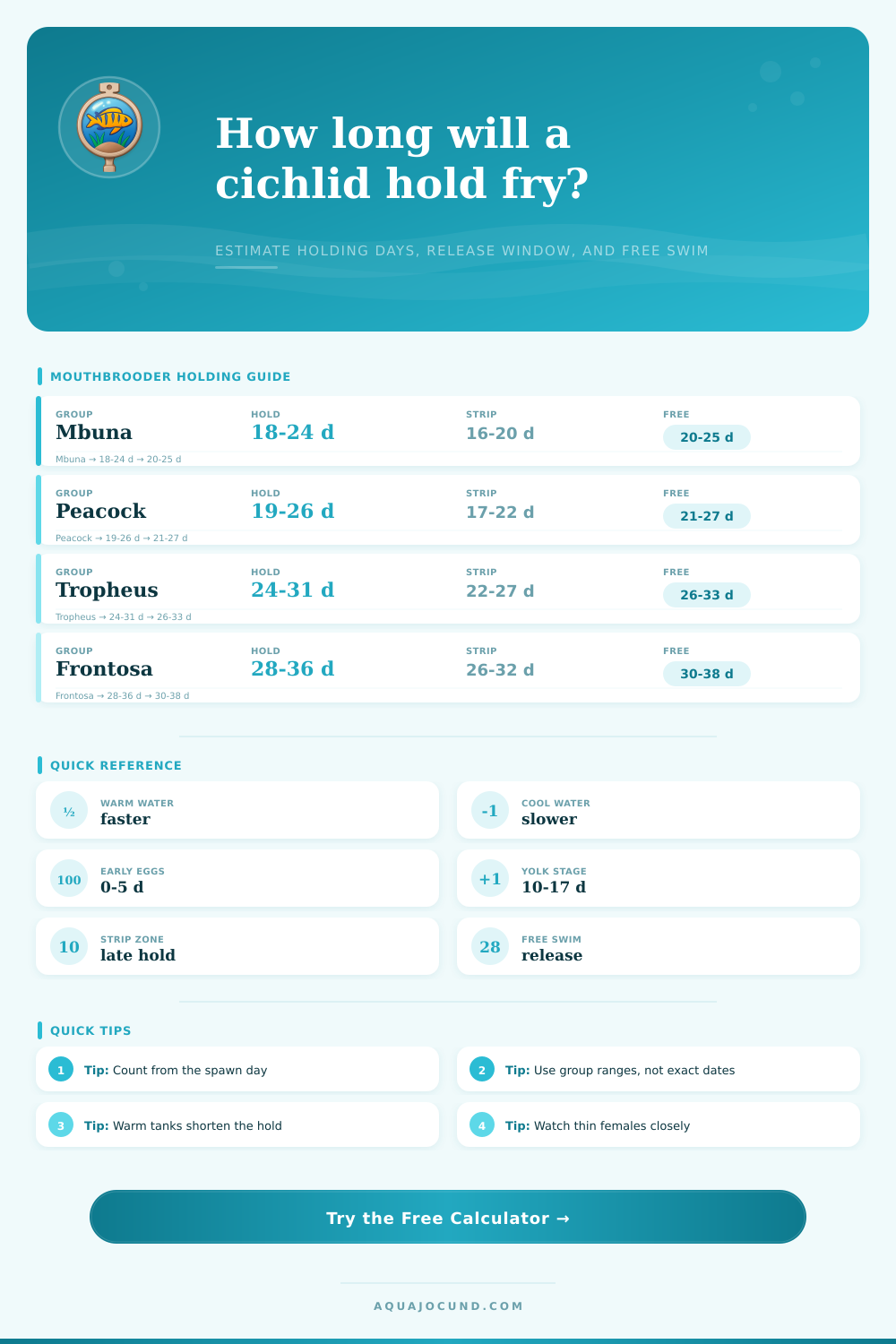
| Group | Typical total hold | Late strip zone | Free-swim estimate |
|---|---|---|---|
| Lake Malawi mbuna | 18 to 24 days | Day 16 to 20 | Day 20 to 25 |
| Peacock and small hap | 19 to 26 days | Day 17 to 22 | Day 21 to 27 |
| Large hap or predator hap | 21 to 29 days | Day 19 to 25 | Day 23 to 31 |
| Victorian mouthbrooder | 16 to 22 days | Day 14 to 19 | Day 18 to 23 |
| Tropheus and Petrochromis | 24 to 31 days | Day 22 to 27 | Day 26 to 33 |
| Frontosa or Cyphotilapia | 28 to 36 days | Day 26 to 32 | Day 30 to 38 |
| Dwarf African mouthbrooder | 15 to 21 days | Day 13 to 18 | Day 17 to 22 |
| Tilapia type mouthbrooder | 12 to 18 days | Day 10 to 15 | Day 14 to 20 |
🌡Temperature Adjustment Table
| Temperature band | Expected effect | Calculator adjustment | Timing note |
|---|---|---|---|
| 72 to 74°F / 22.2 to 23.3°C | Slower development | Add about 2 to 4 days | Watch for thin females near the end |
| 75 to 77°F / 23.9 to 25.0°C | Slightly slower | Add about 1 day | Common for many Malawi tanks |
| 78 to 80°F / 25.6 to 26.7°C | Baseline range | Minimal adjustment | Most published ranges fit here |
| 81 to 83°F / 27.2 to 28.3°C | Faster development | Subtract about 1 to 3 days | Release may come sooner than expected |
📅Day Since Spawn Stage Guide
| Spawn day range | Likely brood stage | Handling read | Calculator use |
|---|---|---|---|
| Day 0 to 5 | Eggs or very early embryos | Avoid handling unless urgent | Estimate total hold only |
| Day 6 to 11 | Embryos and early tails | Still early for routine stripping | Check expected remaining days |
| Day 12 to 17 | Yolk-sac fry developing | Late species may still need time | Compare to group strip start |
| Day 18 to 25 | Late hold or release-ready fry | Many Malawi groups enter window | Use strip or release range |
| Day 26 plus | Extended hold for larger groups | Expected for Frontosa or Tropheus | Check overdue status by group |
🔍Release And Strip Timing Table
| Goal | Usual window | Best input to watch | Result to use |
|---|---|---|---|
| Natural release | Expected hold minus 1 to plus 3 days | Female fullness and hiding | Release window card |
| Planned late strip | About 3 to 5 days before release | Species group and temperature | Strip window card |
| Watch only | Current day through expected release | Days remaining and condition | Days remaining card |
| Emergency assessment | Only when condition forces action | Thin or stressed female setting | Status and breakdown rows |
Is this your cichlid? Is she swollen? Does her mouth seem swollen? But she won’t even open her mouth to eat. You’re not sure if she’s dropped her fry yet. Welcome to the anxious heart of mouthbrooding.
Use the calculator above to see how long your cichlid should be brooding versus a potential problem. Considering her species’ baseline and your specific tank conditions take the guesswork out of it. The basic input is number of days since she picked up your eggs. What does that mean? Day zero is the day you observed her pick up the eggs.
How to Know When Your Cichlid Will Release Her Babies
And this is important because each line has its own metabolism rate. Some species might be ready in 3 weeks (Mbuna), others in 5 (Frontosa). The tool starts with those average numbers for the groups. Next, it accounts for one variable you can actualy influence, temperature. Warmer temperatures accelerates development and therefore shorten the holding time. Cooler temperatures slow things down and lengthen the holding time.
While you’re waiting, monitor the body condition of your female(s). Protecting the developing embryos takes a physical toll on her and she won’t eat while holding them. If she was in poor body condition prior to spawning, she’ll drop weight quicker. You can adjust for this when using the calculator by choosing her body condition. Exhaustion may lead to early release from an otherwise healthy female. Or even worse, she could hold on too long making it dangerous not only for herself but the fry as well.
Watching her belly closely provide real-world data that no formula can fully explain. If natural release doesn’t work there is also a clear window during which you can strip. Normally it’s at the end of your estimated hold time. To strip, you simply gently encourage female to spit out the fry into a collection container. You’d really want to do this if she appears to be in rough shape or has exceeded the expected number of days. Did you know there was an estimated window here? That’s why the tool has a window). So stripping is a final effort, but one worth trying if necessary. Premature stripping result in weak offspring that won’t live long on their own.
Knowing their developmental stages will ease some of that panic. During the initial week, she’s holding eggs. Week two, they’re hatched and floating freely within her mouth (and she’s blowing constant oxygen bubbles on them). This is also the stage where her mouth look biggest. Towards the final stretch of hold time, if she feels comfortable, you may notice little fry darting in/out.
If you don’t have fry darting around by the projected release date, check your inputs. Did you set the temp properly? A couple of degrees change will alter the timeline by a few days. Remember, warm water mean faster growth. I see many people making the same mistake, that’s all they consider is the species name and they forget the environment. Genetics aren’t the only things that matters. Temperature, stress levels, and the environment all matter.
If you have a busy tank where there are chasers, then your females are going to be holding longer because she fear for her life and wants to keep those fry closer to protect them. A quiet tank allow for more natural timing. That’s why I ask about the disturbance level on the calculator. Her psychological state can affect her biological clock.
The most difficult aspect of keeping mouthbrooder is patience. You have these little balls of yolk swimming around inside that female and you just can’t wait any longer to see the babies. If you intervene prematurely, you’re going to mess up the brood. On the other hand, if you let it go too far, you might lose the female. The trick is learning when to do something and when to leave well enough alone. Think of these estimates as ballpark figures, a range, not a deadline. Remember: Fish is alive. They react to what’s happening right now rather then some random average.
As soon as the fry are swimming freely you’ll want to feed them ASAP. While commercially available fry foods and tiny organisms is both fine, I recommend having some prepared in advance of the release. You don’t want to be stuck with a bunch of hungry babies waiting for food. How fast the fry locate food after leaving mom’s protective care will decide whether or not they survive this all important mouth-to-tank transition.
Ultimately it will make you a better reader of your fish. You’ll see the little things that tell them when they’re ready and stressed out. It gives you a framework for numbers but you get your truth from observation. When your eyes say one thing and the number says another, believe your eyes. That’s how you go from guessing at what your fish need to know what your fish need in every situation.