🌊 Chloride to Salinity Calculator
Convert chloride test results into aquarium salinity, specific gravity, habitat fit, and adjustment guidance.
✅ Chloride Conversion Results
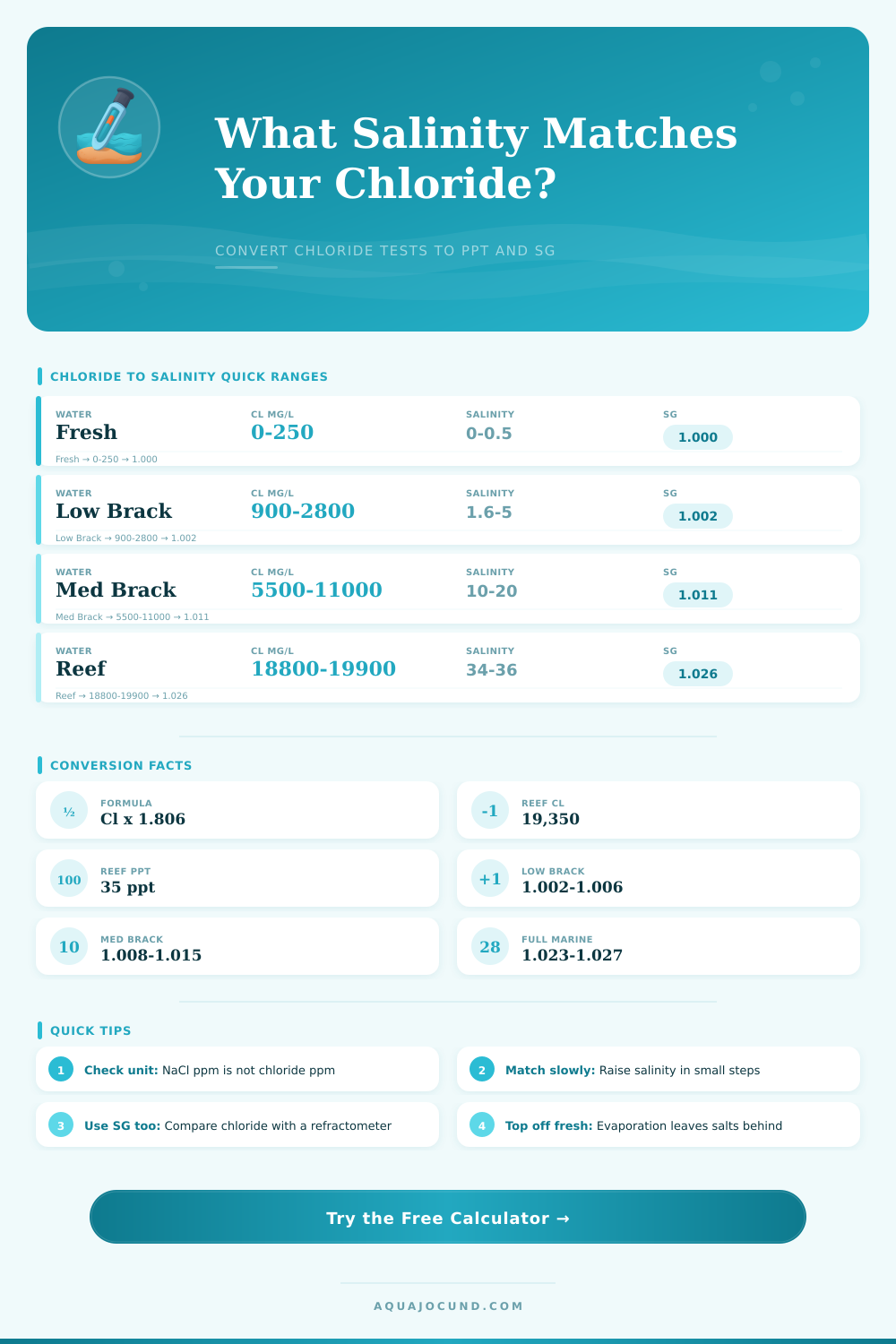
| Water Type | Chloride mg/L | Salinity ppt | Specific Gravity | Typical Use |
|---|---|---|---|---|
| Fresh | 0-250 | 0-0.5 | 1.000-1.0004 | Community, planted, shrimp |
| Hard Fresh | 250-900 | 0.5-1.6 | 1.0004-1.0012 | Livebearer or Rift buffers |
| Low Brackish | 900-4400 | 1.6-8 | 1.001-1.006 | Mollies, gobies, acclimation |
| Mid Brackish | 4400-10000 | 8-18 | 1.006-1.014 | Puffers, monos, archers |
| Fish Marine | 16600-17700 | 30-32 | 1.023-1.024 | Fish-only marine tanks |
| Reef Marine | 18800-19900 | 34-36 | 1.025-1.027 | Reef aquariums and inverts |
| Input Basis | Convert to Chloride mg/L | Then to Salinity | Best When |
|---|---|---|---|
| Chloride ion ppm | Use reading directly | Cl mg/L × 0.00180655 | Aquarium chloride kits and labs |
| Chlorinity ppt | ppt × 1000 | Chlorinity × 1.80655 | Oceanographic chlorinity reports |
| Reported as NaCl ppm | NaCl × 0.6066 | Converted Cl × 0.00180655 | Water softener or pool-style reports |
| Sodium chloride ppt | NaCl ppt × 606.6 | Converted Cl × 0.00180655 | Plain salt bath or dip mixes |
| Refractometer SG | Back-calculate only | Prefer direct salinity scale | Verifying chloride against optics |
| Scenario | Target ppt | Target Cl mg/L | SG Estimate | Notes |
|---|---|---|---|---|
| Betta or shrimp freshwater | 0-0.3 | 0-165 | 1.000 | High chloride may point to tap source or salt use |
| Rift lake mineral water | 0.5-1.5 | 275-830 | 1.0004-1.0011 | Mineral salts are not only chloride |
| Molly low brackish | 2-5 | 1100-2770 | 1.002-1.004 | Raise gradually after quarantine |
| Figure 8 puffer | 5-10 | 2770-5530 | 1.004-1.008 | Stable brackish water is the goal |
| Mudskipper or archer | 10-18 | 5530-9960 | 1.008-1.014 | Match species and source salinity |
| Marine hyposalinity | 14-18 | 7750-9960 | 1.011-1.014 | Use only with proper marine monitoring |
| Fish-only marine | 30-32 | 16600-17700 | 1.023-1.024 | Often run below reef salinity |
| Reef aquarium | 34-36 | 18800-19900 | 1.025-1.027 | Keep stable for coral and inverts |
| Tool | Reads | Strength | Watch Point |
|---|---|---|---|
| Chloride titration | Cl mg/L | Good for brackish checks | Endpoint color and reagent age |
| Lab ion report | Cl mg/L | Best precision | Confirm whether result is chloride or NaCl |
| Refractometer | ppt or SG | Fast marine verification | Calibrate near aquarium range |
| Swing-arm hydrometer | SG | Simple trend tool | Bubbles and temperature bias |
| Conductivity meter | EC or TDS | Freshwater trend tracking | Not a chloride-specific test |
Check the report basis before converting. A result reported as sodium chloride contains only about 60.66% chloride by mass, so treating it as chloride will overstate salinity.
Use chloride conversion as a cross-check, not the only control. For reef and brackish tanks, confirm final salinity with a calibrated refractometer before adding livestock.
Converting Chloride to Salinity Measurements
Converting chloride measurements to salinity measurements are a necessary process to maintain an aquarium. In some instances, the test kit will reveal the chloride levels of an aquarium in milligrams per liter. However, the care sheet for the fish in the aquarium will indicate the required salinity in parts per thousand.
Thus, to transform the measurement of chloride in the aquarium to salinity, you can use a calculator that utilize a constant to perform the calculation. You must understand that a test kit that measure the chloride levels of an aquarium does not measure the total salt of the aquarium. People often make the mistake of assuming that the chloride levels of the aquarium is the same as the salt levels.
How to Convert Chloride to Salinity in Your Aquarium
Chloride is not the same as sodium chloride (NaCl). Sodium chloride is a molecule that contain both sodium and chloride. Therefore, the weight of the sodium chloride molecule is not the same than the weight of the chloride molecule.
Using a measurement of sodium chloride instead of chloride will make the water appear more saltier than it actualy is in the aquarium. Thus, people must understand whether the measurement of the salt levels is of chloride or sodium chloride to avoid adding too much salt to the aquarium. The third factor that must be accounted for when measuring the salinity of an aquarium is the temperature of the water.
The density of the water change with alterations in the temperature of the water. The refractometer and the hydrometer will provide incorrect salinity measurements if the water temperature change. To obtain an accurate measurement of the salinity, you should account for the temperature of the aquarium water.
Accurate salinity measurements of the aquarium are required to maintain the health of the fish and to maintain the reef environment in the aquarium. The salinity of an aquarium also must be adjusted according to the type of fish that live in the aquarium. For example, mollies require low brackish water to thrive, but the Figure 8 Puffer fish require the water to be much more denser with salts.
People should use the habitat ranges for the types of fish to determine the salinity of the aquarium for there specific fish. Understanding the biological requirement of the fish allows people to determine whether the specific gravity of the aquarium water is the correct level for that specific type of fish. Finally, people must not make rapid adjustments to the salinity of the water in the aquarium.
If the salinity levels of the water in the aquarium are too low for the fish that live in the aquarium, adding salt to the water too fast will cause the fish to experience osmotic shock. Osmotic shock occur when the fish has to balance the amount of salt in its blood with the amount of salt in the water in the aquarium. If the salinity levels in the aquarium are too low, plain adding salt to the aquarium will make the salt concentration in the blood of the fish too high.
Therefore, to avoid harming the fish, you should add salt to the aquarium water in small increments over several days to allow the fish to adapt to the increased salinity of the water. Another factor to consider when adding salt to an aquarium is the type of salt. Marine salt mix should be used instead of plain table salt.
Plain table salt does not contain the same minerals as marine salt mix, such as magnesium, calcium, and sulfate. Corals and invertebrates requires these minerals to form there skeletons. A marine salt mix provide these minerals, and plain table salt does not.
Thus, using a marine salt mix in the aquarium instead of plain table salt is necessary for proper salinity calculations. Through understanding the relationship between chloride and salinity in an aquarium, people can use chloride measurement to control and create a stable environment for there fish.