Chiller vs Cooling Fan Comparison Calculator
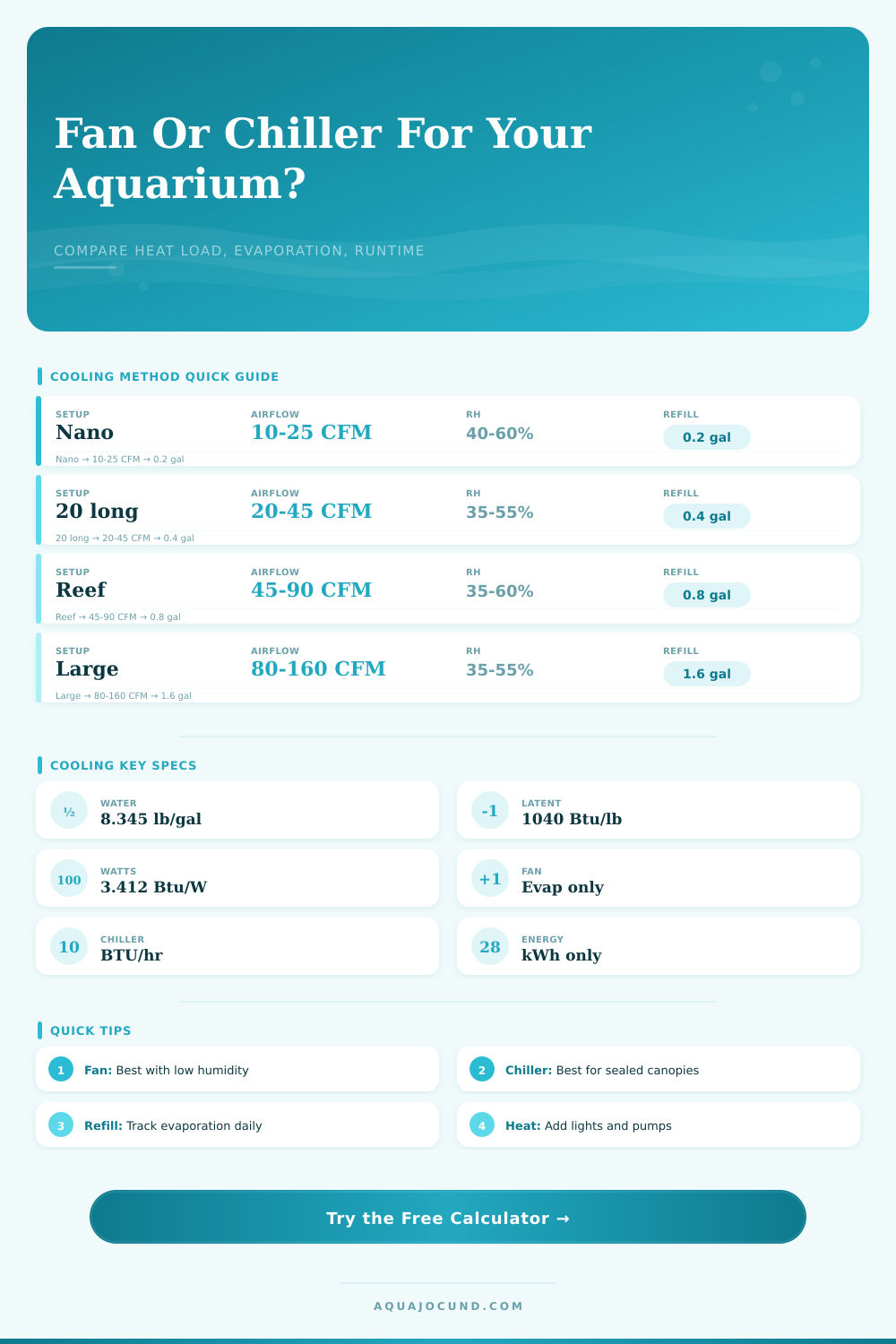
Compare aquarium fan evaporation against chiller BTU/hr, daily runtime, kWh, humidity limits, and the target temperature drop.
Cooling Comparison Results
| Scenario | Tank Range | Heat Load | Fan Path | Chiller Path | Watch Point |
|---|---|---|---|---|---|
| Nano desk tank | 5-15 gal | 60-180 BTU/hr | Small clip fan, short runtime | Usually oversized for tiny water volume | Rapid evaporation swings |
| Open planted tank | 20-40 gal | 150-450 BTU/hr | Works well if room RH stays moderate | Useful when room stays hot overnight | Top-off consistency |
| Canopy community tank | 29-75 gal | 300-800 BTU/hr | Needs vent path out of canopy | More stable under enclosed lights | Trapped warm air |
| Reef with strong lights | 40-120 gal | 600-1800 BTU/hr | Good first stage cooling | Handles peaks after fan limit | Salinity rise from evap |
| High humidity fish room | 40-180 gal | 500-2200 BTU/hr | Limited by moist room air | Predictable BTU removal | Room ventilation |
| Sump-based system | 75-250 gal | 800-3200 BTU/hr | Sump fan gives large surface access | Inline plumbing can remove steady load | Sump water level |
| Heat wave buffer | Any stable tank | Short high peaks | Fast, simple peak shaving | Better for multi-day high room temps | Target drop realism |
| Mostly covered top | 10-125 gal | Varies by lights | Reduced unless lids are opened | Less dependent on open surface | Gas exchange and vents |
| Heat Source | Input To Use | BTU/hr Rule | Runtime Note |
|---|---|---|---|
| Submersible heater stuck on or cycling | Heater watts | watts × 3.412 | Use only watts active during cooling |
| LED or T5 lighting over water | Light watts | watts × 3.412 | Use the light period inside the cooling window |
| Return pump, UV, wavemakers | Pump watts | watts × 3.412 | Most submerged watts become tank heat |
| Warm room transfer | Ambient BTU/hr | estimated or logged | Highest when room exceeds tank target |
| Solar window exposure | Ambient BTU/hr | short peak load | Average it over the selected runtime |
| Canopy heat pocket | Ambient BTU/hr | vent-dependent | Measure room air and canopy air separately |
| Room RH | Fan Effect | Typical Refill Signal | Calculator Adjustment |
|---|---|---|---|
| 25-35% | Very strong evaporative cooling | Fast daily drop in water level | Confirm refill limit before extending runtime |
| 35-50% | Strong and predictable | Moderate daily top-off | Fan estimate usually tracks well |
| 50-65% | Useful but capped sooner | Refill rises slowly with more CFM | Increase surface access before fan speed |
| 65-80% | Weak unless room air is exchanged | Less cooling per added airflow | Compare chiller runtime carefully |
| 80%+ | Often unreliable for target drops | Water may evaporate without enough drop | Lower expected fan coverage |
| Tank | Open Surface | Common Target Drop | Fan CFM Range | Chiller BTU/hr Range |
|---|---|---|---|---|
| 10 gallon | 180-220 sq in | 1-3°F | 10-25 CFM | 200-500 BTU/hr |
| 20 long | 350-420 sq in | 2-4°F | 20-45 CFM | 350-800 BTU/hr |
| 40 breeder | 600-700 sq in | 2-5°F | 40-85 CFM | 700-1500 BTU/hr |
| 75 gallon | 800-950 sq in | 2-5°F | 60-130 CFM | 1200-2500 BTU/hr |
| 125 gallon | 1100-1350 sq in | 2-6°F | 90-180 CFM | 1800-4000 BTU/hr |
| 180 gallon | 1500-1900 sq in | 2-6°F | 120-240 CFM | 2800-6000 BTU/hr |
Results are estimates for aquarium planning. Verify with a calibrated thermometer and salinity or conductivity checks when evaporation changes daily refill volume.
It’s the dog days of summer, 81 degrees according to the thermometer, and your fish are neither dead nor entertaining you. You’re in a room that feels like a sauna, pondering whether a box fan will do or if you’ll have to break down and get a chiller. What can be known about heat that we don’t already know? It is sneaky and invisible until there is trouble. This lack of knowledge stress out July tank owner.
Should you choose passive evaporative cooling or active refrigeration? Physics, not personal preference, drives the decision. You are purchasing a solution to extract energy from a sealed environment. Many folks overestimate fans because they think that fans make cool air. Fans don’t make anything; they only move air.
How to Cool Your Fish Tank
Fans move warm, moist air off of water and replace it with drier air. This allow the water to evaporate more moisture. As water evaporates, it take heat out of the water. So, by using this process, the water gets cooler. It’s cheap but there’s a catch. When the air around the tank become saturated with moisture, it won’t remove any more heat.
The calculator above does all the math for you based off your humidity and surface area. This lets you know when the fan will stop working before you wait for a temperature change that never happens.
Chillers is blunt instruments designed to extract BTUs from water using a compressor. It doesn’t matter what’s happening with the air around it; it works. They cost money to purchase and operate. When your room temperature is ninety-five degrees or seventy-five, it’ll knock down your tank temp to whatever your set point. You get reliability (and higher electric bills) when you pay for chillers.
As ambient heat goes up, so does their runtime. See table on this page. A chiller operating 24/7 costs much more then a fan operating 6 hours. But maybe a fan won’t function in your humid basement?
Knowing what you are measuring is key. Price tag? Nope, that’s first for most folks. Heat load? Yes. The more degrees different between the tank and the room, the more heat will flow into the tank. Consider wattage of all lights, pump motors, etc.
The higher the humidity, the less a fan can absorbs (a fraction). Your chiller will have to work harder. You also have to account for the equipment heat that goes right back in the water. Bailing out a boat with a hole in the hull doesn’t work. Trying to ignore the watts on your power head wouldn’t either.
In real life, actualy specifications don’t necessarily line up with ideal ones. A sump has a lot of exposed surface area in the room. A canopy lid insulates and holds heat. Steady state don’t account for sudden spikes like direct sunlight from a window. You want a buffer. That’s why the tool has a safety margin option.
It would of been better to have a chiller that kicks in periodically. A non-functioning fan does not help lower the temperature. If using a fan, measure your evaporation. The water should be lowering in height. How much it lowers tell you how hard it’s cooling. Watch the refill amount; that tells you just how hard it’s cooling.
A hybrid is frequently the best system. Run the fan to manage the baseline load and reduce the humidity. Run the chiller during peak light heat, or if you have a room temperature that exceeds what the fan can handle. That’s balanced performance vs. It costs money. It recognizes that physics are harsh but efficiency is flexible.
Begin with the simplest solution which works. Add complexity as necessary. The objective isn’t to cool the tank as much as possible. It’s to maintain water sufficiently stable so the fish don’t realize there’s weather outside. Make the thermometer steady and everything else falls in line.