◯ Ceramic Ring Quantity Calculator
Estimate ceramic biomedia liters, bag count, filter chamber fill, surface area, and flow load from tank and compartment measurements.
| Media Type | Surface Area | Bulk Weight | Best Use |
|---|---|---|---|
| Standard ceramic rings | 300-400 m2/L | 0.60-0.75 kg/L | Canisters, HOB baskets, simple submerged trays. |
| Porous ceramic rings | 450-650 m2/L | 0.50-0.65 kg/L | Community tanks needing more media in limited volume. |
| Sintered glass ceramic | 700-1100 m2/L | 0.42-0.55 kg/L | Compact canisters, high stock, or retrofit baskets. |
| Large tubular ceramic rings | 220-320 m2/L | 0.55-0.70 kg/L | High-flow trays where open channels resist clogging. |
| Ceramic pearl media | 500-750 m2/L | 0.45-0.60 kg/L | Even packing in baskets, mesh bags, and small chambers. |
| Ceramic block chips | 600-900 m2/L | 0.45-0.58 kg/L | Sump chambers and trays with pre-filtered water. |
| Pumice ceramic blend | 550-850 m2/L | 0.40-0.55 kg/L | Lightweight high-pore media with moderate flow. |
| Lava ceramic blend | 300-500 m2/L | 0.55-0.75 kg/L | Large baskets where volume is not tight. |
| Tank | Dimensions | Community Load | Heavy Load |
|---|---|---|---|
| 10 gal | 20 x 10 x 12 in / 51 x 25 x 30 cm | 0.25-0.40 L | 0.5-0.8 L |
| 20 long | 30 x 12 x 12 in / 76 x 30 x 30 cm | 0.5-0.8 L | 1.0-1.4 L |
| 29 gal | 30 x 12 x 18 in / 76 x 30 x 46 cm | 0.8-1.2 L | 1.4-2.0 L |
| 40 breeder | 36 x 18 x 16 in / 91 x 46 x 41 cm | 1.0-1.5 L | 1.8-2.6 L |
| 55 gal | 48 x 13 x 21 in / 122 x 33 x 53 cm | 1.4-2.1 L | 2.5-3.6 L |
| 75 gal | 48 x 18 x 21 in / 122 x 46 x 53 cm | 1.9-2.8 L | 3.4-5.0 L |
| 125 gal | 72 x 18 x 21 in / 183 x 46 x 53 cm | 3.2-4.8 L | 5.7-8.2 L |
| Compartment Style | Useful Fill | Flow Note | When To Reduce Fill |
|---|---|---|---|
| Hang-on-back basket | 40-65% | Leave room above and around bags. | When bypass or overflow increases. |
| Canister tray | 60-80% | Spread rings evenly, not packed tight. | When fine pads clog before the tray. |
| Sump submerged chamber | 60-85% | Use crates or bags for easy cleaning. | When detritus settles inside the media. |
| Trickle tower / shower | 50-75% | Open rings help distribute wet-dry flow. | When water channels through one path. |
| Pond pressure box | 50-70% | Account for foam, mats, and backwash space. | When pressure rises quickly after cleaning. |
| Reference | Value | Metric Equivalent | Use In Calculator |
|---|---|---|---|
| 1 liter media | 1.06 qt | 1000 mL | Common small bag size. |
| 1 quart media | 0.95 L | 946 mL | Close to one liter for rough filling. |
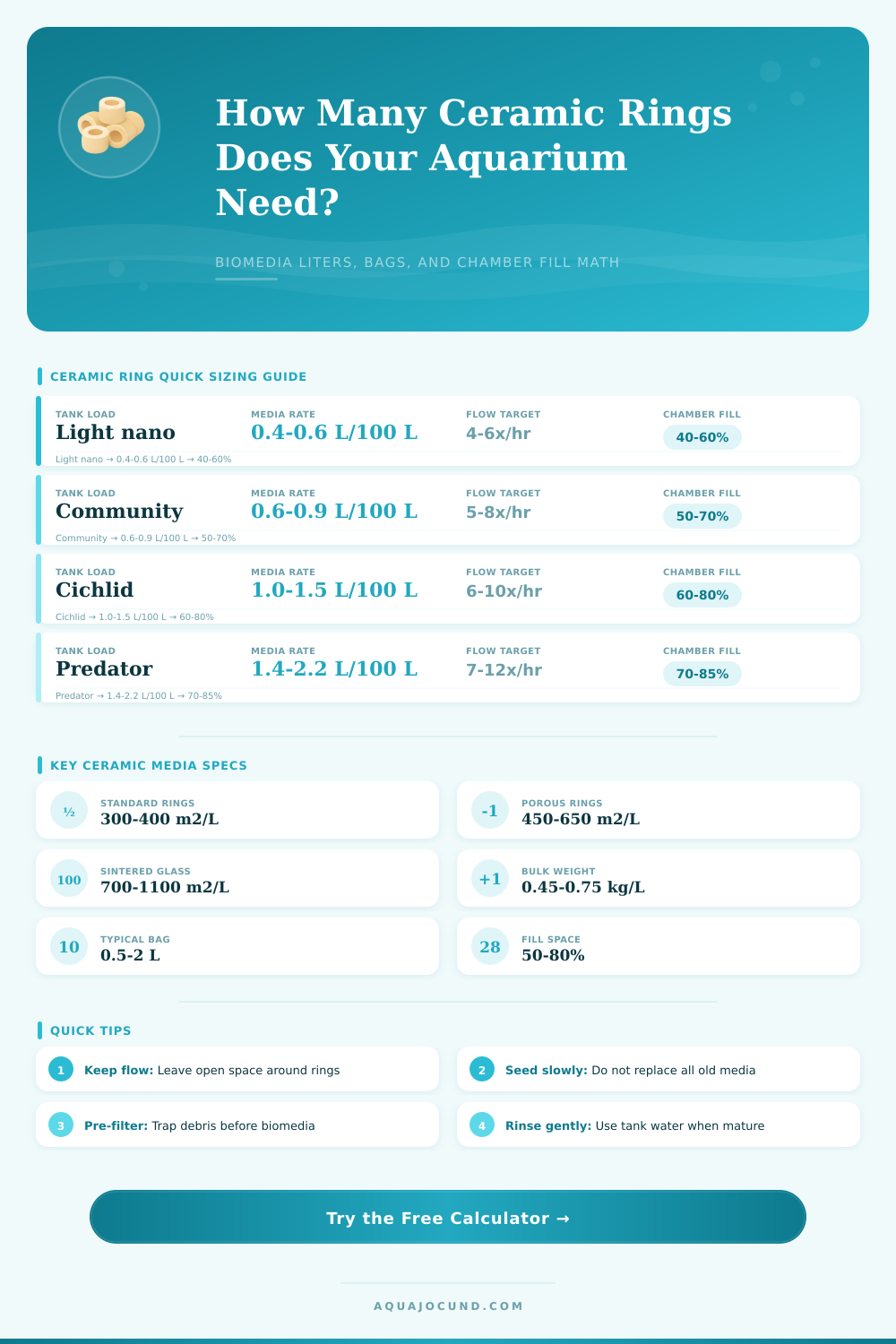
| Good aquarium turnover | 5-8x/hr | Tank volume per hour | Normal ceramic ring contact range. |
| Messy fish turnover | 7-12x/hr | Tank volume per hour | Needs more pre-filter maintenance. |
| Media flow load | 50-200 L/h per L | 13-53 gph per L | Higher values need open packing. |
To determine the proper amount of ceramic ring to use in a filter for an aquarium, several factor need to be considered. Using too few ceramic rings will result in high levels of ammonia in the aquarium water. Using too many ceramic rings will slow the water movement through the filter, possibly leading to the trapping of debris in the filter.
Due to the fact that each aquarium is different in both the amount of water that it contains and the number of fish that lives in that aquarium, each aquarium will require a different amount of ceramic rings. The first factor to consider when determining the amount of ceramic rings to use in an aquarium filter is the net water volume of the aquarium itself. To calculate the net water volume, you must subtract the water volume that is taken up by the substrate and the hardscape of the aquarium from the total water volume of the aquarium.
How Many Ceramic Rings to Use in an Aquarium
The beneficial bacteria that live in the aquarium require a specific amount of volume of water to perform there task of breaking down waste. In addition to the required volume of water for the beneficial bacteria, you should consider the amount of waste that the fish produces in the aquarium. Related to this factor is the flow rate of the filter.
Flow rate has an impact on the amount of oxygen that reaches the beneficial bacteria that live on the ceramic rings. Without adequate levels of oxygen to perform their biological functions, the beneficial bacteria will be unable to fulfill their critical responsibilities for the health of the aquariums ecosystem. Another factor that will impact the amount of ceramic rings that can be placed in a filter is the type of filter that is utilized in the aquarium.
For instance, hang on back filters and internal filters have limited space for placing ceramic rings, whereas canister filters can contain many ceramic rings but may lead to channeling of the water if the ceramic rings are too close together. Sump chambers can contain many ceramic rings but will accumulate detritus over time that may clog the pores of the ceramic rings. The type of media that is to be used in the aquarium will also impact the amount of ceramic rings that is required.
Standard ceramic rings are commonly used for aquarium filters but are replaced with porous ceramic rings that contain more surface area in a smaller area. Using these type of ceramic rings will take up less space within the filter then standard ceramic rings but will require the use of a stronger pre-filter to prevent the pores of the ceramic rings from becoming clogged with debris. Additional factors to consider when calculating the amount of ceramic rings to be used in a filter are the existing media in the aquarium and the future plan for that aquarium.
If the aquarium already contains ceramic rings with beneficial bacteria, it is likely that you should preserve those ceramic rings. The plans for the aquarium may include adding additional fish to increase the bioload of the aquarium. These additional fish will increase the amount of waste that is produced in the aquarium and, therefore, increase the number of ceramic rings that are required to break down that waste.
The calculator for the amount of ceramic rings to be used in a filter accounts for existing and future media. The result of the calculation is rounded to the nearest whole bag of ceramic rings to ensure that there are neither too few nor too many ceramic rings to be purchase. The flow rate of the filter is another critical factor in the determination of the amount of ceramic rings that should be contained within an aquarium filter.
The flow rate will impact the amount of ammonia that accumulates in the aquarium in areas known as dead zone. Slow water movement will result in the formation of dead zones. Flow rates that are too high will prevent the beneficial bacteria from adequately performing their task.
The turnover rate of the filter can be viewed on the calculator to determine whether or not the pump that is being used is adequate for the amount of ceramic rings that are being used in the filter. Many people focus solely on the number of ceramic rings that are to be contained in the filter, but the relationship between the amount of ceramic rings and the space within the filter is also important to consider. The amount of ceramic rings that are required for an aquarium will likely be more greater than the available space within the filter.
In this case, an alteration to the aquarium system will be required. Either higher-surface media for the filter or the addition of another filter chamber can be implemented. The flow rate per liter of water should also be within a practical range so as to not interfere with the function of the aquarium’s filter.
In the case of any change to the aquarium, it is necessary to recalculate the proper amount of ceramic rings that are required within the filter. Changes to the water pump, feeding routines for the fish, or the number of fish within the aquarium will all impact the amount of ceramic rings that is required in the filter. By calculating the amount of ceramic rings that are required for a given aquarium, it is possible to avoid the aquarium’s filter underperforming.
By determining the proper amount of ceramic rings to be added to the filter, it is possible to avoid creating an under-filtered aquarium or an over-packed filter. You should of checked the volume first. Its important to get it right.
Dont forget the amount of furnitures in the tank. The aquarium’s size can make a diffrence. Making sure you have alot of media is key.
Youll want to recieve a good flow rate. It isnt easy to get the balance perfect, but it is worth it. Youre going to love teh results.