Carpet Plant Coverage Calculator
Estimate planted tank carpet coverage, cup or pot quantity, plug density, DSM or immersed spread, target coverage, trimming loss, and time to close the foreground.
📌Carpet Coverage Presets
📐Tank Floor, Planting, And Growth Inputs
Used for the volume reference card; floor area drives the carpet calculation.
Small plugs planted closer give a faster, more even carpet.
This is the footprint after dividing one cup into plugs, not the cup diameter.
📊Live Planning Benchmarks
🌱Carpet Species Comparison Grid
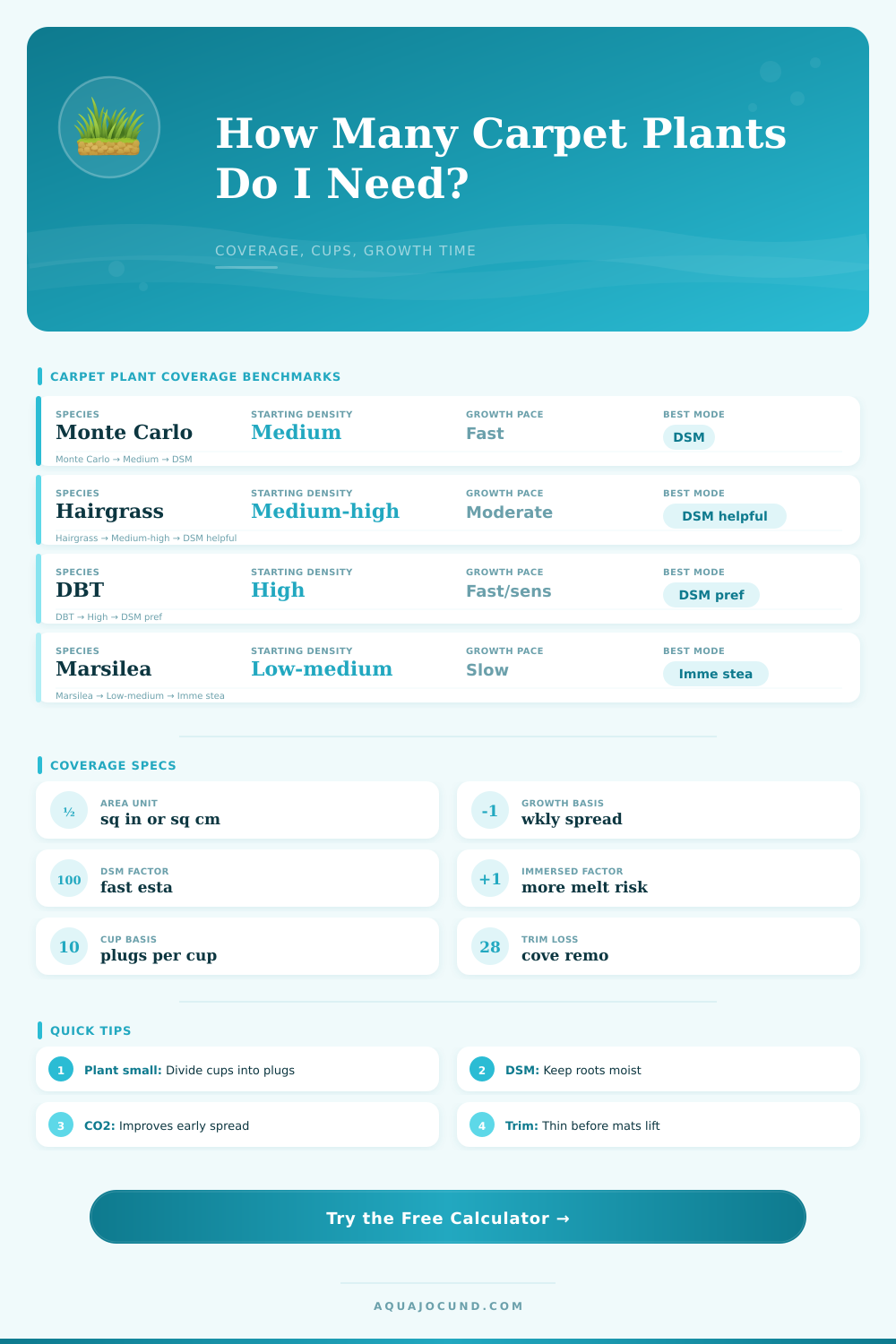
Monte Carlo
Forgiving round-leaf carpet with strong lateral runners under medium-high light.
14-22% weekly spreadDwarf Hairgrass
Fine grass texture; spreads by runners and benefits from close plug spacing.
10-17% weekly spreadDwarf Baby Tears
Tiny leaves, high density, and higher transition risk without stable CO2.
12-20% weekly spreadGlossostigma
Fast foreground runner when light reaches the substrate and trim height stays low.
16-25% weekly spreadMarsilea
Slow, steady clover-like foreground that tolerates lower-tech conditions.
6-11% weekly spreadDwarf Sagittaria
Runner plant that can form a taller lawn in medium light and nutritious substrate.
9-15% weekly spreadCrypt Parva
Very slow compact rosette carpet with low trimming demand and patient fill-in.
3-7% weekly spreadUtricularia
Fine bright carpet; needs soft handling, stable conditions, and careful transition.
8-16% weekly spread📋Species Coverage Reference
| Species | Typical Plug Density | Cup Coverage At Planting | Spread Pattern | Planning Note |
|---|---|---|---|---|
| Monte Carlo | 30-45 plugs/sq ft | 35-55 sq in per cup | Creeping mats | Good all-around carpet for DSM or immersed starts |
| Dwarf hairgrass | 36-60 plugs/sq ft | 25-45 sq in per cup | Runners | Use smaller plugs to avoid clumps with empty lanes |
| Dwarf baby tears HC | 45-72 plugs/sq ft | 24-40 sq in per cup | Tight cushion | Plan extra loss if flooding from emersed growth |
| Glossostigma | 28-45 plugs/sq ft | 40-65 sq in per cup | Fast runners | Trim low or it stacks upward instead of spreading flat |
| Marsilea | 18-36 plugs/sq ft | 40-70 sq in per cup | Slow runners | Lower density works, but full coverage takes longer |
| Crypt parva | 16-30 plugs/sq ft | 30-55 sq in per pot | Slow rosettes | Coverage grows by crowns, not a quick mat |
📏Common Aquarium Floor Coverage Examples
| Tank | Footprint | Floor Area | 85% Target Area | Typical Cups |
|---|---|---|---|---|
| 5 gal nano | 16 x 8 in / 41 x 20 cm | 128 sq in / 826 sq cm | 109 sq in / 702 sq cm | 2-4 cups |
| 10 gal standard | 20 x 10 in / 51 x 25 cm | 200 sq in / 1290 sq cm | 170 sq in / 1097 sq cm | 3-5 cups |
| 20 gal long | 30 x 12 in / 76 x 30 cm | 360 sq in / 2323 sq cm | 306 sq in / 1974 sq cm | 5-8 cups |
| 60P aquascape | 24 x 12 in / 60 x 30 cm | 288 sq in / 1800 sq cm | 245 sq in / 1530 sq cm | 4-7 cups |
| 40 breeder | 36 x 18 in / 91 x 46 cm | 648 sq in / 4181 sq cm | 551 sq in / 3554 sq cm | 8-13 cups |
| 75 gal | 48 x 18 in / 122 x 46 cm | 864 sq in / 5574 sq cm | 734 sq in / 4738 sq cm | 11-18 cups |
🌱Starting Mode And Loss Factors
| Mode | Growth Multiplier | Typical Loss Range | Best Use |
|---|---|---|---|
| Immersed from day one | 1.00x | 8-25% | Stable mature tanks and tissue culture starts |
| Dry start method | 1.30x | 3-12% | Monte Carlo, HC, hairgrass, and sloped aquascapes |
| DSM then flooded transition | 0.95x after flooding | 10-30% | Carpets already rooted before water is added |
| Emersed cup planted immersed | 0.82x early | 15-35% | Store cups converted straight into an aquarium |
📘Density And Coverage Planning Table
| Planting Style | Plugs Per Sq Ft | Spacing | Fill-In Speed | When To Use |
|---|---|---|---|---|
| Wide starter grid | 16-25 | 2.4-3.0 in | Slow | Low-tech, budget-neutral plant starts, patient carpets |
| Balanced carpet grid | 30-45 | 1.8-2.2 in | Moderate | Most Monte Carlo, hairgrass, and Marsilea layouts |
| Dense show start | 48-72 | 1.4-1.7 in | Fast | DSM, competition layouts, HC, or quick foreground closing |
| Pot rosette spacing | 12-30 | 2.2-3.5 in | Slow-moderate | Crypt parva, dwarf sag, and larger rooted foreground plants |
The trick to getting a planted tank is a problem you must face if you want an aquarium garden. You purchase little cup full of plants (like Monte Carlo) and you plant it carefully. Then you wait for those lovely green carpets like you saw on YouTube. A couple of weeks later, you look at your tank and realize you’ve got very few plants floating in mud, and what is there looks sad and sparse.
What happened? People overestimate nature’s ability to be patient and they underestimate physics of growing things. The math of a carpet isn’t “how many cups do I have?” It’s more “how much ground surface area will remain once all my rock, wood, and open sand take their space? After you enter your tank’s size and hardscape blocking percentages, the calculator does all the math.
How to Plant a Perfect Aquatic Carpet
It spits out how much “usable” foreground you have, this is the only thing you need to know when you go shopping. Most people measure their glass (width times length) and base their purchases accordingly. But they ignore the fact that a big hunk of wood sitting smack dab in the middle of the tank reduce the planting area by fifteen percent. If you don’t subtract it, guess what? You’ll underplant by default. This tool makes you face facts about how much dirt you really have to play with before dropping cash on plugs.
The trick is density. Planting 20 plugs per square foot might save money upfront but you’ll have holes in that carpet. That bare ground takes months to fill in as they creep over it, meanwhile those gaps turn into algae heaven. You can plant 40 or even 50 plugs, which will cost you more initially and require more work, but it forms a closed carpet much sooner. And a carpet closes out algae just by denying it light on the substrate.
The table below (on the page) goes into detail on this concept with plug counts for each species, e.g., how many more plugs per square foot are needed to cover Dwarf Baby Tears compared to Marsilea. More isn’t always better. It’s all about covering fast vs budget, within reason.
Your choice of starting method will have a big impact on how the plant grows. With a dry start, you keep the substrate moist but not covered by water for several weeks, letting the leaves develop in an emersed state. These are tougher and faster growing than their submerged cousins. After flooding the tank, they adjust to life underwater without much shock. Whether you decide to do a dry start or just go with immersed starts, the calculator factors this into its growth estimate.
Without the dry start, you’ll be battling melt loss. Often new plants drops their leaves once they are underwater. This results in only bare stems that look like dead matter. It is ugly but normal. This is where most people give up completely.
If left untrimmed, a carpet will spread out and grow up faster then it grows sideways. If you let them get tall, they will start building up because there is always more carpeting coming. They will form a mat that eventually decays at the bottom and gets thrown off the base. By trimming regularly, keeping things short, you account for loss with the trimmer, knowing you’ll lose some coverage in the process. That’s not waste, it’s pruning, forcing the plant to put effort into growing out instead of up. Cut down the verticals so they’ll form lateral growth.
I know, sounds counterproductive to cut something you’re attempting to cultivate… but sometimes density = sacrifice. How long do you want to wait? Some carpeting species (e.g., Cryptocoryne parva) will completely cover the substrate in as little as six months, whereas others (such as those that grow well in high carbon dioxide and light) can be covered in just two months. If you choose slow growers, you need to live with bare patches for quite some time, while fast growers will consume higher amounts of nutrients and will require more demanding lighting conditions.
There’s no such thing as a free lunch when it comes to aquascaping. You have to invest time and money upfront or sacrifice time and maintenance in the long run.
Mistake #1 is forgetting about loss. Not all plugs work out, even if everything goes right. The snail messes with them. The fish digs around them. There isn’t enough root mass to anchor them. A 10-20% buffer on your cup count will account for those losses. This way, once everyone has settled in and you have done the initial trimming, your floor will still be nicely green. Taking into account things like transplants shock, melt, and trimming means you won’t need to scramble at project time to buy additional plants.
Carpet or no carpet? Ultimately a carpet isn’t just decorative, it’s an ecosystem driver as well. It gives shrimps a place to hide. It normalizes water parameters. It also adds the “depth” that brings a sense of nature to an otherwise box-full-of-gravel appearance. If done correctly in the beginning, you can avoid spending weeks fighting patches and battling algae. Be honest about how much space you have, factor in obstructions, and carpet liberally so as to outcompete weeds for the soil. The math is easy but you need the discipline to follow it to make or break an aquascape.