🐟 Canister Filter Size Calculator
Estimate canister filter flow, media volume, turnover, and real output after head loss, hose restriction, bioload, and service interval.
| Media Type | Capacity Factor | Flow Resistance | Best Use |
|---|---|---|---|
| Ceramic rings | 1.00 | Low | General canister baskets |
| Sintered glass media | 1.30 | Medium | High bioload in less volume |
| Porous stone media | 1.20 | Medium | Mixed biological baskets |
| Coarse sponge stack | 0.75 | Low | Mechanical plus bio support |
| Plastic bio balls | 0.65 | Very low | High oxygen, low clogging |
| Lava rock media | 0.85 | Medium | Large baskets, budget-free sizing |
| Mixed canister baskets | 1.00 | Medium | Balanced media layout |
| Tank | Dimensions | Typical Flow | Bio Media |
|---|---|---|---|
| 10 gallon | 20 x 10 x 12 in | 40-60 gph | 0.4-0.8 L |
| 20 long | 30 x 12 x 12 in | 100-140 gph | 0.9-1.5 L |
| 29 gallon | 30 x 12 x 18 in | 145-205 gph | 1.2-2.0 L |
| 40 breeder | 36 x 18 x 16 in | 240-360 gph | 1.8-3.5 L |
| 55 gallon | 48 x 13 x 21 in | 330-440 gph | 2.4-4.0 L |
| 75 gallon | 48 x 18 x 21 in | 450-675 gph | 3.2-5.8 L |
| 125 gallon | 72 x 18 x 22 in | 625-1,000 gph | 5.0-9.0 L |
| 180 gallon | 72 x 24 x 24 in | 900-1,440 gph | 7.0-13.0 L |
| Factor | Low Restriction | Normal | High Restriction |
|---|---|---|---|
| Head height | 0-2 ft / 0-0.6 m | 3-5 ft / 0.9-1.5 m | 6 ft+ / 1.8 m+ |
| Hose diameter | 19-25 mm | 16 mm | 10-12 mm |
| Hose path | Short, smooth bends | Valves and loops | Many elbows or long hose |
| Dirty media margin | Clean monthly | 4-6 week service | 8+ week service |
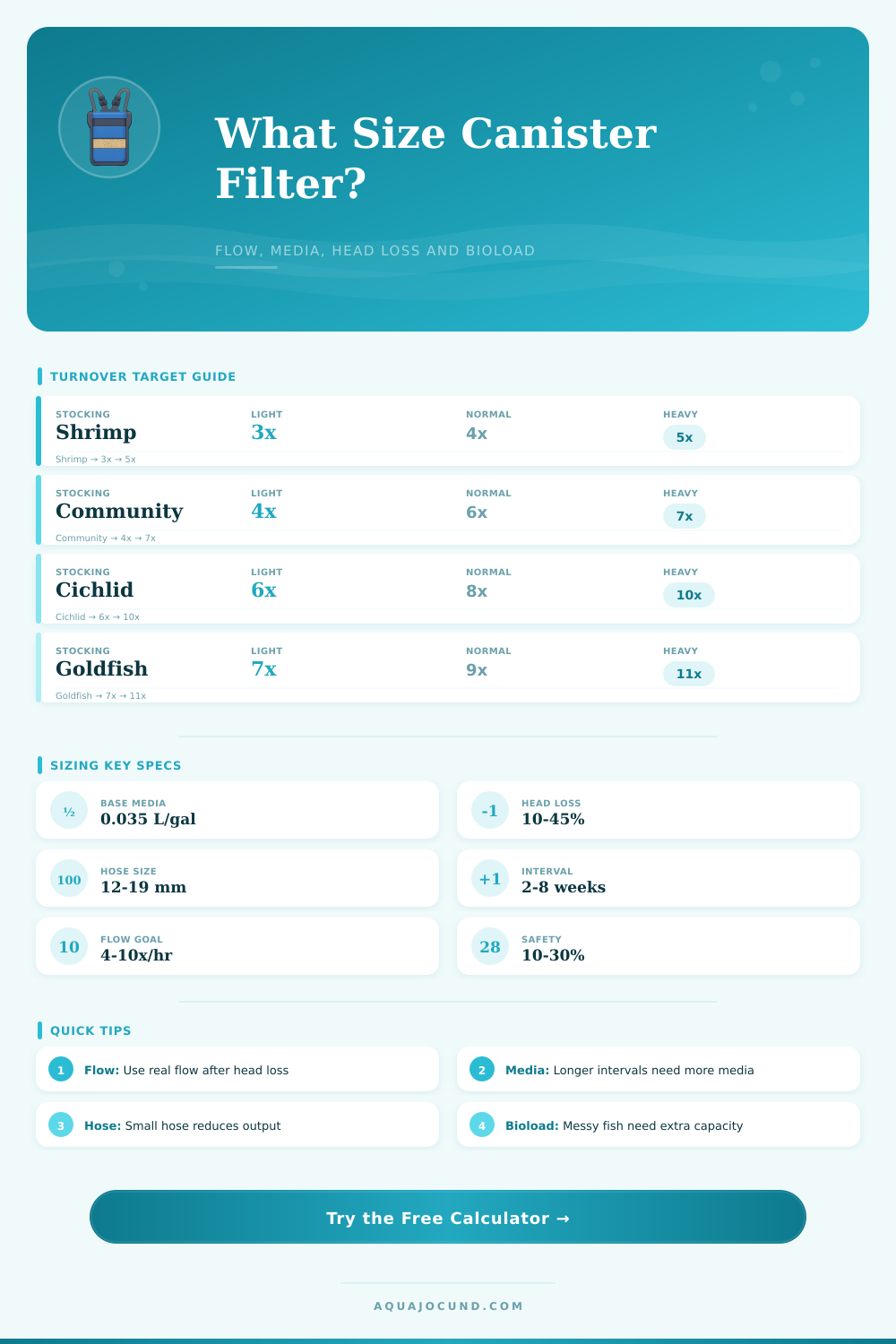
| Stocking Style | Turnover | Base Media | Sizing Note |
|---|---|---|---|
| Shrimp / nano livestock | 4x/hr | 0.025 L/gal | Gentle flow, intake protection |
| Planted community | 5x/hr | 0.030 L/gal | Balanced flow and CO2 stability |
| General community fish | 6x/hr | 0.035 L/gal | Standard canister sizing baseline |
| Cichlid / active fish | 8x/hr | 0.050 L/gal | More waste and stronger flow |
| Goldfish / high waste | 9x/hr | 0.065 L/gal | Large media volume preferred |
| Large predator fish | 9x/hr | 0.060 L/gal | Oversize mechanical and bio media |
When you choose a canister filter for your aquarium, you need to understand the relationship between the canister filter and the aquariums needs. Most people will choose a canister filter for there aquarium based on the volume of that aquarium. However, choosing a canister filter for the volume of your aquarium alone is incorrect because you also must consider the flow rate and the media volume for the canister filter.
You need to choose a canister filter that provides the correct amount of water movement in the aquarium as well as the correct amount of biological filtration. Flow rates is one of the primary factors to consider when purchasing a canister filter. Flow rates are the measure of how much water pass through the canister filter in a specific amount of time.
How to Choose a Canister Filter for Your Aquarium
The box of the canister filter that you select will list flow rates. However, the flow rate listed on the box is the advertised flow rate of the filter, not the actual flow rate of that canister filter in your aquarium. The actual flow rate will usually be lower than the advertised flow rate.
Two factor affect flow rates: the head height of the canister filter and the diameter of the hose that the filter use to exhaust water from the aquarium. The head height is the vertical distance the water must travel to reach the aquarium. The higher the head height, the more lower the flow rate of the canister filter.
A narrow diameter hose will also create a lower flow rate than a hose with a wide diameter; the narrow hose presents more resistance to the water that move through the system. Another important concept to understand when purchasing a canister filter is the turnover rate of the aquarium. The turnover rate is the number of times the aquarium water pass through the canister filter each hour.
Depending on the number of fish in the aquarium, you may need a high turnover rate for the water in the aquarium. For instance, if you have fish that produce alot of waste, such as goldfish, you will need a high turnover rate. Alternatively, if you have a planted community tank, the turnover rate do not have to be as high.
You want to have a turnover rate high enough to ensure that waste water pass through the filter. However, the rate should not be so high that the water in the aquarium creates a current that is too strong for the fish to swim through comfortable. Media volume is the third critical component to consider when choosing a canister filter.
Media volume is the amount of space in the canister filter for the filtration media. A canister filter will have a high flow rate, but if the media volume is too low for the amount of waste that enter the tank, the aquarium will not be adequately filtered. The media volume determines both the amount of biological and mechanical filtration that will occur in your aquarium.
Additionally, the media volume will also determine the length of time that pass between water filter cleanings. For instance, sintered glass will allow the canister filter to perform biological filtration in a small amount of media volume. However, lava rock will require a larger volume of media to provide the same amount of biological filtration.
Another factor to consider when purchasing a canister filter is the service interval for the canister filter. The service interval is the length of time that passes between the moments that you clean the filter. If you want a longer service interval between cleanings, you will need a larger media volume in your canister filter.
This is because the larger the media volume, the more waste the canister filter can retain before it become clogged. If you choose a shorter service interval for your canister filter, you can have a smaller media volume because the canister filter will clean the media in the filter more frequent. These two variables are mathematicaly linked to each other.
Many people will make a mistake in purchasing a canister filter if they only consider a few factor. The five that you should consider when purchasing a canister filter are the head height of the filter, the diameter of the hose use by the canister filter, the turnover rate of the aquarium, the media volume for the canister filter, and the service interval for the canister filter. If you do not consider these factor and only the volume of the aquarium, you could end up with a canister filter with a flow rate that is too low for the aquarium and with a media volume that is too small to allow for proper biological filtration in the aquarium.
Using a calculator to account for the head height of the canister filter and the diameter of the hose will allow you to calculate the actual flow rate that the canister filter will exhibit in your aquarium. If you can balance the flow rate of the canister filter with the media volume and the service interval for the canister filter, you can ensure that the canister filter will function correct in your aquarium.