Calcium Consumption Rate Calculator
Estimate reef calcium ppm drop, daily coral demand, water change offset, correction time, and supplement dose from real test results.
🧪Calcium Test, Volume, Water Change, And Dose Inputs
⚗Calcium Supplement Comparison Grid
📋Supplement Strength Reference
| Supplement | Calcium Strength | 10 ppm In 50 gal | Calculation Note |
|---|---|---|---|
| Liquid two-part calcium | 37 mg/mL Ca | 51 mL | Direct liquid dose from mg calcium required |
| Concentrated liquid calcium | 74 mg/mL Ca | 26 mL | Half the volume of 37 mg/mL liquid |
| Calcium chloride dihydrate | 27.3% calcium by weight | 6.9 g | Uses CaCl2·2H2O molar mass |
| Anhydrous calcium chloride | 36.1% calcium by weight | 5.2 g | Uses dry CaCl2 molar mass |
| Saturated kalkwasser | About 0.80 mg/mL Ca | 2.5 L | Often limited by evaporation volume |
| Calcium reactor effluent | Example 0.55 mg/mL Ca | 3.4 L | Effluent strength varies with reactor tuning |
📈Calcium Demand Profile Table
| Profile | Typical Drop | Target Range | Reading Pattern |
|---|---|---|---|
| New low-demand reef | 0-1 ppm/day | 400-440 ppm | Small change over a week |
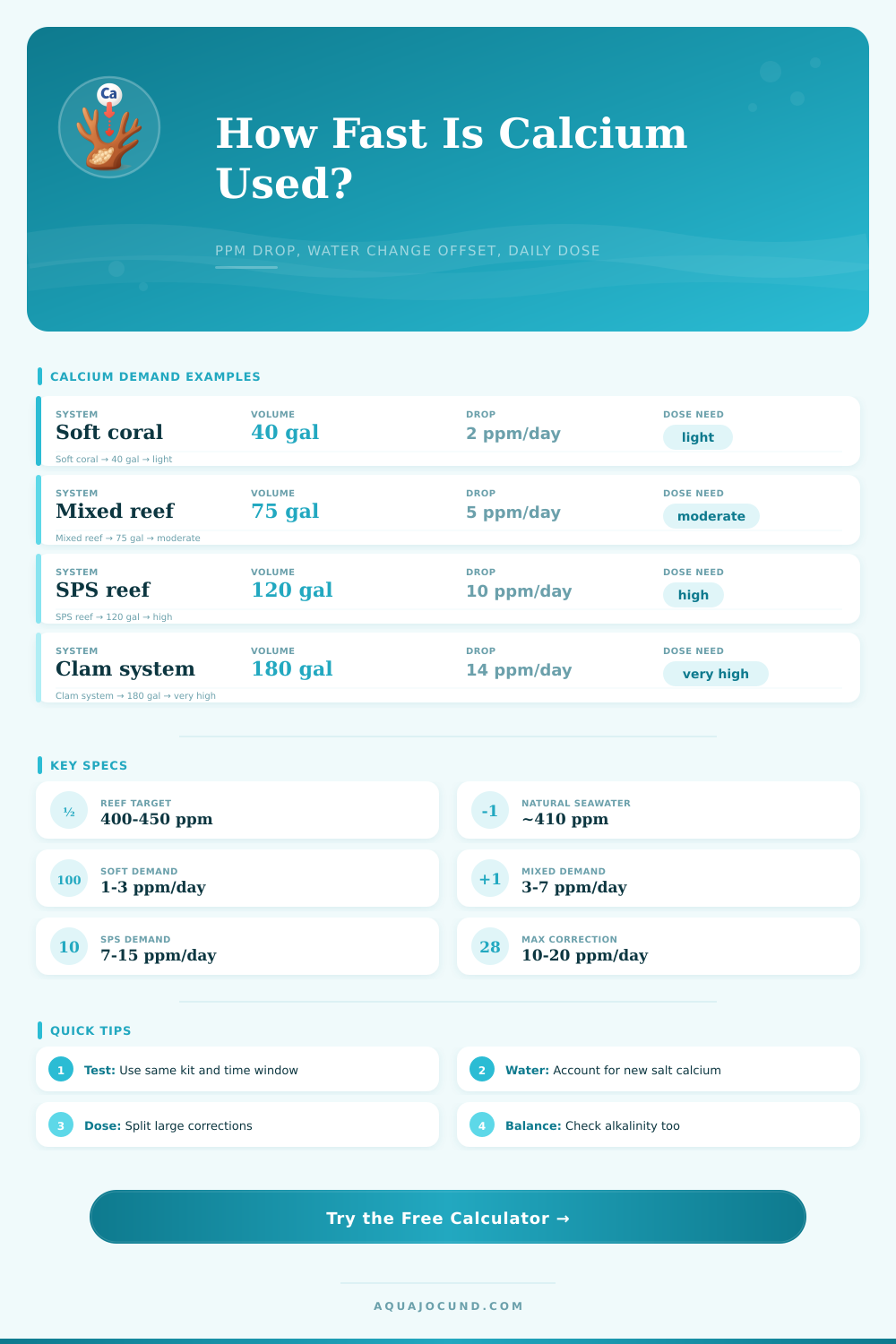
| Soft coral reef | 1-3 ppm/day | 400-440 ppm | Coralline may dominate demand |
| LPS dominant reef | 2-6 ppm/day | 410-450 ppm | Demand rises as skeleton growth increases |
| Mixed reef | 3-7 ppm/day | 410-450 ppm | Often needs daily supplementation |
| SPS dominant reef | 7-15 ppm/day | 420-450 ppm | Daily testing helps tune dose changes |
| Clam or heavy calcification | 10-20+ ppm/day | 420-460 ppm | Split dosing and alk tracking matter |
💧Common Tank Size Dose Examples
| Tank | Dimensions | Net Volume | 5 ppm/day Two-Part |
|---|---|---|---|
| 20 gal long | 30 x 12 x 12 in / 76 x 30 x 30 cm | 16-18 gal / 61-68 L | 8-9 mL/day |
| 40 gal breeder | 36 x 18 x 16 in / 91 x 46 x 41 cm | 32-36 gal / 121-136 L | 16-18 mL/day |
| 75 gal reef | 48 x 18 x 21 in / 122 x 46 x 53 cm | 60-70 gal / 227-265 L | 31-36 mL/day |
| 120 gal reef | 48 x 24 x 24 in / 122 x 61 x 61 cm | 95-110 gal / 360-416 L | 49-56 mL/day |
| 180 gal reef | 72 x 24 x 24 in / 183 x 61 x 61 cm | 145-165 gal / 549-625 L | 74-84 mL/day |
🔄Water Change Offset Examples
| Tank Calcium | New Water Calcium | Water Changed | Offset Applied |
|---|---|---|---|
| 420 ppm | 440 ppm | 10% | +2 ppm added to demand estimate |
| 430 ppm | 430 ppm | 15% | 0 ppm offset |
| 450 ppm | 410 ppm | 10% | -4 ppm lowers demand estimate |
| 400 ppm | 460 ppm | 20% | +12 ppm added to demand estimate |
Taking the calcium test for the first time in your reef tank probably generates a mixture of emotions. On one hand, you now have a number to go by. But on the other hand, what does that number mean? Is it good? Or did you lose some skeleton mass?
The thing about calcium is that it’s dynamic, changing based off growth, dissolution, and removal from your system. Most hobbyists view their test kit as a snapshot. It’s really important to understand how fast it’s changing. What matters most is not obsessing over any particular number but tracking its consumption over time.
Why Tracking Calcium Use Matters More Than Just The Number
Enter your tank size and test interval frequency, and the calculator does the rest for you. It removes the impact of water changes to give you real deal on biological demand. When you do weekly water changes, the new saltwater being added probably contains higher calcium than what’s in your tank. Replacing it adds a bit of an artificial boost, causing your levels to stay propped up while the corals continue pulling down on the mix. You’ll miss that effect if you don’t account for it, resulting in underdosing and poor growth (or bleaching) of SPS coral. That’s why the tool separates out the drop related to life versus maintenance.
It needs certain data over time. It doesn’t need it accurate so much as consistent. Test with the same kit. Test around the same time of your dosing cycle. Testing immediately after adding supplements will skew the amount being consumed. You want to know how much they are demanding, not how much is delivered. Once you have these numbers plugged into it, that’s how much your livestock require each day.
That number can be a base for your dosing strategy whether dosing kalkwasser, using calcium reactors or liquid two-part solutions. Calcium is also consumed by various reef types at varying rates. For example, you may find that your nano tank, which has plenty of soft coral and live rock, use less than a couple ppm per day. This is easily maintained with frequent water changes.
Conversely, if you have an SPS heavy tank it will use up to ten ppm or more per day. At this level, water changes are ineffective and some type of targeted supplementation must be used. If you look at the reference tables on the page you’ll see profile for how demand scales with biomass. Not all tanks is equal. Metabolic activity matters. More fast growing skeletons = quicker consumption.
There’s a tradeoff to how you choose to get supplements into the tank: Convenience versus Control. Two-part liquid solutions are convenient, simply open bottle, add water, shake/mix, drop in tank. But if the carbonate hardness (alkalinity) gets out of sync, they’ll contribute nitrate and phosphate to your system over time. Dry chemicals such as calcium chloride are pure, but must be handled carefuly so as not to cause localized pH spikes and cloudiness. A calcium reactor will act as a buffer against swings, but requires quite a bit of maintenance and electricity. No perfect solution exists; just what works within your routine. This calculator lets you measure the volume required for any given method, letting you directly compare the amount of dosing effort involved.
Another easy mistake, don’t fix shortages too fast. For example, if your calcium is down 40ppm from where it should of been, it’s not good to dump a big batch all at once. That shocks the system and stresses out your livestock. You also run the risk of causing problems if your alkalinity isn’t keeping up. To maintain a steady chemistry, the tool recommends splitting up correction doses over multiple days. Gradual is more like nature anyway. It also allows you time to make sure your alkalinity is keeping pace. This is very important for calcification.
Calcium management isn’t a matter of rescue; it’s a matter of rhythm. It’s not a battle waged weekly; it’s more like a steady flow of food for your corals, but never so much as to overwhelm your filtration. When you know how much your tank needs, there’s no guessing. There’s no more reacting when test results are bad. There’s just prevention and your numbers become reliable. Your dosing becomes automatic. You get back to enjoying the show of watching your frags thicken their skeletons and extend their polyps. Boring? Yes! But healthy corals love being bored.