💧 Bulkhead Size Calculator
Size aquarium overflow bulkheads by drain flow, gravity or siphon mode, safety factor, overflow count, hole saw diameter, and standpipe pairing.
| Nominal bulkhead | Typical hole saw | Open gravity estimate | Full siphon estimate | Common use |
|---|---|---|---|---|
| 1/2 in | 1 1/8 in / 29 mm | 90 gph / 341 LPH | 220 gph / 833 LPH | Small reactors or low return flow |
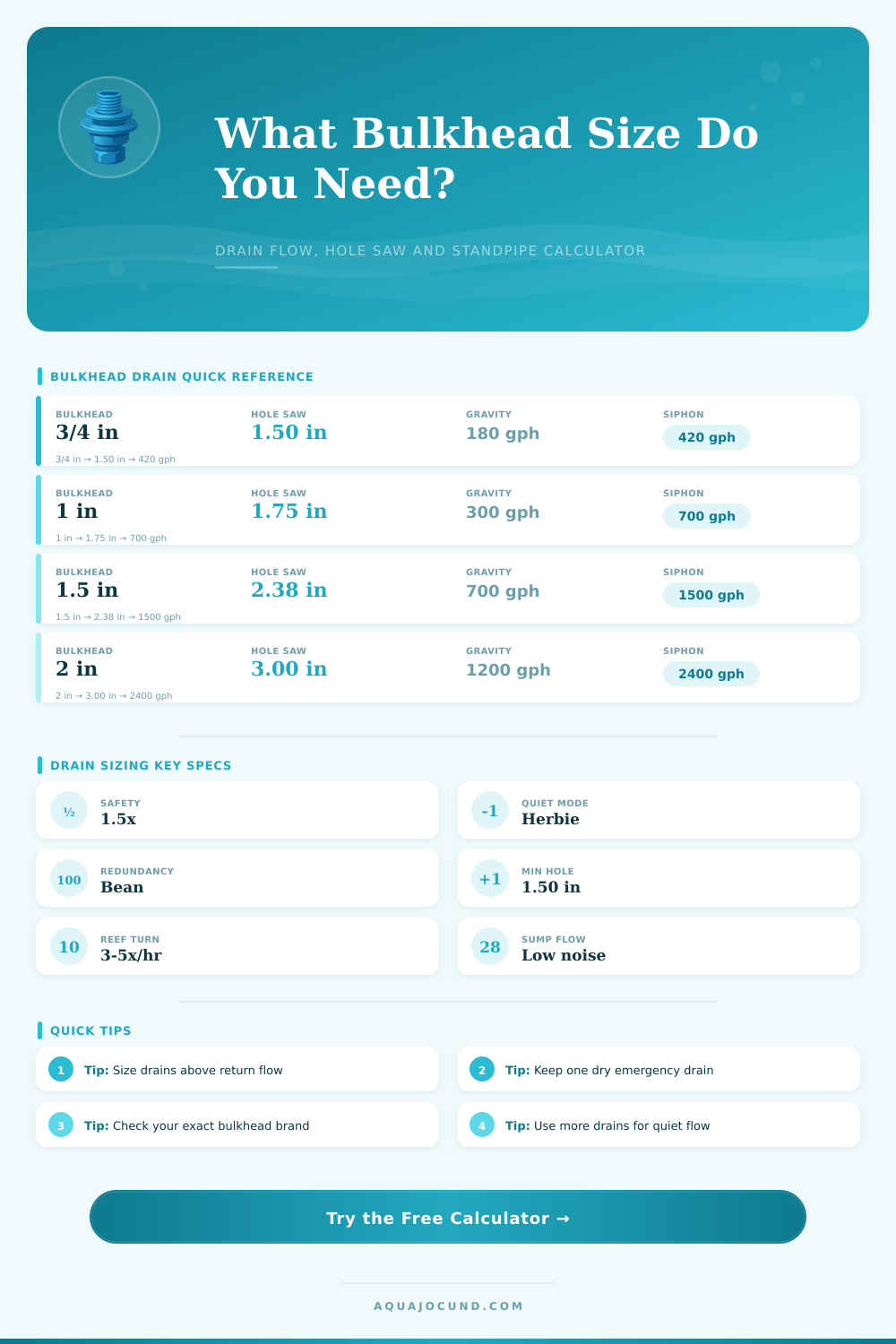
| 3/4 in | 1 1/2 in / 38 mm | 180 gph / 681 LPH | 420 gph / 1590 LPH | Nano overflow or auxiliary drain |
| 1 in | 1 3/4 in / 44 mm | 300 gph / 1136 LPH | 700 gph / 2650 LPH | Typical medium aquarium overflow |
| 1 1/4 in | 2 in / 51 mm | 480 gph / 1817 LPH | 1050 gph / 3975 LPH | Quiet mid-size standpipe |
| 1 1/2 in | 2 3/8 in / 60 mm | 700 gph / 2650 LPH | 1500 gph / 5678 LPH | Large reef and Bean style overflow |
| 2 in | 3 in / 76 mm | 1200 gph / 4542 LPH | 2400 gph / 9085 LPH | High flow display or pond loop |
| 2 1/2 in | 3 5/8 in / 92 mm | 1800 gph / 6814 LPH | 3600 gph / 13627 LPH | Very high flow or public display |
| 3 in | 4 1/2 in / 114 mm | 2600 gph / 9842 LPH | 5200 gph / 19684 LPH | Large tanks, vats, or ponds |
| Pairing | Wet drains | Emergency drains | Typical mode | Sizing note |
|---|---|---|---|---|
| Single standpipe | 1 | 0 | Open gravity | Use only where overflow risk is low and access is easy. |
| Durso style | 1 | 0 | Quiet gravity | Runs quieter than a plain pipe but has limited redundancy. |
| Herbie | 1 siphon | 1 | Full siphon | Emergency should handle the return pump if the siphon blocks. |
| Bean style | 1 siphon plus 1 open | 1 | Mixed | Best redundancy and tuning range for reef overflows. |
| Dual Herbie | 2 siphons | 2 | Full siphon | Splits flow across two overflow boxes for quieter operation. |
| External box | 1 to 2 | 1 | Mixed | Check box width, weir height, and bulkhead nut clearance. |
| Display size | Moderate return | High return | Suggested drain style | Typical starting point |
|---|---|---|---|---|
| 20 gal / 76 L | 80-120 gph | 160-220 gph | Single or Herbie | 3/4 in to 1 in |
| 40 gal / 151 L | 160-240 gph | 320-450 gph | Herbie | 1 in |
| 75 gal / 284 L | 300-450 gph | 600-800 gph | Herbie or Bean | 1 in to 1 1/2 in |
| 120 gal / 454 L | 480-720 gph | 960-1300 gph | Dual Herbie or Bean | 1 1/2 in |
| 180 gal / 681 L | 720-1080 gph | 1400-2000 gph | Bean or dual overflow | 1 1/2 in to 2 in |
| Profile | Flow adjustment | Hole planning | Best use |
|---|---|---|---|
| Standard ABS slip | Baseline | Common aquarium hole chart | Most sump drains and overflow boxes |
| Threaded standard | Small restriction | Similar to standard for many brands | Removable fittings and service access |
| Schedule 80 | Minor restriction | Often needs a larger hole | Heavy duty plumbing and external boxes |
| Low profile | Small restriction | Brand-specific flange depth | Thin overflow boxes and tight interiors |
| Intake strainer | Moderate restriction | Leave cleaning clearance | Open sump intakes and fish protection |
| Barbed hose | Moderate restriction | Check hose ID and barb shoulder | Flexible tubing and compact stands |
| Metric adapter | Minor restriction | Confirm inch-to-mm adapter chart | Mixed metric plumbing systems |
Choosing an correct bulkhead size for an aquarium drain is a necessary task. The bulkhead size for the aquarium drain will determine if the aquarium return pump can move the water that it creates. If the bulkhead size for the aquarium drain is too small for the return pump’s water movement capacity, the return pump will empty the aquarium’s water onto the floor.
Therefore, the bulkhead size must be large enough to allow for the water flow from the aquarium so that the aquarium dont flood. This calculator will allow you to calculate the necessary bulkhead size. Understanding what each input on the calculator is will allow you to effectively use the calculator to determine the correct bulkhead size to order.
Choose the Right Bulkhead Size for Your Aquarium Drain
Bulkheads is used to manage the water flow in the aquarium, to provide safety in case of an emergency drain, and even for controlling the sound made by the aquarium filters. Drains that utilize the force of gravity to move the water from the aquarium will move less water than siphon filters, which will allow for the movement of a larger volume of water once the siphon filter is filled with the aquarium’s water. Therefore, the calculator include settings for both gravity and siphon drains so that the user can pick the type of drain that will be used for the aquarium.
If the user selects the incorrect type of drain, the aquarium may make constant gurgling noises with its filters or the emergency drain may not perform its designate function for the aquarium. The safety factor for the drain will provide for the possibility of unexpected event. For instance, it is possible for a snail to enter the filter’s intake and block the strainer.
It is also possible that the user may leave the valve to the filter in a partially open position. In these cases, a safety factor of 1.5 will provide for the extra capacity the aquarium system requires. The safety factor is applied to the actual water flow from the aquarium, not the return pump’s flow that can often be found on the return pump’s box label.
Standpipe pairing allow for the user to select how many standpipes will be used to allow for redundancy in the aquarium system’s return water. Most small aquarium systems will work with a single open standpipe. However, many aquarists will prefer to have an emergency dry standpipe for larger reef aquarium system.
Standpipe configurations like the Herbie or Bean standpipe style will allow for the split of the water movement through both siphon channels and open channels. The calculator can determine the number of holes that must be cut into the bulkhead and the sizes of those holes. However, it is up to the aquarist to decide whether they would like to have one overflow from the aquarium or two overflows that can help provide protection for the display tank if one of the overflows should fail.
The diameter of the hole saw will determine the size of the hole that will have to be cut into the bulkhead to allow for the movement of the aquarium’s water. Aquarium bulkhead come in different profiles, such as slip or schedule 80. The user can adjust the diameter of the saw hole in the calculator according to the bulkhead profile that is selected.
Therefore, if the user correctly selects the profile for the bulkhead in the calculator, the flange of the bulkhead will be the appropriate size to fit into the overflow tank that has already been built for the aquarium. The turnover rate for an aquarium will vary according to the size of the aquarium and the flow rate of the aquarium’s return filter. For instance, a 75 gallon aquarium with a return filter that has a flow of 650 gallons per hour will have a turnover rate of 8 times per hour.
The volume of the aquarium can be used as a means of checking the calculations made by the calculator to ensure that the aquarium will not be sized for a drain that cannot handle the sump pump’s flow. It is common for both undersizing and oversizing of the bulkhead to occur. An undersized bulkhead will allow the drain to make constant gurgling noises, while an oversized bulkhead may create a siphon that is challenging to properly tune.
These different possibilities are represented for the user in the calculator in the form of the headroom percentage and emergency sizing calculations. These calculations help the aquarist to find a compromise between the two issues. The length of the pipe and the bulkhead profile can impact the amount of water that can move through the standpipe system.
Any long pipe that contains many elbows or a strainer will lose some of the water that moves through the pipe. These reductions in the flow rate are automatically accounted for in the calculator according to the bulkhead profile and loss allowances that the aquarist chooses. These reductions ensure that the sizing calculations are based upon the actual plumbing that will be used for the aquarium.
In order to properly use the bulkhead size calculator, the aquarist should input there actual return flow rate and select their standpipe style preference. They should then adjust the safety factor until they are satisfied with the headroom percentage. If the headroom percentage is too low, then a second overflow can be incorporated into the aquarium or the sizes of the standpipe fittings can be increased.
The calculator will make the arithmetic calculations for the aquarist, allowing them to focus on the physical components of the aquarium system.