🦐 Brine Shrimp Salt Mix Calculator
Size hatch water, salinity, dry salt, buffer, cyst dose, nauplii yield, harvest density, and airflow for Artemia hatching jars, bottles, cones, and fry-room batches.
| Salt mix type | Dry dose correction | Built-in buffer estimate | Best use |
|---|---|---|---|
| Marine salt mix | About 97% salinity strength | Usually enough carbonate for pH 8+ | Balanced reliable nauplii hatches and reef food batches |
| Aquarium salt plus buffer | About 98% salinity strength | Adds estimated baking soda for alkalinity | Freshwater fish rooms that already keep aquarium salt on hand |
| Plain non-iodized salt | About 99.5% salinity strength | Needs separate carbonate buffer | Check pH simple hatching where source water is soft |
| DIY NaCl, baking soda, Epsom | NaCl dose is corrected separately | Carbonate and magnesium are calculated | Repeatable custom brine when using RO water |
| Low mineral grow-out brine | Reduced mineral support | Light buffer only | Short grow-out tubs after hatch, not maximum hatch density |
| Artemia use | Typical salinity | Cyst loading | Notes |
|---|---|---|---|
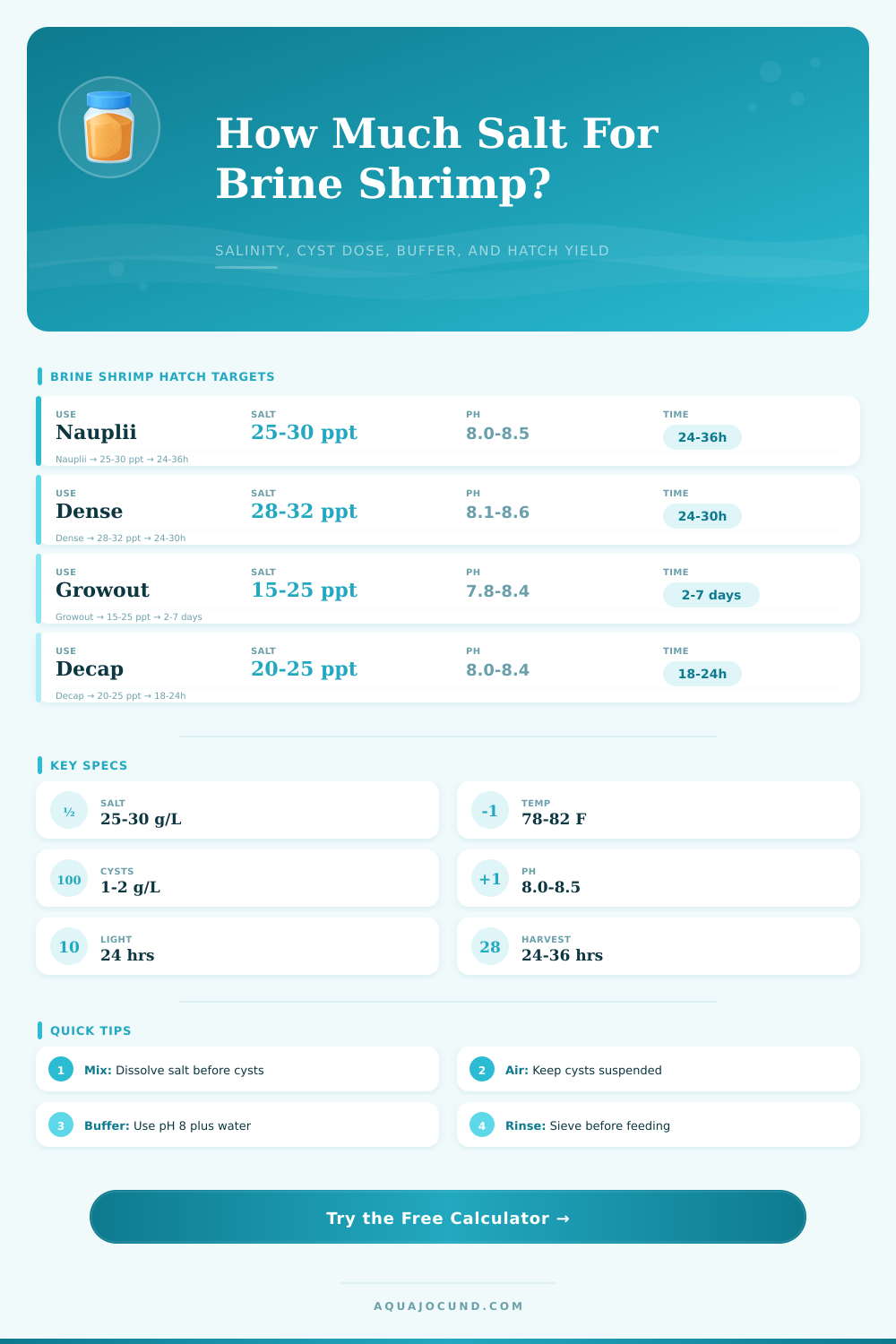
| Fresh nauplii for fry | 25-30 ppt | 1-2 g/L | Best nutrition is usually soon after orange nauplii separate from shells. |
| Dense cone production | 28-32 ppt | 2-3 g/L | Requires strong aeration and very clean hatch vessels to prevent dead spots. |
| Small strain cysts | 25-28 ppt | 1-1.8 g/L | Smaller nauplii suit tiny fry but cyst count per gram may be higher. |
| Decapsulated cysts | 20-25 ppt | 0.5-1.5 g/L | Less shell waste, but oxygen and pH still matter during hatch. |
| Grow-out juveniles | 15-25 ppt | After hatch | Lower salinity can work for culture tubs with feeding and water changes. |
| Vessel | Working volume | Salt at 28 ppt | Practical cyst dose |
|---|---|---|---|
| 1 liter jar | 1.0 L / 0.26 gal | 28 g before correction | 1 to 2 g cysts |
| 2 liter soda bottle | 1.5 L / 0.40 gal | 42 g before correction | 1.5 to 3 g cysts |
| Small hatch cone | 3.8 L / 1 gal | 106 g before correction | 4 to 8 g cysts |
| 10 L cone | 10 L / 2.64 gal | 280 g before correction | 10 to 25 g cysts |
| 5 gallon bucket | 15-18 L working | 420-504 g before correction | 15 to 30 g cysts |
| Condition | Target range | Calculator effect | Watch point |
|---|---|---|---|
| Warm fast hatch | 80-82°F | 24 to 30 hour harvest estimate | Do not allow small vessels overheat under lamps. |
| Room temperature hatch | 74-78°F | 30 to 40 hour harvest estimate | Expect a slower split between nauplii and unhatched cysts. |
| Cool room hatch | 68-73°F | 40 to 54 hour harvest estimate | Raise planned time or reduce feeding expectations. |
| Rolling aeration | No settled cysts | Airflow scales by vessel liters | A deep cone can need more air than a shallow tray. |
There’s also the kind of dissapearsment that comes from watching brine shrimp cysts refuse to hatch. You’ve boiled water and purchased good-quality shells. Instead of the little swarms of tiny orange swimmer your fish will appreciate, you’re left with a clouded tank filled with nothing more than dissolved matter and empty shells.
It isn’t about luck; it’s about chemistry. And the biggest thing is getting salt mix correct at the outset. The other thing I see a lot of hobbyist do is assume any non-iodized salt will do: “I’ll just use some table salt, because it’s easy.” Wrong. Brine shrimp are marine animals that has a defined set of salt balance needs. They will not tolerate changes in pH or salinity well at all.
Tips for Hatching Brine Shrimp
So long as you input your desired target profile and the size of the vessel holding your brines, the calculator do the math for you. It takes the amount of dry salt you want to use and converts it into an exact measure of grams (either using plain table salt or a full marine mix). No need to guess the conversion factors, or try to figure out coefficients to use.
Why use salt? Sodium chloride (table/kosher salt) is just that: straight sodium chloride. It doesn’t buffer pH. When hatching cysts gives off carbon dioxide, it reduces the pH of the water. At a pH lower than eight, the metabolism required for hatching cease. Using a complete marine salt mix automatically stabilizes the alkalinity with its inclusion of magnesium and carbonates. With plain salt, you need to add something like baking soda as a buffer in addition to salt itself. Otherwise your chemistry gets out of whack.
How much depends based off what strength of mix you choose. The device factors that into the dry dose. Other factors that may surprise include vessel shape. Although an upturned two-liter soda bottle might look as big as a typical five-gallon bucket, it actually holds significantly less water, which means it would of required far less salt to get to a desired salinity range of, say, twenty-five to thirty parts per thousand. Likewise, the amount of air flow required depend on the volume. The cysts must be constantly moving and aerated; they’ll die if they settles to the bottom. Over time, they’ll rot.
The calculator estimates how much aeration is needed to mix the given volume and shape proper. This prevents too little aeration in a deep cone or too much stirring in a shallow tray.
Temperature plays a role in timing rather than chemistry. Faster metabolism in warmer water accelerates the hatch process. But burns more energy at the air pump. Slower metabolism in cooler water extends the hatch cycle (by days). And that’s okay, as long as you account for it. To be prepared for the week, many keepers will schedule a slow hatch during the weekend so they’ll have freshly-hatched nauplii available when they get back from work on Monday morning.
Consistency matters. Once you set the temperature, stick with it. Cysts don’t like changes. Temperature shifts stress them and cause an uneven hatch, where some shells pop open early while others takes longer to wake up.
The last step, Harvest: Nauplii are also phototactic, which means they will swim towards the light. This is how most folks harvest them, place a bright light on one side of the container and then siphon off the live nauplii from the lit side. The dead cysts and unhatched shells will fall to the dark part of the container. You’ll end up with a concentrated food source if you just siphon off what’s in the light.
Too many? Split it up or let it go a little longer so there’s more space to move around. When you do get it right, it becomes a predictable process of feeding. No longer concerned if your fish are eating, you can now focus on growing them. Eliminate guesswork with salt mix calculator and pay attention to details that keep the culture going strong. Begin small, nail down the chemistry, and soon you’ll see those little swimmers.