Brine Shrimp Hatch Salinity Calculator
Calculate salt grams, spoons, specific gravity, and cyst density for reliable Artemia hatch water.
Hatch Mix Results
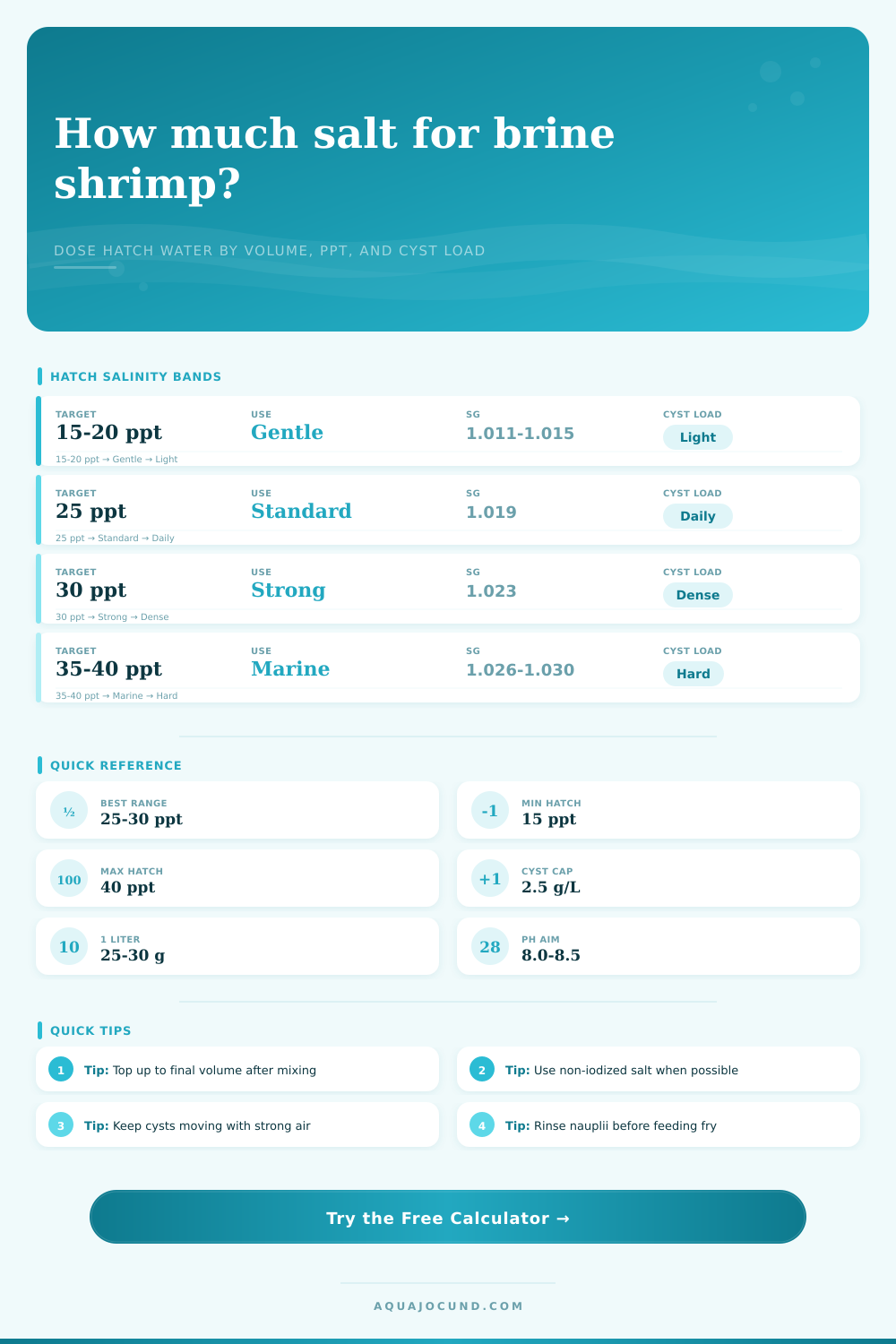
| Target salinity | Approx. specific gravity | Typical hatch use | Calculator note |
|---|---|---|---|
| 10-14 ppt | 1.007-1.010 | Experimental low salt | Below the normal hatch floor; expect weaker results. |
| 15-20 ppt | 1.011-1.015 | Low salt hatch or culture start | Works for some cysts, but keep aeration and pH stable. |
| 25-30 ppt | 1.019-1.023 | Daily hatch bottle or cone | Good default range for fast household hatch batches. |
| 35-40 ppt | 1.026-1.030 | Marine match or hardier cyst lots | Useful when matching marine fry water, but do not exceed 40 ppt. |
| Salt type | Approx. grams per tbsp | Purity factor | Best use |
|---|---|---|---|
| Marine salt mix | 30 g | 1.00 | Balanced minerals for marine fry matching. |
| Aquarium salt | 18 g | 0.98 | Simple hatch water with separate pH checking. |
| Pickling salt | 18.5 g | 0.995 | Clean sodium chloride with predictable spoons. |
| Kosher salt | 15.5 g | 0.99 | Coarse grains; weigh when accuracy matters. |
| Plain table salt | 18 g | 0.99 | Acceptable if plain and not heavily additive-loaded. |
| Fine sea salt | 16.5 g | 0.96 | Variable minerals; confirm with a refractometer. |
| Vessel | Working volume | Salt at 25 ppt | Salt at 30 ppt |
|---|---|---|---|
| Small fry cup | 250 ml | 6.25 g | 7.5 g |
| Half liter bottle | 500 ml | 12.5 g | 15 g |
| Standard bottle hatch | 1 L | 25 g | 30 g |
| Two liter cone | 2 L | 50 g | 60 g |
| Fry room batch | 5 L | 125 g | 150 g |
| Cyst density | Batch style | Aeration need | Planning note |
|---|---|---|---|
| 0.25-0.75 g/L | Light fry feed | Moderate rolling air | Easy separation and clean harvest. |
| 1.0-1.5 g/L | Daily aquarium hatch | Strong bottom air | Good balance for most home hatchers. |
| 2.0-2.5 g/L | Dense production hatch | Very strong suspension | Use only with excellent circulation and light. |
| Over 2.5 g/L | Overloaded hatch | Hard to keep oxygenated | Increase water volume or split the cysts. |
Plugging in your targeted concentration and vessel size into calculator above does the math for you. You no longer have to guess when converting between coefficients and units. Getting chemistry right gives you a successful brine shrimp hatch. Get salinity incorrect and the cysts don’t wake up. They stays asleep. Or they hatch but are weak nauplii that sink.
Manage the core variable which is parts per thousand (ppt). Twenty five to thirty ppt is what most hobbyist shoot for. That range match the salinity of Great Salt Lake where Artemia occur naturaly. Anything below fifteen ppt has too little osmotic pressure for most lots of cysts. Anything over forty ppt make the water too dense. Babies can’t swim around in the thick stuff. Again, there’s a narrow window here but you can get away with being on the money.
Why Getting the Salt Right Is Important
How salt adjusts specific gravity is shown in reference table. If you have a refractometer you can refer back to this table and know that your water is correct. Table salts may contain iodine or anti-caking agents that can harms the fry and stop them from hatching. For safety, stick with clean marine mixes or pickling salt, these will also dissolves completely. The tool takes into account whether you’re using coarse or fine grain kosher salt vs another type of salt. You don’t need to know any special conversion factor for each brand’s product. Simply choose from what you keep in your pantry, and let the system adjust for you.
Volume: How much volume do you put in? That determines how many cysts you should of put in there. Many people makes the mistake of putting too many cysts into a small amount of water. When this happens, you form sludge. Sludge then inhibits flow of oxygen. Your nauplii require access to air bubbles as well as sufficient space to swim around. As a general guideline, keeping the load below two point five grams per liter allow the air stone to agitate the water enough to avoid clumping.
The silent player here is water quality. Generally, brine shrimp likes slightly alkaline water (pH around 8). Tap water may be too acidic and stun embryos. To help, you could add a pinch of baking soda to buffer pH while not altering salinity greatly. Don’t worry about having a lab grade solution.
There’s another hidden lever: temperature. Warmer water hastens hatching but also raise evaporation. That in turn concentrates the salt and can overshoot your goal. Cooler water take longer but results in stronger larvae. Consistency is key to hatching brine shrimp. Find a ratio that fits your lot of cysts and your local water, then use it every time. The calculator lets you remove estimation variables and copy that success.
Enter your goals, your salt type, and your volume. It spits out a precise gram weight. Then you just mix, wait, and watch the cloud of life come alive.